SC agrees to hear after two weeks pleas over Centre's delay in judges' appointment
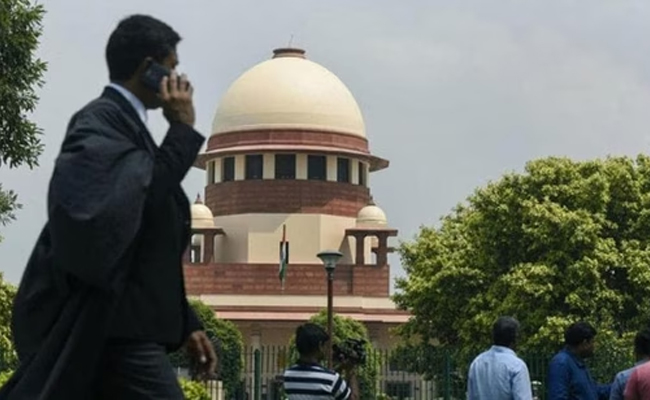
New Delhi (PTI): The Supreme Court on Thursday agreed to list a batch of pleas questioning the delay on the part of the central government in appointment of judges after the collegium reiterated their names.
A bench of Chief Justice of India (CJI) B R Gavai and Justice K Vinod Chandran said it will hear the pleas after two weeks after senior advocate Arvind Datar and advocate Prashant Bhushan mentioned them for urgent listing, saying the petitions were listed in 2023 but were suddenly dropped from the cause list.
"There are names of some judges which were reiterated in 2019, then 2020 and 2022, but till now they have not been cleared. This court has a fixed time limit for taking decisions at every stage. A delay of a few weeks is understandable but a delay of four years is not understandable at all," Datar said.
Eventually, what happens is that the candidate whose name has been recommended for judgeship by the Supreme Court Collegium gradually loses interest and seniority, he said.
The counsel also referred to instances where advocates in Delhi and Mumbai, whose names were recommended, eventually withdrew their names.
CJI Gavai said that in the case of Delhi, when a woman advocate's name was not cleared by the Centre, he tried to persuade on the administrative side.
Datar said the matter was last taken up by Justice (retd) Sanjay Kishan Kaul.
Bhushan, referring to the instance of the Delhi advocate's name not being cleared, said she was a topper of a National Law School and claimed that this has been happening repeatedly.
When Bhushan tried to raise the case of governors, where the apex court has fixed a timeline for clearing bills, CJI Gavai asked Bhushan not to mention anything sub-judice and told him to keep his powder dry.
The top court is hearing a presidential reference over its April 8 verdict which fixed a timeline for governors to clear bills passed by assemblies and also for the President to grant assent to them.
On December 5, 2023, Justice Sanjay Kishan Kaul observed, "Some things are best left unsaid," when some lawyers pointed out the sudden deletion from the cause list of the pleas related to the alleged delay by the Centre in acting on the collegium's recommendations on elevation and transfer of high court judges.
The apex court is seized of two such petitions.
While hearing the matter on November 20, 2023, the court flagged the issue of the Centre "picking and choosing" high court judges recommended for transfer by the collegium, saying it does not send out a good signal.
The appointment of judges through the collegium system, where judges appoint judges of constitutional courts, has often become a hot button issue between the Supreme Court and the Centre, with the mechanism drawing criticism from different quarters.
The top court is hearing petitions, including one filed by the Advocates' Association, Bengaluru, seeking contempt action against the Union Ministry of Law and Justice for allegedly not adhering to the timeline set by the court in a 2021 judgement for clearing the names recommended by the SC Collegium for elevation and transfer of high court judges.
Let the Truth be known. If you read VB and like VB, please be a VB Supporter and Help us deliver the Truth to one and all.
AIITA welcomes Karnataka’s ban on obscene songs in school events
Bhatkal: The Karnataka unit of the All India Ideal Teachers Association (AIITA) has welcomed the Karnataka government’s decision to strictly ban school children from dancing to obscene songs during educational and cultural programmes in government, aided, and private schools across the state.
AIITA Karnataka State President M. R. Manvi congratulated the government for taking what he termed an important step to preserve the sanctity of education.
“Such decisions to safeguard the dignity of school children and uphold the values of education are the need of the hour. This rule should not be limited to government schools alone but must be strictly implemented in all private educational institutions as well,” he said.
He further urged the government to address other concerns within school programmes.
“The government should not only prohibit obscene dances in the name of school anniversaries, but also ensure that plays and dialogues that incite religious hatred are avoided. Schools should be centres of harmony, not platforms for spreading hatred,” he added.
According to a recent circular issued by the Department of School Education and Literacy, obscene dances are adversely affecting the mental health and moral values of students.
In this regard, schools have been advised to use songs that promote nationalism, positive thinking, the greatness of Kannada culture, and value-based traditions instead of inappropriate content during programmes.
The circular also emphasises that students should be dressed in decent attire.
AIITA also backed the department’s warning that disciplinary action would be taken against head teachers if such guidelines are violated. The association has further demanded that district Deputy Directors of Public Instruction strictly monitor the implementation of these rules.