SC agrees to hear plea seeking extension of time for registration of waqf properties

New Delhi (PTI): The Supreme Court on Thursday agreed to list an application seeking extension of time for mandatory registration of all waqf properties, including waqf-by-users under the UMEED portal.
In an interim order, the top court had on September 15 put on hold a few key provisions of the Waqf (Amendment) Act, 2025, including a clause that only those practising Islam for the last five years could create Waqf, but refused to stay the entire law outlining the presumption of constitutionality in its favour.
It also held the Centre’s order to delete the "waqf by user" provision in the newly-amended waqf law was prima facie not arbitrary and the argument that waqf lands would be grabbed by governments held “no water”.
Waqf by user refers to a practice where a property is recognised as a religious or charitable endowment (waqf) based on its long-term, uninterrupted use for such purposes, even if there isn't a formal, written declaration of waqf by the owner.
On Thursday, a bench headed by Chief Justice B R Gavai was urged by lawyer Nizam Pasha, appearing for AIMIM leader Asaduddin Owaisi, that a miscellaneous application seeking extension of time for registration of waqf properties be extended.
He said that six months time was given in the amended law for registration of the waqf properties and “Five months went during the judgement, we now only have one month left.”
Solicitor General Tushar Mehta, who was in the courtroom in connection with another case, objected to the mentioning of the plea and said it should be intimated to the Centre.
“Let it be listed, listing does not mean granting (the relief),” the CJI said.
The Centre had on June 6 launched the Unified Waqf Management, Empowerment, Efficiency and Development Act, 1995 (UMEED) central portal to create a digital inventory after geo-tagging all waqf properties.
According to the mandate of the UMEED portal, details of all registered Waqf properties across India are to be mandatorily uploaded within six months.
Let the Truth be known. If you read VB and like VB, please be a VB Supporter and Help us deliver the Truth to one and all.
Death toll in Mundathikode fireworks explosion rises to 16
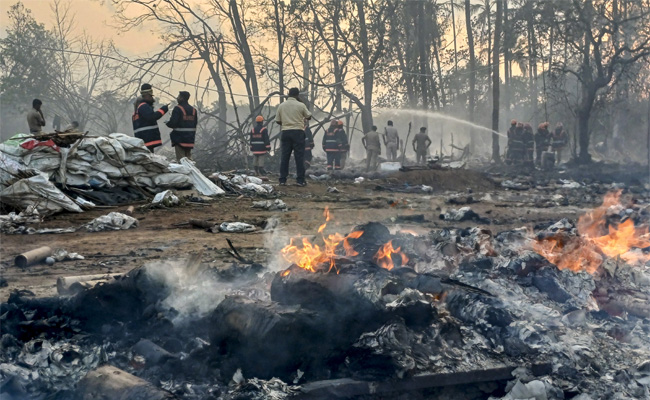
Thrissur (Kerala) (PTI): One more person who had been hospitalised following the Mundathikode fireworks explosion died at Thrissur Medical College on Sunday, police said.
With this, the death toll in the incident has risen to 16.
According to Thrissur Medical College police, the deceased has been identified as Unnikrishnan from Edappal, who was among the 38 persons present at the fireworks manufacturing unit in Mundathikode where the explosions occurred on April 21.
Police said Unnikrishnan had suffered over 80 per cent burns and had remained in critical condition.
The condition of the two other injured persons remains critical, police said.
Of the 38 persons present at the site, 16 have died, while four remain missing.
The fireworks were being manufactured for Thiruvambady Devaswom as part of the Thrissur Pooram festivities.
The licensee of the unit had also suffered burn injuries and had died earlier.