Supreme Court hears batch of petitions challenging Waqf (Amendment) Act, 2025
_vb_09.jpeg)
New Delhi: The Supreme Court of India today began hearing a large batch of petitions challenging the constitutionality of the Waqf (Amendment) Act, 2025. A bench led by Chief Justice of India Sanjiv Khanna, along with Justices Sanjay Kumar and KV Viswanathan, commenced the hearing at 2 PM.
Over seventy petitioners have approached the Court, including prominent political leaders such as AIMIM MP Asaduddin Owaisi, Congress MP Md Jawed, RJD MP Manoj Kumar Jha, TMC MP Mahua Moitra, and SP MP Zia Ur Rehman. Religious and civil society bodies like the All India Muslim Personal Law Board, Jamiat Ulema-i-Hind, Samastha Kerala Jamiatul Ulema, the Association for Protection of Civil Rights, and the Imam of Jama Masjid Bengaluru have also joined the challenge. Political parties such as DMK, IUML, YSRC Party, CPI, and even Tamil actor Vijay, representing TVK, are among the petitioners.
Several state governments — including Rajasthan, Gujarat, Haryana, Maharashtra, Assam, Uttarakhand, and Chhattisgarh — have filed intervention applications in support of the Amendment. The Central Government has filed a caveat to participate in the proceedings.
A bench comprising Chief Justice Sanjiv Khanna and Justices Sanjay Kumar and K V Viswanathan outlined two aspects.
"There are two aspects we want to ask both the sides to address. Firstly, whether we should entertain or relegate it to the high court? Secondly, point out in brief what you are really urging and wanting to argue?" the CJI said.
"The second point may help us in deciding the first issue to some extent," the CJI added.
The hearing is underway with senior advocate Kapil Sibal, appearing for the petitioners' side, making submissions.
Senior Advocate Kapil Sibal argued that the Amendment abolishes the concept of "waqf by user", which he described as integral to the Islamic tradition and recognized in the Ram Janmabhoomi judgment. He also expressed concern over new limitations introduced by the law, saying they would prevent rightful claims on unregistered waqf properties, especially those that are centuries old.
CJI Khanna responded, stating that while limitation periods serve a legal purpose, their impact would be assessed on a case-by-case basis.
Sibal also raised objections to changes in the composition and appointment processes of Waqf Boards, alleging that they now amount to a “complete takeover” through nomination, violating Articles 25 and 26 of the Constitution.
Senior Advocate CU Singh emphasized the charitable and religious character of waqf institutions and stated that the focus should not be limited to essential religious practices alone under Article 26.
Justice Viswanathan remarked that administration of property, even religious in origin, could be subject to regulation, while cautioning against overuse of the "essential religious practice" doctrine.
CJI Khanna made an informal remark noting concerns over the extent of waqf claims, pointing out that there were reports that the Delhi High Court building itself stands on waqf land. He added that while not all waqf by user claims are invalid, a balance must be struck.
The hearing is ongoing, with arguments expected to continue.
The Centre recently notified the Waqf (Amendment) Act, 2025, which got the assent of President Droupadi Murmu on April 5 after its passage from Parliament following heated debates in both houses.
The bill was passed in the Rajya Sabha with 128 members voting in favour and 95 opposing it. It was cleared by the Lok Sabha with 288 members supporting it and 232 against it.
Let the Truth be known. If you read VB and like VB, please be a VB Supporter and Help us deliver the Truth to one and all.
CM Siddaramaiah alleges ‘criminal conspiracy’ in Sringeri recount, vows legal action
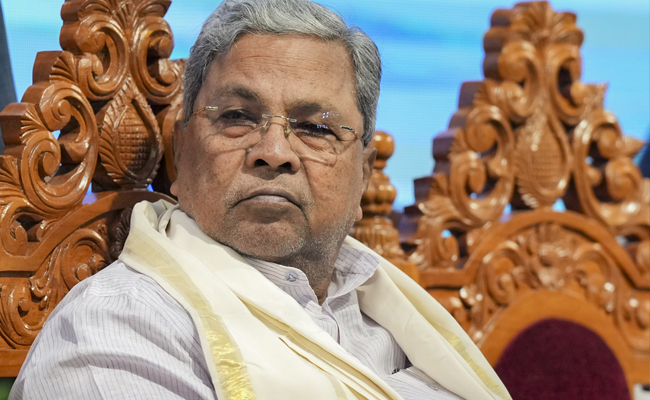
Bengaluru (PTI): Alleging a “criminal conspiracy” by BJP candidate D N Jeevaraj in the Sringeri Assembly poll recounting, Karnataka CM Siddaramaiah on Tuesday said the outcome was manipulated after valid postal ballot votes in favour of Congress leader T D Raje Gowda were tampered with during the recounting process.
Following a Karnataka High Court order on an election petition filed by Jeevaraj, challenging Raje Gowda’s election, the reverification and recounting were conducted on Saturday.
After the reverification and recount of postal ballots for the Sringeri Assembly constituency, votes polled in favour of Raje Gowda were reduced by 255, the returning officer said.
A report on the matter has been submitted to the Election Commission of India for further action, the officer added.
Congress leader Raje Gowda had won the 2023 Assembly polls from Sringeri by 201 votes, defeating his nearest rival Jeevaraj.
Addressing a press conference in Bengaluru, Siddaramaiah said the High Court had directed the recounting of postal ballots and that irregularities were noticed during the exercise conducted on May 2.
“This is a clear case of criminal conspiracy,” Siddaramaiah said, alleging that valid votes cast in favour of Raje Gowda were altered after being accepted by counting agents of all parties, including Congress, BJP, and JD(S).
He claimed that during the recounting of postal ballots, 255 votes were initially accepted as valid by all agents but were later tampered with by subordinate officials.
“There is a second mark on the votes polled in favour of Raje Gowda. They had accepted these as valid votes. Subsequently, another mark was made by officials. This is a clear case of criminal conspiracy,” he said.
When asked who was behind the alleged conspiracy, the CM replied, “It was hatched by Jeevaraj and others. It is planned.”
Siddaramaiah further alleged that the returning officer acted improperly by declaring the result despite the presence of an Election Commission observer during the recounting.
“Immediately after the counting, the returning officer announced the result. He should not have done so; this is against the law,” he said.
He pointed out that Raje Gowda had originally won by 201 votes, but after the recounting, the BJP candidate was declared the winner by 52 votes.
“The BJP has committed a criminal act of conspiracy. This is not vote chori but vote dacoity,” he alleged.
The CM said a police complaint had already been filed by Raje Gowda’s election agent, Sudhir Kumar, and emphasised the need for electoral integrity.
“We want transparency and free and fair elections. That is what our Constitution mandates,” he added.
Stating that the government would pursue legal remedies, Siddaramaiah said, “We are preparing an appeal challenging the returning officer’s announcement in a court of law.”
Responding to a separate query on elections in other states, the CM said there appeared to be an anti-incumbency factor in West Bengal, while results in Tamil Nadu were “surprising,” adding that Vijay’s party was emerging as the largest there.
Following the victory of party candidates in Bagalkote and Davanagere South, Siddaramaiah expressed confidence about future electoral prospects in Karnataka.
“Even in 2028, we will win the Assembly elections. We will come back,” the CM said.
Siddaramaiah added that he would order a forensic examination into the alleged tampering of postal ballots.