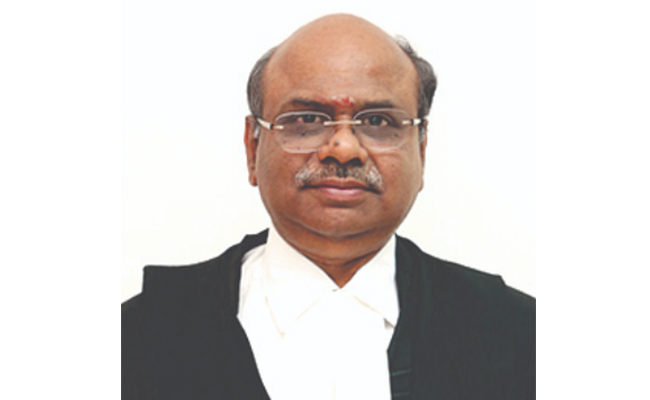
New Delhi (PTI): The Supreme Court Collegium on Monday recommended appointment of Justice D Krishnakumar, currently serving as a judge of the Madras High Court, as the chief justice of the Manipur High Court.

The Collegium, headed by Chief Justice of India Sanjiv Khanna and comprising Justices B R Gavai and Surya Kant, took the decision in a meeting held on Monday.

A vacancy in the office of the chief justice of the High Court of Manipur would arise consequent upon the retirement of Justice Siddharth Mridul on November 21, 2024. Therefore, appointment to that office is required to be made, the Collegium noted.

"It is proposed to appoint Mr. Justice D Krishnakumar, presently serving as a Judge of the Madras High Court, as the Chief Justice of High Court of Manipur with effect from the date on which the incumbent Chief Justice demits office on retirement," it said.

"Mr. Justice D. Krishnakumar was appointed as a Judge of the Madras High Court on 07th April 2016 and is due to retire on 21st May 2025.

"He is the senior-most puisne Judge in his parent High Court and belongs to a Backward Community. Before his elevation as a Judge of the High Court, he had extensive practice in civil, Constitutional and service matters in the High Court, with specialisation in Constitutional law," it added.

The Collegium noted that Justice Krishnakumar is a competent judge with sound legal acumen and is endowed with high level of integrity and honesty.

"While recommending the name of Mr. Justice D. Krishnakumar, the Collegium has also taken into consideration the fact that at present there is only one Chief Justice from the Madras High Court among the Chief Justices of the High Courts.

"Having regard to all relevant factors, the Collegium is of the considered view that Mr. Justice D. Krishnakumar is fit and suitable in all respects for being appointed as the Chief Justice of High Court of Manipur," it said.

"The Collegium, therefore, resolves to recommend that Justice D Krishnakumar be appointed as the Chief Justice of High Court of Manipur consequent upon the retirement of Mr. Justice Siddharth Mridul on 21st November 2024," it said.

Let the Truth be known. If you read VB and like VB, please be a VB Supporter and Help us deliver the Truth to one and all.


New Delhi (PTI): The Supreme Court on Wednesday refused to entertain a plea against a recent home ministry circular on singing of national song Vande Mataram at official events and schools, saying the directive was not mandatory.

A bench of Chief Justice Surya Kant and justices Joymalya Bagchi and Vipul M Pancholi noted that there was no penal consequence prescribed for not singing the song and termed the plea as "premature".

"We just feel that you have some vague apprehensions of discrimination which do not have any clear nexus with the impugned circular," Justice Bagchi told senior advocate Sanjay Hegde, appearing for petitioner Muhammed Sayeed Noori.

CJI Kant agreeing with the views of Justice Bagchi pointed out that the circular uses the word 'may' which indicates that the directive was advisory in nature.

"It is a premature apprehension; if there are any penal consequences, you come to us," the CJI said, adding, "The word 'may' is used in the circular. There are no penal or adverse consequences. Nobody has asked that you do it in your academy or school."

The CJI further said, "This is only a protocol. The word used is 'when it is played'. Earlier, we had a national flag protocol... which says what are the things to be followed when the national flag is hoisted."

Hegde, however, submitted that even if there is no penalty prescribed for not following the 'advisory', it can lead to compulsions to sing Vande Mataram, and those who do not follow it can be singled out and discriminated against and they will be threatened to conform.

Noori has challenged the Ministry of Home Affairs circular of January on the protocol to be followed for singing of the entire stanzas of Vande Mataram song.

During the hearing, Solicitor General of India Tushar Mehta, who was present in the court for hearing in another matter said, "Do we need to be advised to respect the national song?"

Hegde objected to the submission of Mehta without filing a formal reply to the petition and highlighted that people from all religions, including atheists, will be eventually compelled to sing the song as a social demonstration of loyalty.

Mehta referred to Article 51A(a) of the Constitution which establishes the fundamental duty of every citizen to abide by the Constitution and respect its ideals, institutions, the national flag and the national anthem.

Hegde said as per Article 51A(a), a citizen only has the fundamental duty to respect the national flag and the national anthem, and there was no reference to Vande Mataram and referred to an earlier order of the apex court which observed that patriotism cannot be compelled in respect to directive to sing the national anthem in a cinema hall.

Justice Bagchi said, "The statement 'patriotism cannot be compelled' was only a viewpoint. I am sorry many will disagree with this view of yours."

"It cannot be compelled even for the national anthem," the CJI remarked, adding, "We will appreciate this argument if it is made mandatory. That part is completely silent, there are no penal consequences, there is no sanction, there is no requirement that it has to be sung."

Hegde further contended that the Constitution has to protect individual conscience and the tradition teaches us tolerance.

"If there's an advisory without sanctions, this court may take it, there's no way that advisory can be enforced," he said.

The bench told Hegde that he is at liberty to approach the court if he is discriminated against or any notice threatening penal action is issued on the basis of the MHA's circular.

CJI Kant said, "It is a premature apprehension. If there are any penal consequences, you come to us. We are giving you this liberty."

Mehta submitted, "A person who says patriotism is not compulsory should not be entrusted with a writ in the court."

Hegde objected to Mehta's remark and said, "The Constitution is for all. It does not depend on where you stand politically or religiously."