SC declines urgent hearing on plea on firecrackers, says people must have invested in this business
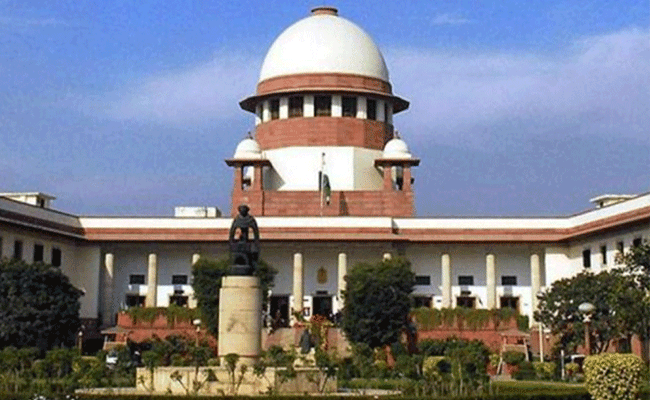
New Delhi (PTI): The Supreme Court on Friday refused to accord urgent hearing on a plea relating to ban on firecrackers, saying Diwali is round the corner and people must have invested money in the firecracker business.
"Sorry. We would not list that matter now. Diwali is round the corner. You come in the nick of time. People must have invested money in firecrackers business. You should have come two months earlier," a bench comprising Chief Justice U U Lalit and Justice Hemant Gupta said.
"We would not be able to deal with this matter. Otherwise, look at the consequences of this. Any injunction and those people are out of business," the bench told the counsel, who mentioned the matter for urgent listing.
The counsel told the bench the matter pertains to this year's firecracker ban in Delhi and some other states.
"Sorry. It will be done after Diwali," the bench said.
The apex court had on Thursday refused to accord urgent hearing to a plea against an order banning storage, sale, and use of all types of firecrackers in the national capital till January 1, 2023.
The top court had asked the lawyer, who had mentioned the matter on Thursday and sought urgent hearing, to approach the Delhi High Court.
The Delhi High Court had earlier deferred hearing on the plea of green cracker merchants against the blanket ban on firecrackers till January 1.
On October 10, the apex court had refused to stay the Delhi government's order banning storage, sale, and use of all varieties of firecrackers till January 1 to check pollution levels in the national capital, saying it did not want to add to the air pollution.
The top court had last year clarified there is no blanket ban on the use of firecrackers and only those fireworks which contain barium salts are prohibited.
Let the Truth be known. If you read VB and like VB, please be a VB Supporter and Help us deliver the Truth to one and all.
Deepfake video of Nirmala Sitharaman used to dupe Belagavi man in Rs 7.9 lakh scam
Belagavi (Karnataka) (PTI): A 76-year-old man in Belagavi city was allegedly cheated of Rs 7.9 lakh in an online investment scam that used an AI-generated deepfake video misusing the name of Finance Minister Nirmala Sitharaman to lure investors, police said on Wednesday.
An online fraud case was registered at the cybercrime police station on May 1, they said.
According to Belagavi Police Commissioner Bhushan Gulabrao Borase, the victim, Prakash Gubbi, a senior citizen, stated in his complaint that in November last year, he came across a video on YouTube in which Finance Minister Nirmala Sitharaman appeared to endorse an investment scheme.
The video also mentioned a link in its description for making investments.
The victim clicked on the link, entered his details, and was later contacted on social media by a person identifying himself as Adarsh Anand, who persuaded him to invest, the officer told reporters.
Citing the complaint, the officer said the victim initially invested a small amount, after which the application began showing profits of USD 65,000.
When he attempted to withdraw the amount, the accused demanded a “customs duty” payment of Rs 4.2 lakh, claiming it was required to process the withdrawal.
The victim paid the amount, after which he was asked to pay an additional Rs 2 lakh. It was at this stage that he realised he had been cheated. In total, he lost around Rs 7.9 lakh in the fraud, the officer added.
A case has been registered under relevant provisions of the Information Technology Act, and police are investigating the matter, police said.
The commissioner cautioned the public not to trust such videos, stating that the finance minister does not endorse any such schemes.
He warned that such content is created using artificial intelligence and deepfake technology.
He further advised the public to remain vigilant, avoid offers that appear too good to be true on the internet, and invest only through legitimate, registered agencies or trusted channels.
Deepfake technology enables the creation of realistic videos, audio recordings, and images that can mislead viewers by superimposing one person’s likeness onto another, altering their words and actions. This can present a false narrative or spread misinformation.