SC directs Kerala Police to grant round-the-clock security to 2 women who entered Sabarimala shrine
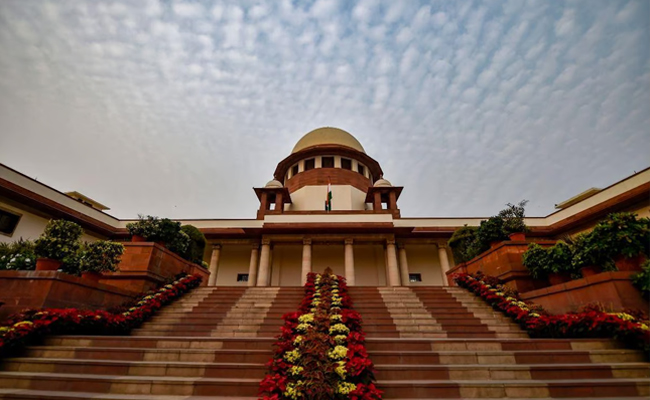
New Delhi, Jan 18 : The Supreme Court directed the Kerala Police on Friday to provide round-the-clock security to two women who had entered the Sabarimala temple.
A bench comprising Chief Justice Ranjan Gogoi and justices L N Rao and Dinesh Maheshwari said it was only going into the aspect of security of the two women and would not like to entertain any other prayer made in the petition.
The bench also refused to tag the matter along with the pending petitions in the Sabarimala case.
It was hearing the petitions of 42-year-old Bindu, a college lecturer and CPI(ML) activist from Kozhikode district's Koyilandy, and Kanakadurga, 44, a civil supplies department employee from Angadipuram in Malappuram, who had entered the Sabarimala shrine on January 2.
"We deem it appropriate to entertain this writ petition by directing the Kerala Police to provide adequate security round the clock to petitioner number 1 (Bindu) and petitioner 2 (Kanakdurga). Beyond that we don't want to go into any of the issues mentioned in the petition," the bench said.
Senior advocate Vijay Hansaria, appearing for the Kerala government, said it was already providing adequate security to these women and other devotees who have entered the Sabarimala temple. He said till now 51 female devotees have entered the shrine.
Advocate Mathews J Nedumpara appearing for some petitioners, who have filed a review plea challenging the decision of the top court to allow women of all ages to enter the temple, said that none of the female devotees has entered the Sabarimala shrine.
The bench, however, refused to go into all these issues and said that if the Kerala government was already providing security to the female devotees without the court's order then there is no harm if the government continues providing adequate security even after the court's order.
Senior advocate Indira Jaising, appear for the women petitioners, said the court should direct tagging of the petitions with the pending matters on the Sabarimala temple issue.
To this, the bench said the prayer for tagging is rejected.
Earlier this month, the two women had stepped into the hallowed precincts guarded by the police, more than three months after the apex court's historic judgment lifting the ban on the entry of girls and women between 10 and 50 years of age into the shrine of Lord Ayyappa, its "eternally celibate" deity.
Following the entry of the women into the shrine, the chief priest had decided to close the sanctum sanctorum of the temple to perform the 'purification' ceremony.
The plea had sought round-the-clock security to both the women due to threat to their life for entering into the hilltop shrine as one of the women was assaulted by her mother in-law.
The plea had sought directions declaring all authorities not to conduct the rite of purification or to shut the temple on account of any woman of the age of 10-50 having entered the temple.
It had said that the purification ritual is representative of a cleansing ceremony, signifying the petitioners were impure, which is violative of their dignity under Article 21 of the Constitution.
The petition also sought directions declaring that any form of prevention of women aged between 10 and 50 years from visiting the hilltop shrine is contrary to the September 28, 2018 judgment of the apex court.
On September 28 last year, a five-judge Constitution bench, headed by then Chief Justice Dipak Misra, in a 4:1 verdict paved the way for entry of women of all ages into the Sabarimala temple, saying the ban amounted to gender discrimination.
The top court has said it may not start hearing pleas seeking a review of the Sabarimala verdict from January 22 as one of the judges was on medical leave.
Earlier, the apex court had decided to hear in open court the review petitions against the verdict. Besides Justice Indu Malhotra and the CJI, justices R F Nariman, A M Khanwilkar and D Y Chandrachud are part of the five-judge constitution bench.
Justice Malhotra had delivered the dissenting judgment in the case.
There are around 48 petitions seeking review of the judgment and they were filed following violent protests in favour and against the verdict.
Let the Truth be known. If you read VB and like VB, please be a VB Supporter and Help us deliver the Truth to one and all.
Rickelton's ton in vain as SRH beat MI by 6 wickets
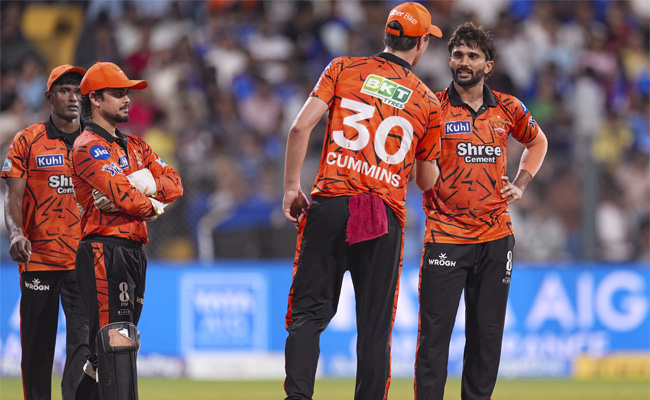
Mumbai (PTI): Ryan Rickelton's whirlwind unbeaten ton was overshadowed by Heinrich Klaasen's unbeaten 65 as Sunrisers Hyderabad defeated Mumbai Indians by six wickets in an IPL match here on Wednesday.
Chasing an imposing 244-run target, Travis Head (76 off 30) and Abhishek Sharma (45 off 24) shared 129 runs for the opening wicket to set the platform for SRH.
Klaasen (65 not out off 30 balls) then displayed his all-round hitting abilities to guide SRH home with the help of Nitish Kumar Reddy (21) and Salil Arora (30 not out off 10) in 18.4 overs.
Earlier, Rickelton's knock powered MI to 243 for five.
MI rode on a 93-run stand between Rickelton (123 not out off 55 balls) and Will Jacks (46 off 22) in 7.1 overs for the opening stand to power the side.
MI skipper Hardik Pandya scored a valuable 31 off 15 balls before being dismissed.
Praful Hinge (2/54), Eshan Malinga (1/29), Sakib Hasan (1/39) and Nitish Kumar Reddy (1/31) were the wicket-takers for SRH.
Brief Scores:
Mumbai Indian: 243 for 5 in 20 overs (Ryan Rickelton 123 not out; Praful Hinge 2/54).
Sunrisers Hyderabad: 249 for 4 in 18.4 overs (Travis Head 76, Heinrich Klaasen 65 not out; AM Ghazanfar 2/51).