SC directs political parties to furnish receipts of electoral bonds, donors' identity details to EC
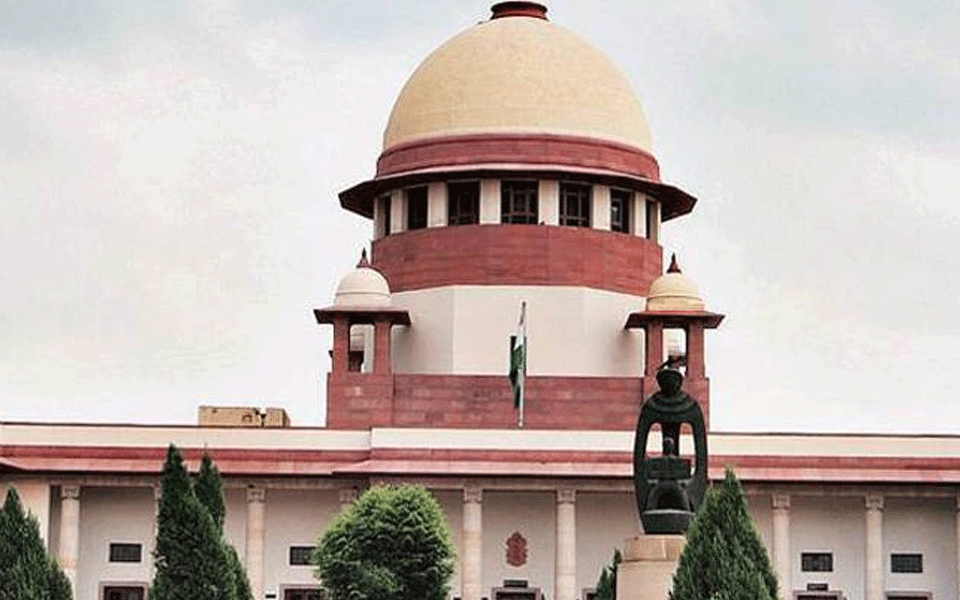
New Delhi: The Supreme Court Friday directed all political parties to furnish receipts of political funding received through electoral bonds and details of identity of donors in a sealed cover to the Election Commission.
In an interim order, the apex court also directed all political parties to provide details of the amount of the bond and bank account of donors by May 30 to the poll panel.
The apex court said it would examine in detail changes made in Income Tax law, electoral law and banking laws to make them in consonance with the electoral bond scheme and ensure balance does not tilt in favour of any political party.
It also directed the Finance Ministry to reduce the window of purchasing electoral bonds from 10 days to five days in April-May and said it would fix a date later for final disposal of the petition filed by an NGO.
The NGO has challenged the validity of the scheme and sought that either the issuance of electoral bonds be stayed or names of donors be made public to ensure transparency in the poll process.
The order was pronounced by a bench comprising Chief Justice Ranjan Gogoi and Justices Deepak Gupta and Sanjiv Khanna.
The government had notified the Electoral Bond Scheme 2018 on January 2, 2018.
As per provisions of the scheme, electoral bonds may be purchased by a person, who is a citizen of India or incorporated or established in India.
A person being an individual can buy electoral bonds, either singly or jointly with other individuals.
Only political parties registered under Section 29A of the Representation of the People Act, 1951 and which secured not less than one per cent of votes polled in the last general election to the House of the People or the Legislative Assembly of the State, shall be eligible to receive electoral bonds.
As per the notification, electoral bonds shall be encashed by an eligible political party only through a bank account with an authorised bank.
The Centre and the Election Commission had taken contrary stands in the Supreme Court on Wednesday over political funding with the government wanting to maintain anonymity of donors of electoral bonds and the poll panel batting for revealing names of donors for transparency.
The bench on Thursday had reserved the order, saying if the identity of the purchasers of electoral bonds meant for transparent political funding was not known, then efforts of the government to curtail black money in elections would be "futile".
The Centre, through Attorney General K K Venugopal, had vehemently supported the scheme saying the purpose behind it is to eliminate the use of black money in elections and asked the court not to interfere with it at this stage and examine whether it has worked or not only after the elections.
However, advocate Prashant Bhushan, appearing for Association of Democratic Reforms (ADR)', had said the scheme has nothing to do with the effort to curb black money and it opens the banking means also to donate by remaining anonymous.
During in an earlier hearing, Bhushan had claimed that the party in power was the major beneficiary of the scheme.
The EC, represented by senior lawyer Rakesh Dwivedi, had opposed Centre's submissions and said secrecy allowed in the electoral bonds scheme "legalises anonymity".
The bench had also observed, "If the identity of purchasers of bonds is not known then there will be greater ramification on the Income Tax law and all your (government's) efforts to curtail black money will be futile".
Venugopal had also said the anonymity of donors of electoral bonds is to be maintained for various reasons such as fear of repercussions on a firm or an individual if the other political party or group wins.
The Attorney General had also said: "Historically, black money is used in elections. This is a reformatory steps. The scheme can be examined after the elections."
In its affidavit, the Centre had said electoral bonds "attempt at bringing greater transparency, ensuring KYC compliance and keeping an audit trail in comparison to the earlier opaque system of cash donations.
Let the Truth be known. If you read VB and like VB, please be a VB Supporter and Help us deliver the Truth to one and all.
CM Siddaramaiah alleges ‘criminal conspiracy’ in Sringeri recount, vows legal action
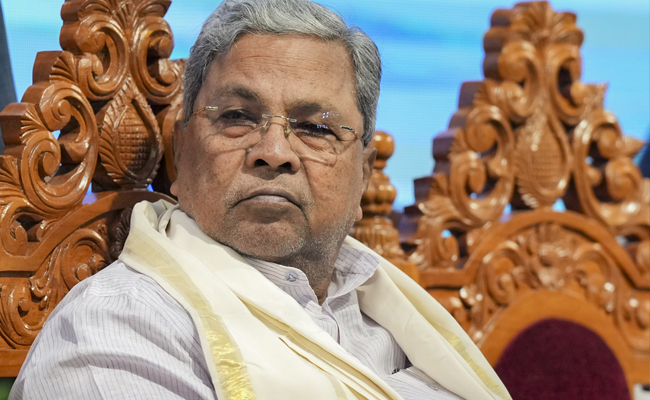
Bengaluru (PTI): Alleging a “criminal conspiracy” by BJP candidate D N Jeevaraj in the Sringeri Assembly poll recounting, Karnataka CM Siddaramaiah on Tuesday said the outcome was manipulated after valid postal ballot votes in favour of Congress leader T D Raje Gowda were tampered with during the recounting process.
Following a Karnataka High Court order on an election petition filed by Jeevaraj, challenging Raje Gowda’s election, the reverification and recounting were conducted on Saturday.
After the reverification and recount of postal ballots for the Sringeri Assembly constituency, votes polled in favour of Raje Gowda were reduced by 255, the returning officer said.
A report on the matter has been submitted to the Election Commission of India for further action, the officer added.
Congress leader Raje Gowda had won the 2023 Assembly polls from Sringeri by 201 votes, defeating his nearest rival Jeevaraj.
Addressing a press conference in Bengaluru, Siddaramaiah said the High Court had directed the recounting of postal ballots and that irregularities were noticed during the exercise conducted on May 2.
“This is a clear case of criminal conspiracy,” Siddaramaiah said, alleging that valid votes cast in favour of Raje Gowda were altered after being accepted by counting agents of all parties, including Congress, BJP, and JD(S).
He claimed that during the recounting of postal ballots, 255 votes were initially accepted as valid by all agents but were later tampered with by subordinate officials.
“There is a second mark on the votes polled in favour of Raje Gowda. They had accepted these as valid votes. Subsequently, another mark was made by officials. This is a clear case of criminal conspiracy,” he said.
When asked who was behind the alleged conspiracy, the CM replied, “It was hatched by Jeevaraj and others. It is planned.”
Siddaramaiah further alleged that the returning officer acted improperly by declaring the result despite the presence of an Election Commission observer during the recounting.
“Immediately after the counting, the returning officer announced the result. He should not have done so; this is against the law,” he said.
He pointed out that Raje Gowda had originally won by 201 votes, but after the recounting, the BJP candidate was declared the winner by 52 votes.
“The BJP has committed a criminal act of conspiracy. This is not vote chori but vote dacoity,” he alleged.
The CM said a police complaint had already been filed by Raje Gowda’s election agent, Sudhir Kumar, and emphasised the need for electoral integrity.
“We want transparency and free and fair elections. That is what our Constitution mandates,” he added.
Stating that the government would pursue legal remedies, Siddaramaiah said, “We are preparing an appeal challenging the returning officer’s announcement in a court of law.”
Responding to a separate query on elections in other states, the CM said there appeared to be an anti-incumbency factor in West Bengal, while results in Tamil Nadu were “surprising,” adding that Vijay’s party was emerging as the largest there.
Following the victory of party candidates in Bagalkote and Davanagere South, Siddaramaiah expressed confidence about future electoral prospects in Karnataka.
“Even in 2028, we will win the Assembly elections. We will come back,” the CM said.
Siddaramaiah added that he would order a forensic examination into the alleged tampering of postal ballots.