SC grants bail to hate speech accused in Haridwar Dharma Sansad case
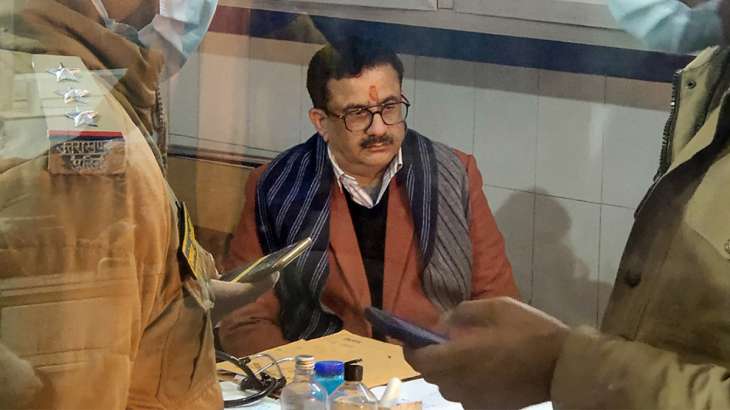
New Delhi, Sep 12: The Supreme Court on Monday granted bail to Jitendra Narayan Tyagi, an accused in the Haridwar Dharma Sansad case related to alleged inflammatory speeches made against Muslims.
A bench of Justices Ajay Rastogi and B V Nagarathna directed Tyagi, formerly known as Wasim Rizvi, to furnish an undertaking before the trial court that he will not address electronic media or social media and shall not indulge in such alleged activities anymore, directly or indirectly.
"The petitioner may be produced before the Trial Court within three days and shall be released on post-arrest bail subject to such terms and conditions to the satisfaction of the concerned trial Court and furnishing undertaking in above terms before the trial Court.
"If the petitioner violates or commits a breach of any of the conditions on which bail has been granted to him, the respondents/prosecution is at liberty to move an application seeking cancellation of bail," the bench said.
The top court on August 29 refused to extend the interim bail granted earlier on medical grounds and directed Tyagi to surrender.
The apex court on May 17 granted three months of interim bail to Tyagi on medical grounds and directed him to give an undertaking that he would not indulge in hate speech and not give any statement on electronic or digital or social media.
Tyagi had approached the top court after the Uttarakhand High Court dismissed his bail plea in March this year.
The case against him and others had been lodged on the complaint of Nadeem Ali, a resident of Jwalapur Haridwar at Haridwar Kotwali on January 2 this year.
He had alleged in his complaint that Dharma Sansad or religious Parliament was organised in Haridwar by Hindu sages from December 17 to 19 last year and in the garb of this event, the participants were instigated to wage a war against Muslims.
Objectionable words were allegedly used against the Holy Quran and Prophet Mohammad, Ali had said in his complaint, adding these provocative statements had later gone viral on social media.
These videos were circulated by Tyagi, Yati Narsinghanand, and others, he had alleged.
The FIR also alleged that an attempt was made by Prabodhanand Giri to spread violence against the people living in Haridwar's mosques.
On Ali's complaint, Narsindhanand Giri, Sagar Sindhu Maharaj, Dharamdas Maharaj, Parmanand Maharaj, Sadhvi Annapurna, Swami Anand Swaroop, Ashwani Upadhyay, Suresh Chavan along with Swami Prabodhanand Giri, Jitendra Narayan were booked under various sections of the IPC for allegedly delivering hate speeches in the name of religion at the conclave.
Let the Truth be known. If you read VB and like VB, please be a VB Supporter and Help us deliver the Truth to one and all.
Rajnath, Shah, other Union ministers change social media profile photos to 'Op Sindoor' logo
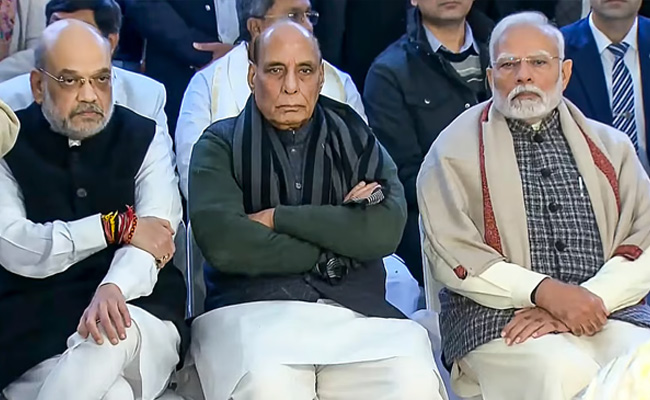
New Delhi (PTI): Defence Minister Rajnath Singh, Home Minister Amit Shah, External Affairs Minister S Jaishankar and other top ministers on Thursday changed the display pictures on their social media profiles to mark the first anniversary of Operation Sindoor following a call by Prime Minister Narendra Modi.
The prime minister, earlier in the day, shared a digital poster depicting the now widely recognised logo of Operation Sindoor and urged others to do the same as a mark of respect to the armed forces.
Operation Sindoor was launched in response to the deadly Pahalgam terror attack, with Indian forces conducting precision strikes on multiple terror infrastructure in Pakistan and Pakistan-Occupied-Kashmir (PoK).
After launching the military operation, the Indian Army, in a post on X, at 1:51 am on May 7 had said, "Justice is served. Jai Hind!"
On its first anniversary, the Indian military on Thursday said, Operation Sindoor -- "precise in action, eternal in memory" -- reflected the country's determination to defend its sovereignty with courage, coordination and strength.
The Army, the Navy, the Indian Air Force, the Headquarters Integrated Defence Staff (HQ IDS) and the defence ministry also updated the display pictures on their social media profiles to mark the anniversary.
Defence Minister Singh, while updating his profile photo on X, said Operation Sindoor stands as a "powerful symbol" of national resolve and preparedness, and that their actions reflected unmatched precision, and set a "benchmark" for modern military operations.
"On the anniversary of Operation Sindoor, we salute the valour and sacrifices of our armed forces, whose courage and dedication continue to safeguard the nation. Their actions during the operation reflected unmatched precision, seamless jointness and deep synergy across services, setting a benchmark for modern military operations," he wrote.
"Operation Sindoor stands as a powerful symbol of national resolve and preparedness, showing that our armed forces are always ready to act decisively when it matters most. It also stands testament to India’s steady advance towards achieving #Atmanirbharta, enhancing capability while reinforcing resilience," he added.
The Ministry of External Affairs, led by its minister Jaishankar, also marked the anniversary, and reasserted and amplified India's diplomatic stand on this operation.
"A year ago, #OperationSindoor demonstrated the nation's resolve to defend itself against cross-border terrorism from Pakistan. With its decisive actions, India ensured accountability for terrorist actions. And underlined that such a serious threat to peace and security will be effectively countered. Under the leadership of PM @narendramodi, India stands strong and determined to convey a message of zero tolerance for terrorism," the EAM posted on X.
Earlier in a separate post, Jaishankar too changed his profile picture and posted an image of the Operation Sindoor logo on the timeline.
Home Minister Shah, in a post on X, said, "Operation Sindoor stands as an epochal mission of India that will always remind our enemies of the infallible striking power of our armed forces."
After Indian forces had launched the operation in the early hours of May 7, Pakistan later also launched offensives against India, and all subsequent counter-offensives by India were also carried out under Operation Sindoor.
The military conflict between the two nuclear-armed neighbours, lasting nearly 88 hours, halted after they reached an understanding on the evening of May 10.
Union Culture and Tourism Minister Gajendra Singh Shekhawat, Education Minister Dharmendra Pradhan, Railway Minister Ashwini Vaishnav, Environment Minister Bhupendra Yadav, Women and Child Development Annapurna Devi and Jal Shakti Minister C R Paatil too updated their profile photos.
The Indian Army in an early morning post wrote, "#OperationSindoor India's resolute response calibrated and precise. Committed to safeguarding sovereignty and its people. #JusticeServed Jai Hind".
It also shared a video clip encapsulating the circumstances that led to the decisive military action in the early hours of May 7 last year, as well as some footage offering a glimpse to the military might of India.
"India will identify, track and punish every terrorist and their backers," PM Modi had earlier said in his address, whose excerpt is part of the widely shared clip.
Recalling the military action launched on the intervening night of May 6-7, the Indian Air Force put out the anniversary post on X at 1:05 AM.
"Operation Sindoor Justice served. Precise in action, eternal in memory-Operation Sindoor continues. India forgets nothing-India forgives nothing. #operation #Sindoor #operationsindoor #IAF," the IAF posted.
The Headquarters Integrated Defence Staff (HQ IDS) also posted the anniversary message at 1:05 AM, saying, "Symbol of national resolve #OpSindoor JAI HIND #OpSindoor #indianarmedforces #NationalSecurity".
The Indian embassies in the US, the UK, Spain, France, Germany and Italy also updated their display pictures on their social media profiles.
The embassies in France, Germany, Spain and Italy posted on X in French, German and Italian, amplifying the message of the Indian leadership on Operation Sindoor's anniversary in the respective countries.
The Indian Embassy in the UK posted on X, "One year of #OperationSindoor A tribute to India’s resolve, unity, and unwavering stand against terrorism. Saluting the courage and sacrifice of our armed forces who protect the nation with pride and honor. #OpSindoor #IndiaAgainstTerrorism #IndianArmedForces #NationalSecurity #IndiaFirst #SaluteOurForces #JaiHind #OperationSindoorContinues".
The Indian embassy in Israel also changed its profile photo on X and reposted PM Modi's post, and the X account of the embassy in Iran too changed the display picture to the logo of Operation Sindoor.
The Indian Navy in an early morning post on X said Operation Sindoor reflected India's determination to defend its sovereignty with courage and strength.
"Nation's Resolve. Forces United In moments that test a nation's will, the Indian Defence Forces stand united - resolute in purpose, precise in action and unwavering in commitment. #OperationSindoor reflects India's determination to defend its sovereignty with courage, coordination and strength. #OpSindoor #NationFirst #IndianNavy @HQ_IDS_India @adgpi @IAF_MCC," the Navy posted and changed its profile photo.