SC grants bail to three accused in 2024 Pune Porsche crash case
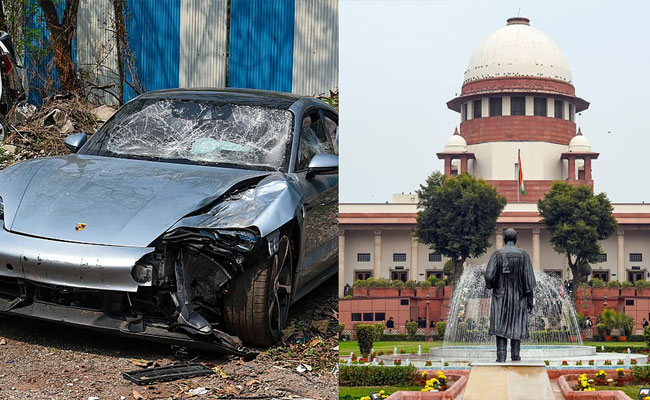
New Delhi (PTI): The Supreme Court on Monday granted bail to three accused in the 2024 Pune Porsche accident case that claimed two lives, while observing that parents are to be blamed for such incidents involving juveniles.
A bench of Justices BV Nagarathna and Ujjal Bhuyan observed that parents are not able to control their children.
"Substance abuse is another thing but giving them (children) car keys and funds to have a gala time is unacceptable," the court observed.
On January 23, the top court sought a response from the Maharashtra government on a plea filed by accused Amar Santish Gaikwad seeking bail in the case.
Gaikwad represented by advocate Sana Raees Khan was alleged to be a middleman, who gave Rs 3 lakh to the assistant of a doctor in a hospital to replace a blood sample of the juvenile accused.
On May 19, 2024, a Porsche allegedly driven by a 17-year-old boy under the influence of alcohol, fatally knocked down two IT professionals in Pune's Kalyani Nagar area.
On January 7, the top court sought a response from the Maharashtra government on pleas filed by two other accused seeking bail in the case.
Aditya Avinash Sood (52) and Ashish Satish Mittal (37) represented by senior advocates Siddharth Dave and Siddharth Agarwal were arrested on August 19 last year, as their blood samples were used for tests in connection with two minors who were in the car along with the 17-year-old main accused at the time of the accident.
The high court on December 16 last year rejected the bail pleas of eight accused, including Gaikwad, Sood and Mittal, in the case.
The Juvenile Justice Board (JJB) had granted bail to the minor accused on lenient terms, sparking nationwide outrage. The bail conditions included writing a 300-word essay on road safety.
As bail to the accused juvenile triggered outrage, the Pune police approached the JJB to review its decision. The board then modified the order and sent the juvenile to an observation home. In June, the high court ordered the release of the juvenile.
While the juvenile involved in the case was released from an observation home, 10 accused, including his parents Vishal Agarwal and Shivani Agarwal, doctors Ajay Tawre and Shreehari Halnor, Sassoon Hospital's staffer Atul Ghatkamble, Aditya Avinash Sood, Ashish Mittal and Arun Kumar Singh, and two middlemen, were sent to jail in the blood sample swapping case.
Let the Truth be known. If you read VB and like VB, please be a VB Supporter and Help us deliver the Truth to one and all.
AIITA welcomes Karnataka’s ban on obscene songs in school events
Bhatkal: The Karnataka unit of the All India Ideal Teachers Association (AIITA) has welcomed the Karnataka government’s decision to strictly ban school children from dancing to obscene songs during educational and cultural programmes in government, aided, and private schools across the state.
AIITA Karnataka State President M. R. Manvi congratulated the government for taking what he termed an important step to preserve the sanctity of education.
“Such decisions to safeguard the dignity of school children and uphold the values of education are the need of the hour. This rule should not be limited to government schools alone but must be strictly implemented in all private educational institutions as well,” he said.
He further urged the government to address other concerns within school programmes.
“The government should not only prohibit obscene dances in the name of school anniversaries, but also ensure that plays and dialogues that incite religious hatred are avoided. Schools should be centres of harmony, not platforms for spreading hatred,” he added.
According to a recent circular issued by the Department of School Education and Literacy, obscene dances are adversely affecting the mental health and moral values of students.
In this regard, schools have been advised to use songs that promote nationalism, positive thinking, the greatness of Kannada culture, and value-based traditions instead of inappropriate content during programmes.
The circular also emphasises that students should be dressed in decent attire.
AIITA also backed the department’s warning that disciplinary action would be taken against head teachers if such guidelines are violated. The association has further demanded that district Deputy Directors of Public Instruction strictly monitor the implementation of these rules.