SC hearing pleas challenging validity of electoral bonds scheme
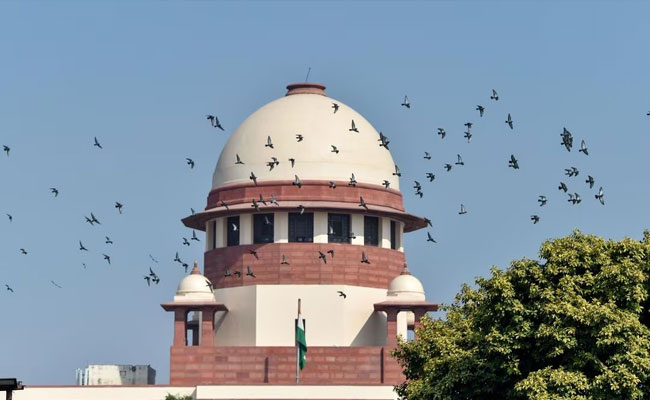
New Delhi (PTI): The Supreme Court on Tuesday commenced hearing on a batch of petitions challenging the validity of the electoral bonds scheme for funding political parties.
The scheme, which was notified by the government on January 2, 2018, was pitched as an alternative to cash donations made to political parties as part of efforts to bring in transparency in political funding.
According to the provisions of the scheme, electoral bonds may be purchased by any citizen of India or entity incorporated or established in India. An individual can buy electoral bonds, either singly or jointly with other individuals.
The hearing on the four petitions, including those filed by Congress leader Jaya Thakur, the Communist Party of India (Marxist) and NGO Association for Democratic Reforms (ADR), commenced before a five-judge constitution bench headed by Chief Justice D Y Chandrachud.
Advocate Prashant Bhushan, appearing for ADR, told the bench that it was a case which goes to the "very root of our democracy".
"First of all, I wish to say that this is a case which goes to the very root of our democracy and I am glad that the court has finally fixed it for hearing and constituted a constitution bench given the importance of the case," Bhushan told the bench, also comprising Justices Sanjiv Khanna, B R Gavai, J B Pardiwala and Manoj Misra.
The hearing in the matter is underway.
Attorney General (AG) R Venkataramani, in a statement filed before the top court in the matter, has said that citizens do not have the right to information under Article 19(1)(a) of the Constitution regarding the source of the funds.
Holding that the electoral bonds scheme for funding political parties contributes to clean money, the top law officer has said there can be no general right to know "anything and everything", without being subjected to reasonable restrictions.
"The scheme in question extends the benefit of confidentiality to the contributor. It ensures and promotes clean money being contributed. It ensures abiding by tax obligations. Thus, it does not fall foul of any existing right," the AG has told the apex court.
On October 10, the court had taken note of Bhushan's submissions that the matter needed adjudication before the electoral bonds scheme opens for the 2024 general election.
One of the PIL petitioners claimed in March that a total amount of Rs 12,000 crore has so far been paid to political parties through electoral bonds and two-thirds of it has gone to one major political party.
ADR, which filed the first PIL in the matter in 2017 on the issue of alleged corruption and subversion of democracy through illicit and foreign funding of political parties and lack of transparency in the bank accounts of all political parties, had moved an interim application seeking that the sale of electoral bonds not be reopened.
On January 20, 2020, the apex court refused to grant an interim stay on the scheme and sought the responses of the Centre and Election Commission to an interim application filed by the NGO seeking a stay on the scheme.
Only the political parties registered under Section 29A of the Representation of the People Act, 1951 and which secured not less than one per cent of the votes polled in the last election to the Lok Sabha or a state legislative Assembly are eligible to receive electoral bonds.
According to the notification, electoral bonds shall be encashed by an eligible political party only through an account with an authorised bank.
The apex court had, in April 2019, also declined to stay the electoral bonds scheme and made it clear that it will accord an in-depth hearing on the pleas as the Centre and the EC had raised "weighty issues" that had "tremendous bearing on the sanctity of the electoral process in the country".
The Centre and the EC had earlier taken contrary stands in the court over political funding, with the government wanting to maintain the anonymity of the donors and the poll panel batting for revealing their names for the sake of transparency.
Let the Truth be known. If you read VB and like VB, please be a VB Supporter and Help us deliver the Truth to one and all.
Rickelton's ton in vain as SRH beat MI by 6 wickets

Mumbai (PTI): Ryan Rickelton's whirlwind unbeaten ton was overshadowed by Heinrich Klaasen's unbeaten 65 as Sunrisers Hyderabad defeated Mumbai Indians by six wickets in an IPL match here on Wednesday.
Chasing an imposing 244-run target, Travis Head (76 off 30) and Abhishek Sharma (45 off 24) shared 129 runs for the opening wicket to set the platform for SRH.
Klaasen (65 not out off 30 balls) then displayed his all-round hitting abilities to guide SRH home with the help of Nitish Kumar Reddy (21) and Salil Arora (30 not out off 10) in 18.4 overs.
Earlier, Rickelton's knock powered MI to 243 for five.
MI rode on a 93-run stand between Rickelton (123 not out off 55 balls) and Will Jacks (46 off 22) in 7.1 overs for the opening stand to power the side.
MI skipper Hardik Pandya scored a valuable 31 off 15 balls before being dismissed.
Praful Hinge (2/54), Eshan Malinga (1/29), Sakib Hasan (1/39) and Nitish Kumar Reddy (1/31) were the wicket-takers for SRH.
Brief Scores:
Mumbai Indian: 243 for 5 in 20 overs (Ryan Rickelton 123 not out; Praful Hinge 2/54).
Sunrisers Hyderabad: 249 for 4 in 18.4 overs (Travis Head 76, Heinrich Klaasen 65 not out; AM Ghazanfar 2/51).