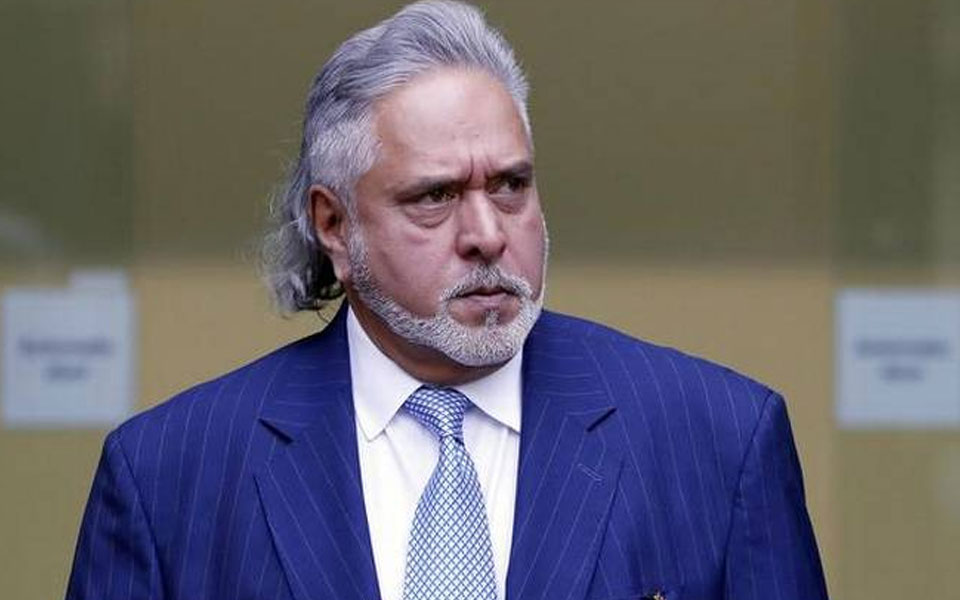
New Delhi, Dec 7 : The Supreme Court Friday issued notice to the Enforcement Directorate (ED) on industrialist Vijay Mallya's plea challenging the ongoing proceedings in a Mumbai court to declare him as a fugitive economic offender.

A bench comprising Chief Justice Ranjan Gogoi and Justice S K Kaul sought the probe agency's response on the plea.

The ED moved the special court seeking to declare the London-based industrialist a fugitive economic offender under the Fugitive Economic Offender Act 2018.

The apex court issued notice on Mallya's plea but refused to stay proceedings before the Mumbai special court.

The Bombay High Court recently dismissed Mallya's appeal. The industrialist has filed an appeal against the high court order.

Under the provisions of the Act, once a person is declared a fugitive economic offender, then the prosecuting agency has the powers to confiscate the accused persons' properties.

The special court had on October 30 rejected Mallya's application, following which the liquor baron approached the high court.

Mallya's counsel had told the division bench that his pleas should not be misunderstood as a ploy to run away from proceedings.

"We are also anxious to clear dues and to see to it that creditors get their dues back. We don't want properties to be seized by the Enforcement Directorate, which would then hamper process of clearance of dues," his counsel had said.

The high court, however, had said it was not inclined to grant any relief.

"The application has been filed at the threshold and at a very premature stage when the lower court is still hearing the prosecuting agency's request to declare him (Mallya) a fugitive economic offender," the court had said in its order.

The bench, while dismissing the plea filed by Mallya, had said the lower court shall hear the application filed by the ED on merits.

Let the Truth be known. If you read VB and like VB, please be a VB Supporter and Help us deliver the Truth to one and all.


New Delhi: A bill to set up a 13-member body to regulate institutions of higher education was introduced in the Lok Sabha on Monday.

Union Education Minister Dharmendra Pradhan introduced the Viksit Bharat Shiksha Adhishthan Bill, which seeks to establish an overarching higher education commission along with three councils for regulation, accreditation, and ensuring academic standards for universities and higher education institutions in India.

Meanwhile, the move drew strong opposition, with members warning that it could weaken institutional autonomy and result in excessive centralisation of higher education in India.

The Viksit Bharat Shiksha Adhishthan Bill, 2025, earlier known as the Higher Education Council of India (HECI) Bill, has been introduced in line with the National Education Policy (NEP) 2020.

The proposed legislation seeks to merge three existing regulatory bodies, the University Grants Commission (UGC), the All India Council for Technical Education (AICTE), and the National Council for Teacher Education (NCTE), into a single unified body called the Viksit Bharat Shiksha Adhishthan.

At present, the UGC regulates non-technical higher education institutions, the AICTE oversees technical education, and the NCTE governs teacher education in India.

Under the proposed framework, the new commission will function through three separate councils responsible for regulation, accreditation, and the maintenance of academic standards across universities and higher education institutions in the country.

According to the Bill, the present challenges faced by higher educational institutions due to the multiplicity of regulators having non-harmonised regulatory approval protocols will be done away with.

The higher education commission, which will be headed by a chairperson appointed by the President of India, will cover all central universities and colleges under it, institutes of national importance functioning under the administrative purview of the Ministry of Education, including IITs, NITs, IISc, IISERs, IIMs, and IIITs.

At present, IITs and IIMs are not regulated by the University Grants Commission (UGC).

Government to refer bill to JPC; Oppn slams it

The government has expressed its willingness to refer it to a joint committee after several members of the Lok Sabha expressed strong opposition to the Bill, stating that they were not given time to study its provisions.

Responding to the opposition, Parliamentary Affairs Minister Kiren Rijiju said the government intends to refer the Bill to a Joint Parliamentary Committee (JPC) for detailed examination.

Congress Lok Sabha MP Manish Tewari warned that the Bill could result in “excessive centralisation” of higher education. He argued that the proposed law violates the constitutional division of legislative powers between the Union and the states.

According to him, the Bill goes beyond setting academic standards and intrudes into areas such as administration, affiliation, and the establishment and closure of university campuses. These matters, he said, fall under Entry 25 of the Concurrent List and Entry 32 of the State List, which cover the incorporation and regulation of state universities.

Tewari further stated that the Bill suffers from “excessive delegation of legislative power” to the proposed commission. He pointed out that crucial aspects such as accreditation frameworks, degree-granting powers, penalties, institutional autonomy, and even the supersession of institutions are left to be decided through rules, regulations, and executive directions. He argued that this amounts to a violation of established constitutional principles governing delegated legislation.

Under the Bill, the regulatory council will have the power to impose heavy penalties on higher education institutions for violating provisions of the Act or related rules. Penalties range from ₹10 lakh to ₹75 lakh for repeated violations, while establishing an institution without approval from the commission or the state government could attract a fine of up to ₹2 crore.

Concerns were also raised by members from southern states over the Hindi nomenclature of the Bill. N.K. Premachandran, an MP from the Revolutionary Socialist Party representing Kollam in Kerala, said even the name of the Bill was difficult to pronounce.

He pointed out that under Article 348 of the Constitution, the text of any Bill introduced in Parliament must be in English unless Parliament decides otherwise.

DMK MP T.M. Selvaganapathy also criticised the government for naming laws and schemes only in Hindi. He said the Constitution clearly mandates that the nomenclature of a Bill should be in English so that citizens across the country can understand its intent.

Congress MP S. Jothimani from Tamil Nadu’s Karur constituency described the Bill as another attempt to impose Hindi and termed it “an attack on federalism.”