SC order on same-sex marriage evokes mixed response from LGBTQ activists
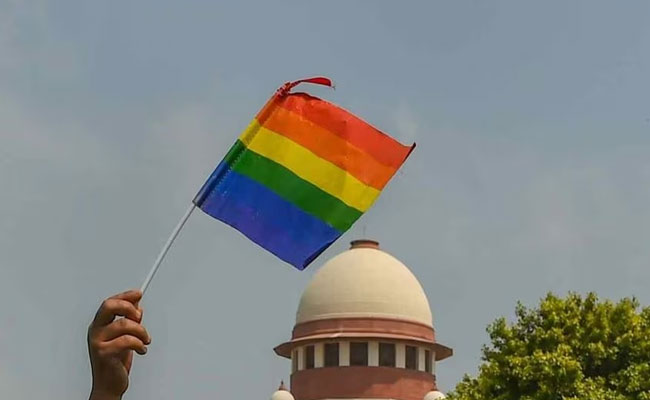
Kolkata (PTI): The Supreme Court judgment on the legality of same-sex marriage elicited mixed responses from LGBTQ activists, with one section hailing parts of the Constitution Bench's order, while others expressing dissatisfaction as it did not legalise same-gender weddings.
The court can't make law but only interpret it and it is for Parliament to change the Special Marriage Act, Chief Justice of India D Y Chandrachud who headed the bench said in his ruling.
The bench also said that the ability to choose a life partner goes to the roots of the right to life and liberty under Article 21 of the Constitution.
"This is historic! Transgenders inside heterosexual relations are right away given the right to marry, rights to adoption and for whole LGBTQIA+ umbrella," said Bappaditya Mukherjee, Founder and Director of Prantakatha', an NGO.
"The SC has directed both the Centre and state governments to facilitate all constitutional privileges to the community through law in an expedited manner with specific directions with respect to privileges associated with civil union," he said.
The apex court directed the Centre, states and UTs to take steps to sensitise the public about queer rights and ensure that inter-sex children are not allowed sex-change operations at an age they cannot fully comprehend the consequence.
Non-heterosexual and heterosexual unions must be seen as both sides of the same coin, said Justice SK Kaul, a member of the Constitution Bench.
"I see this as a powerful and important way ahead not only for the LGBTQIA+ community, but also for unmarried couples, couples in romantic reactions. Also being the largest democracy in the world, this judgement will pave equity for millions across countries," Mukherjee said.
However, Samata Biswas, a professor at Sanskrit College and University, who teaches gender studies, is not euphoric.
"The Supreme Court denying marriage equality to same-gender couples, and pushing it to the currently regressive legislature is definitely a setback for the queer movement in India," she said.
The five-judge Constitution bench refused to grant legal recognition to same-sex marriages and said it is the job of Parliament to change the Special Marriage Act.
"While matrimony is not and should not be the only form of recognised partnership, denying marriage equality strengthens regressive and conservative voices in society," Biswas, also Secretary of Calcutta Research Group, a thinktank.
Directing the Centre, states and Union Territories (UTs) to ensure the queer community is not discriminated against, the CJI, who is heading the constitution bench, said queer is a natural phenomenon known for ages and is neither urban nor elitist.
Some of the petitioners had urged the apex court to use its plenary power, "prestige and moral authority" to push society to acknowledge such a union which would ensure LGBTQIA+ lead a "dignified" life like heterosexuals.
LGBTQIA+ stands for lesbian, gay, bisexual, transgender, queer, questioning, intersex, pansexual, two-spirit, asexual and ally persons.
Let the Truth be known. If you read VB and like VB, please be a VB Supporter and Help us deliver the Truth to one and all.
AIITA welcomes Karnataka’s ban on obscene songs in school events
Bhatkal: The Karnataka unit of the All India Ideal Teachers Association (AIITA) has welcomed the Karnataka government’s decision to strictly ban school children from dancing to obscene songs during educational and cultural programmes in government, aided, and private schools across the state.
AIITA Karnataka State President M. R. Manvi congratulated the government for taking what he termed an important step to preserve the sanctity of education.
“Such decisions to safeguard the dignity of school children and uphold the values of education are the need of the hour. This rule should not be limited to government schools alone but must be strictly implemented in all private educational institutions as well,” he said.
He further urged the government to address other concerns within school programmes.
“The government should not only prohibit obscene dances in the name of school anniversaries, but also ensure that plays and dialogues that incite religious hatred are avoided. Schools should be centres of harmony, not platforms for spreading hatred,” he added.
According to a recent circular issued by the Department of School Education and Literacy, obscene dances are adversely affecting the mental health and moral values of students.
In this regard, schools have been advised to use songs that promote nationalism, positive thinking, the greatness of Kannada culture, and value-based traditions instead of inappropriate content during programmes.
The circular also emphasises that students should be dressed in decent attire.
AIITA also backed the department’s warning that disciplinary action would be taken against head teachers if such guidelines are violated. The association has further demanded that district Deputy Directors of Public Instruction strictly monitor the implementation of these rules.