SC refuses status quo on Dharavi redevelopment
 (1)_vb_18.jpeg)
New Delhi (PTI): The Supreme Court on Friday refused to order a status quo on Dharavi redevelopment project in Mumbai.
A bench of Chief Justice Sanjiv Khanna and Justice Sanjay Kumar sought responses from the Maharashtra government and Adani Properties Pvt Ltd, which was awarded the tender for the project, on a petition challenging a December 20, 2024 verdict of the Bombay High Court.
The high court had cleared the decks for redevelopment of the slums in Dharavi and upheld the tender awarded to the Adani Group for the project, ruling there was no "arbitrariness, unreasonableness or perversity" in the decision.
The high court in the process dismissed the plea of UAE-based Seclink Technologies Corporation challenging the state government's decision to award the mega redevelopment project to Adani Properties Pvt Ltd, which had made a Rs 5,069-crore offer.
Seclink Technologies Corporation emerged as the highest bidder for the project first in 2018 with its Rs 7,200-crore offer, but the tender was later scrapped by the government.
The Adani Group had emerged as the highest bidder for the 259-hectare Dharavi redevelopment project in the heart of Mumbai and bagged it with its Rs 5,069-crore offer in the 2022.
The corporation moved against the high court decision.
While issuing notice on its plea, the bench directed Adani Properties Pvt Ltd to make payments for the project through a single bank account.
After the bench issued notice on the plea, senior advocate C Aryama Sundaram appearing for Seclink Technologies Corporation urged the court to order a status quo.
The CJI, however, said, "No."
Sundaram informed the bench that the petitioner company offered Rs 7,200 crore in the first tender.
"I will increase my offer of Rs 7,200 crore by 20 per cent," he told the bench, adding that the figure comes to Rs 8,640 crore.
"What about additional obligations?" asked solicitor general Tushar Mehta, appearing for the state.
When the bench asked Sundaram, if it was willing to increase the offer "with the same obligations as put on the highest bidder", Sundaram said "yes".
The bench noted Sundaram's submission on the proposed commitment and said, "The petitioner will file an affidavit to the said effect before this court."
The matter would come in the week of May 25.
The bench, however, clarified no special equities would be claimed by either sides.
Senior advocate Mukul Rohatgi, appearing for Adani Properties Pvt Ltd, said the project work had already commenced.
"I have carried out constructions. I have deposited funds. About 2,000 people are employed," he said.
Mehta said some railway quarters were demolished aside from new constructions taking place.
While dismissing Seclink Technologies Corporation's plea, the high court had also rejected its contention that the tender was "tailor made" to suit a particular firm of the private conglomerate, noting three bidders had participated in the process.
The government had cancelled the 2018 tender and issued a fresh one in 2022 with additional conditions.
The corporation first challenged the cancellation of the 2018 tender and subsequently the 2022 award of tender to the Adani Group.
The state government had claimed in the high court that the tender was awarded in a transparent manner without any undue favour to the highest bidder.
The government said the 2018 tender was cancelled and a fresh one was issued four years later owing to several factors like the COVID-19 pandemic and the Russia-Ukraine war which affected the financial and economic state of affairs.
The first tender for the mega redevelopment project was issued in November 2018.
In March 2019, the bids were opened and it was found that Seclink Technologies Corporation was the highest bidder.
Dharavi, one of the world's densest urban sprawls, is a slum colony having a mix of residential and small industrial units.
Let the Truth be known. If you read VB and like VB, please be a VB Supporter and Help us deliver the Truth to one and all.
Sujit Nair raises concerns over speculation of DMK-AIADMK understanding to block TVK
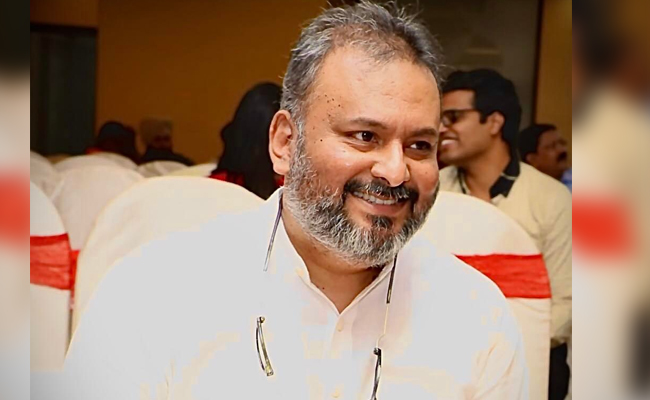
Chennai: Journalist and political commentator Sujit Nair has expressed concern over speculation that the Dravida Munnetra Kazhagam and the All India Anna Dravida Munnetra Kazhagam could explore a post-poll understanding to prevent Vijay-led Tamilaga Vettri Kazhagam from forming the government in Tamil Nadu.
In a social media post, Sujit Nair said the election verdict in Tamil Nadu reflected a clear public demand for political change and argued that the mandate should be respected irrespective of political preferences.
Referring to reports and political discussions surrounding a possible understanding between the DMK and AIADMK, he said he hoped such developments remained only speculative conversations and did not turn into reality.
Nair stated that if such an alliance were to take shape, it would raise serious questions about ideological politics in the country. He said TVK had emerged through a democratic electoral process and that the legitimacy to govern in a parliamentary democracy comes from the people’s verdict.
According to him, attempts to prevent an electoral winner from forming the government through unexpected political arrangements may be constitutionally valid, but many people could view them as politically opportunistic.
He further said that such a move could particularly affect the political image of the DMK, which has historically projected itself around ideology, social justice and opposition politics. Nair said that in ideological terms, the DMK appeared closer to TVK than to the AIADMK, and joining hands with its long-time political rival only to remain in power could weaken its broader political narrative.
He added that the same questions would apply to the AIADMK as well, as the party had spent decades positioning itself against the DMK and such an arrangement could create discomfort among its cadre and supporters.
Drawing a comparison with Maharashtra politics in 2019, Nair said he had expressed similar views when the Shiv Sena formed an alliance with the Indian National Congress and the Nationalist Congress Party after the Assembly elections.
He said post-poll alliances between long-standing political rivals often create a public perception that ideology and electoral mandates become secondary when political power equations come into play.
Nair also said such developments increase public cynicism towards politics and reinforce the belief among voters that ideology is often sidelined after elections.
He maintained that the Tamil Nadu verdict was emphatic and said respecting both the spirit and substance of the mandate was important for the credibility of democratic politics.