SC refuses to grant interim stay on operation of electoral bonds, to take up matter on April 10
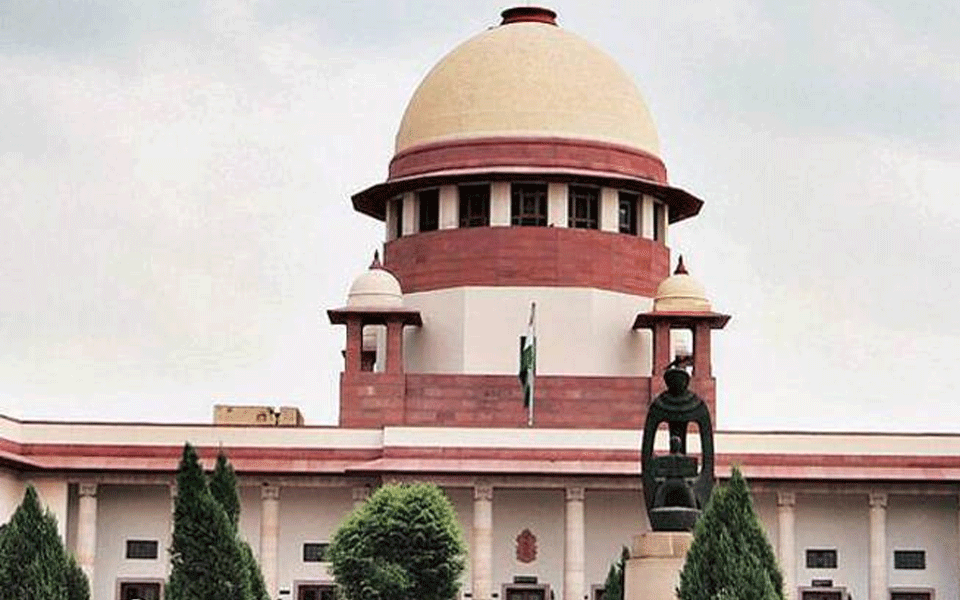
New Delhi: The Supreme Court Friday refused to grant interim stay on the electoral bonds scheme and asked the petitioner NGO to file an appropriate application for it.
A bench headed by Chief Justice Ranjan Gogoi said the issue requires detailed hearing and, therefore, it will be taken up on April 10.
Advocate Prashant Bhushan, appearing for NGO Association of Democratic Reforms (ADR), alleged that thousands of crore are anonymously being given to political parties.
He alleged that 95 percent of electoral bonds are being given to the ruling party.
Attorney General KK Venugopal, appearing for the Centre, said the electoral bonds scheme was brought to check the flow of black money into political funding.
He said Bhushan was giving an election speech that 95 percent of the electoral bonds have gone to ruling party.
The bench in lighter vein said: "It's election time. We will hear on April 10".
ADR's application has sought stay on the Electoral Bond Scheme, 2018, which was notified by the Centre in January last year.
It said the amendments carried out in the relevant Acts have "opened the floodgates to unlimited corporate donations to political parties and anonymous financing by Indian as well as foreign companies, which can have serious repercussions on the Indian democracy".
The matter holds importance as the Centre and the Election Commission (EC) have taken contrary stands, with the former justifying the decision saying it would promote transparency in political funding while the latter maintaining that the changes made in the law would have "serious repercussions".
In its affidavit filed on one of the petitions filed by the CPI(M) and its general secretary Sitaram Yechury, the Centre defended its decision to issue electoral bonds, saying it aimed at ensuring "enhanced accountability" and pushing electoral reforms "to defeat the growing menace of black money".
The Centre said the bonds were introduced on January 2, 2018 to promote transparency in funding and donations received by political parties and that these can be encashed by an eligible political party only through their authorised bank accounts.
It said the bonds did not have the name of the donor or the receiving political party and only carried a unique hidden alphanumeric serial number as an in-built security feature.
Only a political party registered under section 29A of the Representation of the People Act, 1951 and which had secured not less than one per cent of the votes polled in the last election to the Lok Sabha or a legislative assembly, would be eligible to receive the bonds, the Centre had said.
On March 27, the poll panel had informed the apex court that it had written to the Centre saying that the changes made in several laws relating to political funding will have "serious repercussions" on transparency.
It had also said that the changes in the FCRA, 2010 would allow unchecked foreign funding of political parties, which could lead to Indian policies being influenced by foreign companies.
The poll panel said on May 26, 2017, it had written to the Ministry of Law and Justice about its views that the changes made in the Income Tax Act, the Representation of the People Act and the Finance Act would be against the endeavour to have transparency in funding to political parties.
Referring to the EC's communication with the ministry, it said: "It is evident that any donation received by a political party through an electoral bond has been taken out of the ambit of reporting under the contribution report as prescribed under section 29C of the RP Act.
"In a situation where electoral bonds were not reported, it cannot be ascertained whether the political party has taken any donation from government companies and foreign sources."
On February 2 last year, the apex court had sought the Centre's response on a plea moved by the CPI(M), which had termed the issuance of electoral bonds by the government as "arbitrary" and "discriminatory".
Let the Truth be known. If you read VB and like VB, please be a VB Supporter and Help us deliver the Truth to one and all.
Power bank catches fire inside stationary IndiGo plane at Chandigarh airport; all evacuated

New Delhi (PTI): The power bank of a passenger onboard a stationary IndiGo aircraft caught fire at the Chandigarh airport on Tuesday, and all passengers and the crew were evacuated, according to a source.
In a statement, the airline said that when IndiGo flight 6E 108 from Hyderabad to Chandigarh was stationary after landing, an incident involving a customer's personal electronic equipment catching fire was reported.
"In the interest of safety, an immediate evacuation was carried out, and all the relevant authorities were immediately informed. All customers have been safely moved to the terminal and are being attended to by the team to ensure their well-being," the statement said.
The source said that soon after the aircraft landed, there was smoke coming from one of the overhead bins and all onboard were evacuated.
The smoke was due to the power bank catching fire, the source said, adding that no one sustained major injuries.
Details about the number of passengers could not be ascertained.