SC rejects plea against MHA's circular on Vande Mataram, says it's not mandatory
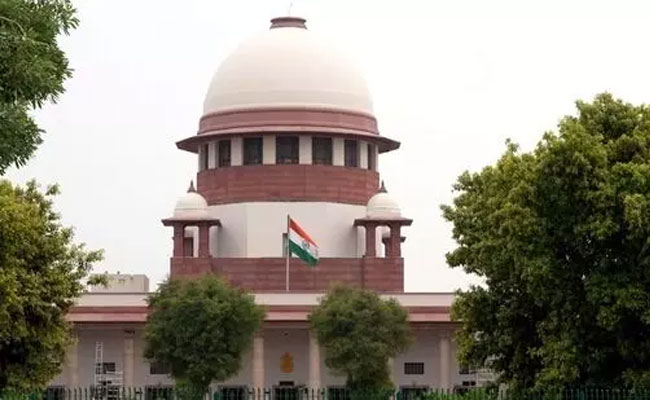
New Delhi (PTI): The Supreme Court on Wednesday refused to entertain a plea against a recent home ministry circular on singing of national song Vande Mataram at official events and schools, saying the directive was not mandatory.
A bench of Chief Justice Surya Kant and justices Joymalya Bagchi and Vipul M Pancholi noted that there was no penal consequence prescribed for not singing the song and termed the plea as "premature".
"We just feel that you have some vague apprehensions of discrimination which do not have any clear nexus with the impugned circular," Justice Bagchi told senior advocate Sanjay Hegde, appearing for petitioner Muhammed Sayeed Noori.
CJI Kant agreeing with the views of Justice Bagchi pointed out that the circular uses the word 'may' which indicates that the directive was advisory in nature.
"It is a premature apprehension; if there are any penal consequences, you come to us," the CJI said, adding, "The word 'may' is used in the circular. There are no penal or adverse consequences. Nobody has asked that you do it in your academy or school."
The CJI further said, "This is only a protocol. The word used is 'when it is played'. Earlier, we had a national flag protocol... which says what are the things to be followed when the national flag is hoisted."
Hegde, however, submitted that even if there is no penalty prescribed for not following the 'advisory', it can lead to compulsions to sing Vande Mataram, and those who do not follow it can be singled out and discriminated against and they will be threatened to conform.
Noori has challenged the Ministry of Home Affairs circular of January on the protocol to be followed for singing of the entire stanzas of Vande Mataram song.
During the hearing, Solicitor General of India Tushar Mehta, who was present in the court for hearing in another matter said, "Do we need to be advised to respect the national song?"
Hegde objected to the submission of Mehta without filing a formal reply to the petition and highlighted that people from all religions, including atheists, will be eventually compelled to sing the song as a social demonstration of loyalty.
Mehta referred to Article 51A(a) of the Constitution which establishes the fundamental duty of every citizen to abide by the Constitution and respect its ideals, institutions, the national flag and the national anthem.
Hegde said as per Article 51A(a), a citizen only has the fundamental duty to respect the national flag and the national anthem, and there was no reference to Vande Mataram and referred to an earlier order of the apex court which observed that patriotism cannot be compelled in respect to directive to sing the national anthem in a cinema hall.
Justice Bagchi said, "The statement 'patriotism cannot be compelled' was only a viewpoint. I am sorry many will disagree with this view of yours."
"It cannot be compelled even for the national anthem," the CJI remarked, adding, "We will appreciate this argument if it is made mandatory. That part is completely silent, there are no penal consequences, there is no sanction, there is no requirement that it has to be sung."
Hegde further contended that the Constitution has to protect individual conscience and the tradition teaches us tolerance.
"If there's an advisory without sanctions, this court may take it, there's no way that advisory can be enforced," he said.
The bench told Hegde that he is at liberty to approach the court if he is discriminated against or any notice threatening penal action is issued on the basis of the MHA's circular.
CJI Kant said, "It is a premature apprehension. If there are any penal consequences, you come to us. We are giving you this liberty."
Mehta submitted, "A person who says patriotism is not compulsory should not be entrusted with a writ in the court."
Hegde objected to Mehta's remark and said, "The Constitution is for all. It does not depend on where you stand politically or religiously."
Let the Truth be known. If you read VB and like VB, please be a VB Supporter and Help us deliver the Truth to one and all.
Women’s Reservation Bill: K'taka CM accuses PM Modi of adopting 'double standard'
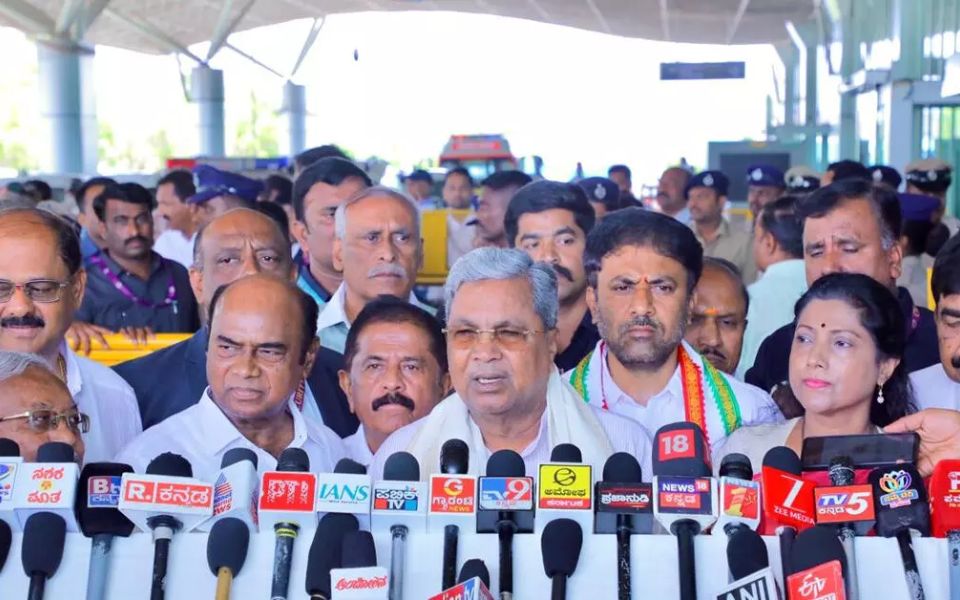
Mysuru (Karnataka) (PTI): Karnataka Chief Minister Siddaramaiah on Monday accused Prime Minister Narendra Modi of adopting a “double standard” on women’s reservation, alleging that the Centre had delayed implementation despite having the opportunity to act earlier.
Addressing reporters here, Siddaramaiah said the BJP and Modi had earlier opposed welfare guarantees and were now replicating them, while also questioning the timing and intent behind the women’s reservation move.
“That’s what I call double standards. Narendra Modi is not for social justice. If he was, this would have been done long ago. How many years has he been in power? It’s been 12 years. Why hasn’t it been done so far?” he asked.
The Chief Minister reiterated that the Congress had consistently supported women’s reservation and accused the Centre of "politicising" the issue.
“We spoke about women’s reservation. The Prime Minister asked me what our stand was. I said we are in favour of women’s reservation,” he said, referring to recent discussions with the PM.
He maintained that delimitation should only be carried out after a fresh Census to ensure equitable representation among states.
“In my view, delimitation should be done after a new census. That is why we opposed it. We have not opposed women’s reservation. We have always supported it,” he said.
Highlighting Congress’ past role, he said, “Who brought the 73rd and 74th amendments? Rajiv Gandhi and the Congress party. Those amendments ensured 50 per cent reservation for women in local bodies. Why would we oppose it?”
Siddaramaiah further questioned the union government’s delay in implementation. “Narendra Modi indulged in politics and got it passed in 2023. Why didn’t he implement it immediately? Then why did he wait so long? He could have implemented it immediately. If he is committed to women’s reservation, he should have implemented it,” he said.
On the linkage between delimitation and reservation, he asked, “Why did the Centre link it with delimitation? Why did it go for a constitutional amendment?” adding that such a move could disadvantage southern states that have successfully controlled population growth.
“Southern states have controlled population well, but northern states haven’t. Naturally, it benefits them and disadvantages us,” he said.
Responding to BJP’s criticism that women would “teach Congress a lesson,” Siddaramaiah said, “They are doing politics. If Modi had brought this earlier, who would have opposed women’s reservation?”
On electoral prospects elsewhere, he said he had no direct information on Tamil Nadu but was optimistic about ruling DMK's victory.
"According to the information I have, DMK and its alliance are likely to win,” while asserting that Kerala would also be won by the opposition.
In a major setback to the BJP-led Central government, a Constitution Amendment Bill to implement 33 per cent reservation for women in legislatures in 2029 and increase the number of Lok Sabha seats to 816 was defeated on Friday, with the ruling dispensation asserting that the struggle to give the rights to women will continue.
While 298 members voted in support of the bill in Lok Sabha, 230 MPs voted against it. Out of 528 members who voted, the bill required 352 votes for a two-third majority.
According to the Constitution (131st Amendment) Bill, Lok Sabha seats were to be increased to 816 from the current 543 to "operationalise" the women's reservation law before the 2029 parliamentary polls, following a delimitation exercise based on the 2011 Census.
Seats were also to be increased in state and Union territory assemblies to accommodate 33 per cent reservation for women.