SC reserves verdict on pleas challenging Centre's 10 per cent EWS quota
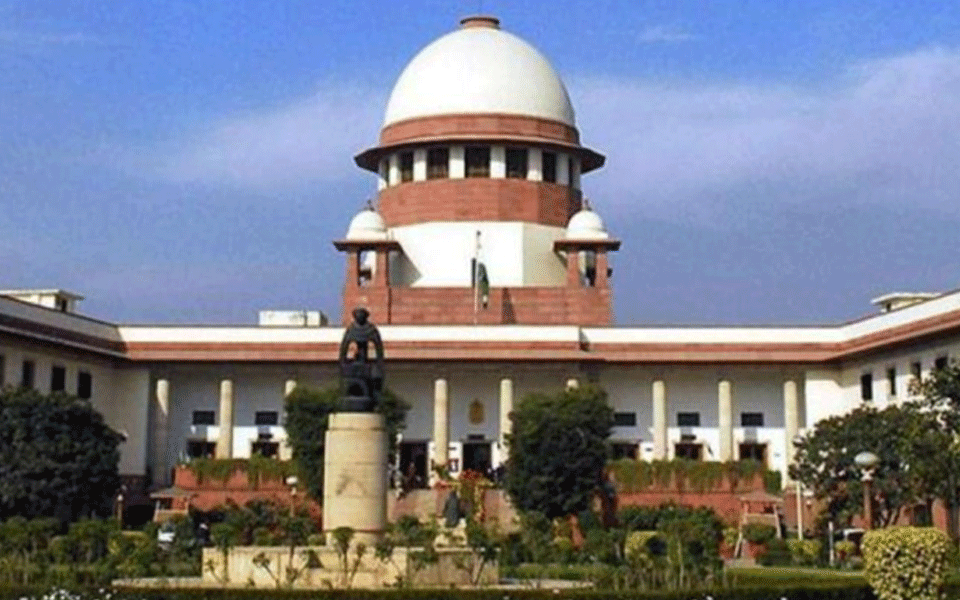
New Delhi (PTI): The Supreme Court on Tuesday reserved its verdict on a batch of pleas challenging the validity of the 103rd Constitution amendment providing 10 per cent reservation to economically weaker sections (EWS) persons in admissions and government jobs.
A five-judge Constitution bench headed by Chief Justice Uday Umesh Lalit reserved the verdict on the legal question of whether the EWS quota violated the basic structure of the constitution after hearing a battery of senior lawyers including Attorney General K K Venugopal and Solicitor General Tushar Mehta in the marathon hearing that lasted for six-and-half-day.
Academician Mohan Gopal had opened the arguments in the case before the bench, which also comprised Justices Dinesh Maheshwari, S Ravindra Bhat, Bela M Trivedi, and J B Pardiwala, on September 13 and opposed the EWS quota amendment by terming it as "deceitful and a backdoor attempt" to destroy the concept of reservation.
Senior lawyers including Ravi Verma Kumar, P Wilson, Meenakshi Arora, Sanjay Parikh, and K S Chauhan and advocate Shadan Farasat also assailed the quota, saying it also excluded the poor belonging to the Scheduled Castes (SCs), Scheduled Tribes (STs), and Other Backward Classes (OBCs) categories, and defeats the creamy layer concept.
Tamil Nadu, represented by senior advocate Shekhar Naphade, also opposed the EWS quota, saying the economic criteria cannot be the basis for classification and the top court will have to revisit the Indira Sawhney (Mandal) judgement if it decides to uphold this reservation.
On the other hand, the attorney general and the solicitor general vehemently defended the amendment, saying the reservation provided under it was different and had been given without disturbing the 50 per cent quota meant for the socially and economically backward classes (SEBC).
Hence, the amended provision does not violate the basic structure of the Constitution, they said.
The solicitor general argued in detail about the state's power to take affirmative action to elevate the poor among the general category and said the constitutional amendment strengthens the basic feature of the Constitution and its validity cannot be tested on grounds of some statistics.
He said the EWS quota was "necessitated" to benefit the general category poor, a "large segment" of the population not covered under any existing reservation scheme.
Senior advocate Gopal Sankarnarayanan, appearing for NGO 'Youth for Equality', supported the EWS quota scheme, contending it was long overdue and a right step in the right direction.
The top court heard as many as 40 petitions and most of the pleas, including the lead one filed by 'Janhit Abhiyan' in 2019, challenged the validity of the Constitution Amendment (103rd) Act 2019.
The Central government had filed some petitions seeking the transfer of pending cases, challenging the EWS quota law, from various high courts to the apex court for an authoritative pronouncement.
The bench, on September 8, had framed three broad issues for adjudication arising from the pleas challenging the Centre's decision to grant 10 per cent reservation to EWS in admissions and jobs.
The bench had said the three issues suggested by the attorney general for the decision "broadly" covered all the aspects relating to the petitions on the constitutional validity of the decision to grant the reservation.
"Whether the 103rd Constitution amendment Act can be said to breach the basic structure of the Constitution by permitting the State to make special provisions, including reservation, based on economic criteria," read the first issue framed.
The second legal question was whether the constitutional amendment could be said to breach the basic structure by permitting the state to make special provisions concerning admissions to private unaided institutions.
"Whether the 103rd Constitution amendment can be said to breach the basic structure of the Constitution in excluding the SEBCs/OBCs, SCs/STs from the scope of EWS reservation," the third issue, to be adjudicated upon by the bench, read.
The doctrine of basic structure was propounded by the top court in 1973 while deciding the Keshavananda Bharati case. It was held that Parliament could not amend every bit of the Constitution, and aspects such as rule of law, separation of powers, and judicial freedom formed part of the "basic structure" of the Constitution and hence, could not be amended.
The Centre, through the 103rd Constitutional Amendment Act, 2019, introduced the provision for Economically Weaker Sections (EWS) reservation in admissions and public services.
Earlier, the Centre, in 2019, had also told the apex court that its law, granting a 10-per cent quota for Economically Weaker Sections (EWSs), was brought in to promote "social equality" by providing "equal opportunities in higher education and employment to those who have been excluded by virtue of their economic status".
The Lok Sabha and the Rajya Sabha cleared the bill on January 8 and 9 in 2019 respectively and it was then signed by then President Ram Nath Kovind. The EWS quota is over and above the existing 50 per cent reservation to SCs, STs, and Other Backward Classes (OBCs).
Let the Truth be known. If you read VB and like VB, please be a VB Supporter and Help us deliver the Truth to one and all.
Sujit Nair raises concerns over speculation of DMK-AIADMK understanding to block TVK
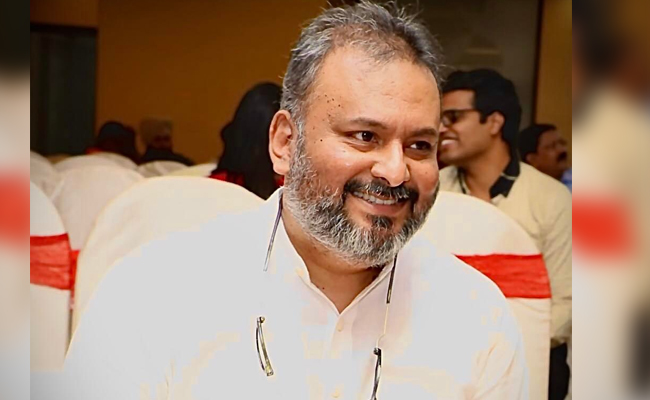
Chennai: Journalist and political commentator Sujit Nair has expressed concern over speculation that the Dravida Munnetra Kazhagam and the All India Anna Dravida Munnetra Kazhagam could explore a post-poll understanding to prevent Vijay-led Tamilaga Vettri Kazhagam from forming the government in Tamil Nadu.
In a social media post, Sujit Nair said the election verdict in Tamil Nadu reflected a clear public demand for political change and argued that the mandate should be respected irrespective of political preferences.
Referring to reports and political discussions surrounding a possible understanding between the DMK and AIADMK, he said he hoped such developments remained only speculative conversations and did not turn into reality.
Nair stated that if such an alliance were to take shape, it would raise serious questions about ideological politics in the country. He said TVK had emerged through a democratic electoral process and that the legitimacy to govern in a parliamentary democracy comes from the people’s verdict.
According to him, attempts to prevent an electoral winner from forming the government through unexpected political arrangements may be constitutionally valid, but many people could view them as politically opportunistic.
He further said that such a move could particularly affect the political image of the DMK, which has historically projected itself around ideology, social justice and opposition politics. Nair said that in ideological terms, the DMK appeared closer to TVK than to the AIADMK, and joining hands with its long-time political rival only to remain in power could weaken its broader political narrative.
He added that the same questions would apply to the AIADMK as well, as the party had spent decades positioning itself against the DMK and such an arrangement could create discomfort among its cadre and supporters.
Drawing a comparison with Maharashtra politics in 2019, Nair said he had expressed similar views when the Shiv Sena formed an alliance with the Indian National Congress and the Nationalist Congress Party after the Assembly elections.
He said post-poll alliances between long-standing political rivals often create a public perception that ideology and electoral mandates become secondary when political power equations come into play.
Nair also said such developments increase public cynicism towards politics and reinforce the belief among voters that ideology is often sidelined after elections.
He maintained that the Tamil Nadu verdict was emphatic and said respecting both the spirit and substance of the mandate was important for the credibility of democratic politics.