SC says no to plea against selection of Delhi Waqf Board administrator
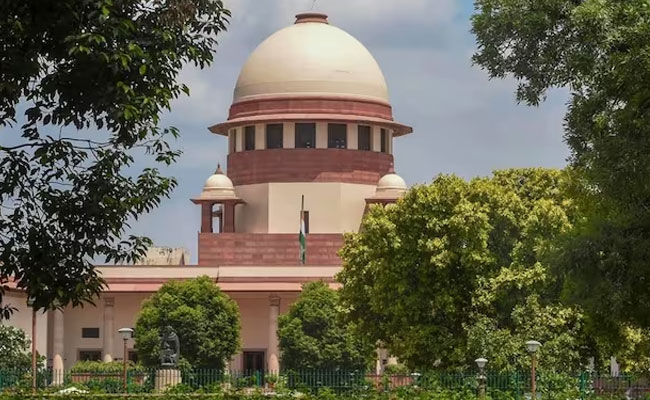
New Delhi (PTI): The Supreme Court on Monday refused to examine a plea against the appointment of Delhi government’s Principal Secretary (Home) Ashwani Kumar as the Delhi Waqf Board administrator on January 10.
A bench of Justices M M Sundresh and Rajesh Bindal asked the petitioner to move the Delhi High Court.
The top court was hearing a plea filed by one Zameer Ahmad Jumlana seeking directions to restrain and prohibit Kumar from discharging functions as the administrator of the Delhi Waqf Board and to vacate the office with immediate effect.
Lieutenant Governor (LG) V K Saxena, who approved Kumar's appointment, also okayed the appointment of IAS officer Azimul Haque as Delhi Waqf Board's CEO on January 3.
The petition alleged the term of the Delhi State Waqf Board expired on August 26, 2023, and since then no board was constituted.
The plea contended in the absence of the board, its powers were taken over by the LG by appointing Kumar purportedly using the powers under Section 99 of the Waqf Act, 1995.
"When the tenure of the board has lapsed on August 26, 2023, there is no question of exercise of any power of the state government under Section 99 of the Waqf Act 1995 to take over the board. Thus, the respondent number 1 is an usurper of the power of the Delhi State Waqf Board,” it said.
According to the petition, Kumar was not eligible under the Waqf Act of 1995 and took advantage of the fact that the Delhi Waqf Board was in an indefinite abeyance due to the negligence of the respondents.
On May 28, the Delhi High Court dismissed a similar plea filed by one Yasmin Ali and imposed Rs 10,000 costs.
The high court said the plea was publicity-oriented and an abuse of the process of law as it did not give any valid reasons for quashing the appointment of the city government officer as the administrator of the board.
Let the Truth be known. If you read VB and like VB, please be a VB Supporter and Help us deliver the Truth to one and all.
Kerala: Blast at fireworks unit rips through paddy field, leaving death, devastation
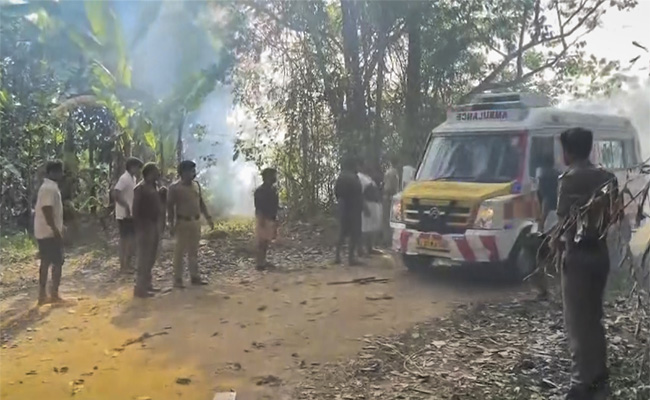
Thrissur (Kerala) (PTI): Scenes from a powerful explosion at a fireworks unit in Mundathicode were heartbreaking, as rescuers—mostly residents—described how the blast tore through a quiet paddy field, killing at least 12 people, injuring several others, and leaving widespread destruction.
Columns of thick black smoke rose high into the sky from a cluster of temporary sheds erected in the middle of the field, where firecrackers were being prepared for a local annual festival known for its spectacular fireworks and percussion ensembles.
A routine workday quickly descended into chaos at around 3.30 pm.
Firefighters and rescue personnel who rushed to the isolated site were forced to stop midway as intermittent explosions continued, sending shockwaves across the area.
Unable to approach, they sprayed water from a distance, waiting for the blasts to subside before moving in.
Television visuals and eyewitness accounts painted a grim picture—residents, among the first to reach the spot, were seen carrying the injured across uneven, slushy terrain and collecting scattered human remains.
“Parts of bodies were lying scattered. We helped gather them and send them to hospitals,” said a local man, his voice trembling.
Officials said around 40 workers were believed to have been present at the unit at the time of the explosion, many of whom suffered burn injuries, several of them critical.
The injured were rushed to hospitals, mainly the Government Medical College, Thrissur, as ambulances shuttled between the remote site and medical facilities.
Wilson, one of the surviving workers, recalled the terrifying moment.
“There was a sudden flash beside me and then fire… after that, I don’t remember anything,” he said. He maintained that all workers at the unit were Malayalees and that no migrant labourers were employed.
According to him, the unit had been operating in compliance with safety norms.
“There was nothing illegal. Maybe the extreme heat or direct sunlight on the gunpowder triggered the fire,” he said.
Residents said the fireworks unit had functioned in the area for years without incident, making the scale of Tuesday’s tragedy even more shocking. The sound of the explosion was heard kilometres away, and some nearby houses reportedly suffered damage.
Even hours after the initial blast, occasional explosions and the risk of igniting stored firecrackers continued to hamper rescue operations, with fire and police personnel proceeding cautiously through the debris.
As smoke slowly cleared over the once tranquil fields, festive anticipation surrounding the Pooram gave way to grief, with families anxiously awaiting news of their loved ones and authorities struggling to ascertain the exact toll in what is among the worst such accidents in the region in recent times.