'Her loose tongue set entire country on fire': SC slams Nupur Sharma over Prophet remark

New Delhi(PTI): The Supreme Court on Friday came down heavily on suspended BJP leader Nupur Sharma for her controversial comments against the Prophet, saying her "loose tongue" has "set the entire country on fire" and asked her to immediately apologise to the nation for her remarks.
Refusing to entertain Sharma's plea for clubbing of FIRs lodged in various states against her for the remark, the bench held that the comment was made either for cheap publicity, political agenda or some nefarious activities.
"She actually has a loose tongue and has made all kinds of irresponsible statements on TV and set the entire country on fire. Yet, she claims to be a lawyer of 10 years standing... She should have immediately apologised for her comments to the whole country," the court said.
Sharma's remark against the Prophet, made during a TV debate, triggered protests across the country and invited sharp reactions from many Gulf countries. The BJP subsequently suspended her from the party.
"These remarks are very disturbing and smack of arrogance. What is her business to make such remarks? These remarks have led to unfortunate incidents in the country...These people are not religious. They do not have respect for other religions. These remarks were made for cheap publicity or political agenda or some other nefarious activities , the bench said.
While refusing to entertain Sharma's plea for clubbing of FIRs, a vacation bench of Justices Surya Kant and JB Pardiwala allowed her to withdraw the plea.
"She has a threat or she has become a security threat? The way she has ignited emotions across the country this lady is single-handedly responsible for what is happening in the country," the bench said when Sharma's lawyer Maninder Singh pointed out that she was facing threats to life.
The bench further said," the way she ignited emotions across the country has led to unfortunate incidents. This lady is single-handedly responsible for what is happening in the country. We saw the debate".
The court's observations against the suspended BJP leader come in the backdrop of the brutal murder of a tailor in Udaipur by two men, who had posted videos online, claiming that they were avenging an insult to Islam.
Senior advocate Singh, appearing for Sharma, said she had apologised for her remarks.
The bench said,"her apology came too late and that too conditionally saying if religious sentiments are hurt and so on. She should have been on TV immediately and apologised to the nation".
The court said her petition smacks of arrogance and that she thinks that the magistrate of the country is too small for her. Singh said Sharma was a spokesperson of a political party and her unintentional comments were in relation to a debate.
"If you are a spokesperson of a party, it is not a license to say things like this", the bench said, adding, "if there was a misuse of the debate, the first thing she should have done was to file an FIR against the anchor".
Singh said she had reacted to the debate initiated by other debators and pointed to the transcript of the debate.
The bench said, "what was the TV debate for? Was it to fan an agenda and why did they choose a sub-judice topic?"
Referring to various apex court verdicts, Singh said there cannot be a second FIR on the same cause of action. Justice Kant said she has remedy before the high court and can very well approach it, if there is a second FIR.
Singh then referred to the Arnab Goswami case, and said the law has been laid down by the apex court.
The bench said,"the case of a journalist expressing his right on a particular issue is on a different pedestal from a spokesperson of a political party who is lambasting others with irresponsible statements without thinking of the consequences".
Singh said she has joined the investigation being conducted by the Delhi Police and not running away.
The bench said, "What has happened in the investigation so far? What has Delhi Police done so far? Don't make us open our mouths? They must have put a red carpet for you."
After the hearing for nearly 30 minutes, the bench said it is not convinced with her bonafide and refused to entertain the petition.
Let the Truth be known. If you read VB and like VB, please be a VB Supporter and Help us deliver the Truth to one and all.
K’taka HC asks Centre to examine broadcasts, digital content on media trial against actor Darshan
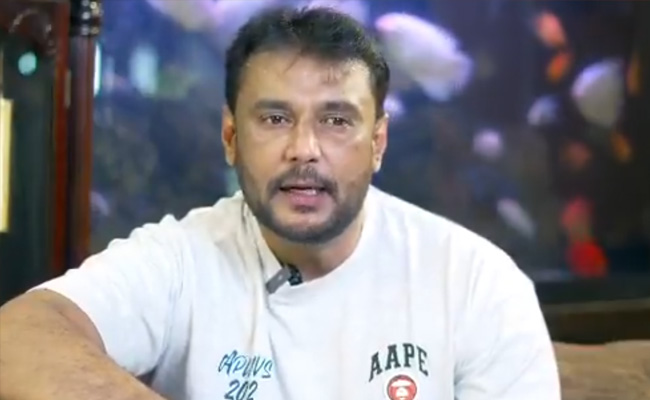
Bengaluru (PTI): The High Court of Karnataka has directed the Ministry of Information and Broadcasting and the Ministry of Electronics and Information Technology to examine broadcasts and digital content related to Kannada actor Darshan in connection with the Renukaswamy murder case.
It has also asked them to take necessary action if any violations of the rules are found.
Darshan and his friend, actress Pavithra Gowda, are among the 17 accused in the Renukaswamy murder case. He is currently lodged in jail under judicial custody.
“Respondent Nos. 1 and 2 (Ministries) are directed to forthwith examine the impugned broadcasts and digital content relating to the petitioner and the subject crime. Upon being satisfied that the same are violative of Rule 6 of the Programme Code framed under the Cable Television Networks (Regulation) Act, 1995, they shall take immediate action in accordance with Sections 19 and 20 of the Act,” Justice Sachin Shankar Magadum said in his order dated April 30, while partly allowing the petition.
“This may include regulating, suspending, prohibiting, or directing discontinuance of such telecast, broadcast, streaming, or dissemination, pending inquiry and final consideration of the complaint,” he added.
Darshan, in his petition, had claimed that he is aggrieved by a sustained and targeted media campaign in connection with the murder case.
He said that despite the trial being at a nascent stage, various television channels and digital platforms have indulged in media-driven adjudication, disseminating speculative narratives, selectively leaked materials, and unverified allegations, thereby shaping public perception and impairing the petitioner’s right to a fair trial.
Despite judicial interdictions, the petitioner alleged that the media continues to telecast content in violation of statutory provisions and binding court orders.
The court said the material placed on record, particularly the clippings produced, unfortunately, depicts a disturbing trend wherein the broadcast media has gone to the extent of recreating courtroom proceedings, with only the face of the presiding judge masked, while the faces of the accused and counsel are openly displayed.
Such programmes are telecast on every date of hearing, thereby converting pending judicial proceedings into a form of public spectacle, it said.
The judge said, “This Court cannot but observe that such conduct amounts to a calculated media-driven adjudication, fostering a parallel narrative and engendering prejudicial pre-trial publicity. The continued telecast of such content, in the teeth of subsisting injunction orders, reflects a blatant disregard for judicial authority and contributes to the creation of a ‘carnival atmosphere of justice.’”
By virtually staging courtroom scenes and projecting selective narratives, the media not only risks subverting due process but also erodes adjudicatory neutrality, impairing the petitioner’s right to a fair trial, he said.
The court further said that the material on record discloses violations of the Programme Code under the Cable Television Networks (Regulation) Act, the Contempt of Courts Act, and the Information Technology Act and Rules.
“The material on record discloses prima facie violations of statutory provisions and judicial orders. The ongoing media narrative poses a serious threat to the petitioner’s right to a fair trial under Article 21,” it said.
“Freedom of speech is a cherished constitutional value; however, when it degenerates into media-driven adjudication, it ceases to be a safeguard of democracy and becomes a threat to it,” the judge said.
“The press is a watchdog, but when it assumes the role of judge, jury, and executioner, the rule of law stands imperilled. Courts cannot permit the course of justice to be overshadowed by the glare of studio lights,” he added.
The court has also asked the ministries to examine the necessity of prohibition of broadcast, suspension or revocation of permissions or licences, imposition of penalties, and initiation of such further statutory proceedings as are permissible in law; to conduct an inquiry into the alleged violations of the Programme Code and pass appropriate orders.
It has directed them to file a compliance report before the court within twelve weeks.
The judge also stated that liberty is reserved to the petitioner to initiate appropriate proceedings under the Contempt of Courts Act, 1971, if so advised.