SC slaps Rs 5 lakh cost on man for challenging 'defective oath' taken by CJ of Bombay HC
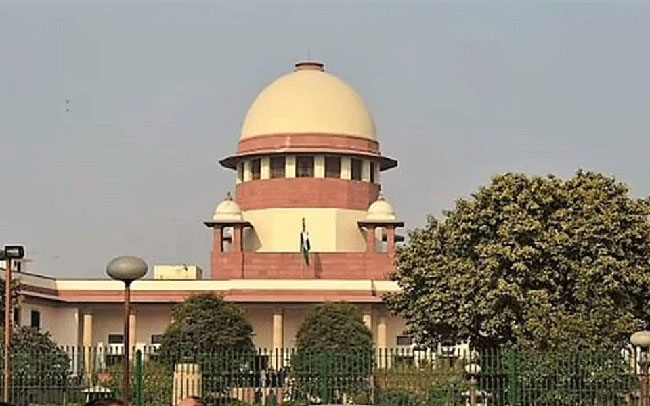
New Delhi(PTI): The Supreme Court has imposed a cost of Rs 5 lakh on a man for claiming in a PIL that the oath taken by the Bombay High Court chief justice was "defective", and said it was a frivolous attempt to gain publicity.
A bench headed by Chief Justice DY Chandrachud said the oath having been administered by the Governor and having been subscribed to after the administration of the oath, such objections cannot be raised.
The top court said this was only a frivolous attempt to use the PIL jurisdiction to propagate some publicity for the petitioner.
"The petitioner does not, as he possibly cannot, dispute that the oath of office was administered to the correct person. The oath having been administered by the Governor and having been subscribed to after the administration of the oath, such objections cannot be raised.
"We are clearly of the view that such frivolous PILs occupy the time and attention of the Court thereby deflecting the attention of the court from more serious matters and consuming the infrastructure of the judicial manpower and Registry of the Court," the bench also comprising Justice JB Padriwala and Justice Manoj Misra said.
It said the time has come when the court should impose exemplary costs in such frivolous PILs.
"We accordingly dismiss the petition with costs of Rs 5,00,000, which shall be deposited by the petitioner in the Registry of this Court within a period of four weeks," the bench said.
The apex court said that if the cost is not deposited within the aforesaid period, the same shall be collected as arrears of land revenue through the Collector and District Magistrate at Lucknow.
The top court was hearing a PIL filed by Ashok Pandey contending that he is aggrieved by what he described as a 'defective oath' administered to the Chief Justice of the High Court of Judicature at Bombay.
The petitioner stated that the Chief Justice did not use the expression "I" before his name while taking the oath, in contravention of the Third Schedule of the Constitution. He also contended that the representatives and administrator of the Government of the Union Territory of Daman and Diu and Dadar and Nagar Haveli were not invited to the oath ceremony.
Let the Truth be known. If you read VB and like VB, please be a VB Supporter and Help us deliver the Truth to one and all.
AIITA welcomes Karnataka’s ban on obscene songs in school events

Bhatkal: The Karnataka unit of the All India Ideal Teachers Association (AIITA) has welcomed the Karnataka government’s decision to strictly ban school children from dancing to obscene songs during educational and cultural programmes in government, aided, and private schools across the state.
AIITA Karnataka State President M. R. Manvi congratulated the government for taking what he termed an important step to preserve the sanctity of education.
“Such decisions to safeguard the dignity of school children and uphold the values of education are the need of the hour. This rule should not be limited to government schools alone but must be strictly implemented in all private educational institutions as well,” he said.
He further urged the government to address other concerns within school programmes.
“The government should not only prohibit obscene dances in the name of school anniversaries, but also ensure that plays and dialogues that incite religious hatred are avoided. Schools should be centres of harmony, not platforms for spreading hatred,” he added.
According to a recent circular issued by the Department of School Education and Literacy, obscene dances are adversely affecting the mental health and moral values of students.
In this regard, schools have been advised to use songs that promote nationalism, positive thinking, the greatness of Kannada culture, and value-based traditions instead of inappropriate content during programmes.
The circular also emphasises that students should be dressed in decent attire.
AIITA also backed the department’s warning that disciplinary action would be taken against head teachers if such guidelines are violated. The association has further demanded that district Deputy Directors of Public Instruction strictly monitor the implementation of these rules.