SC stays Delhi HC order on feeding of stray dogs
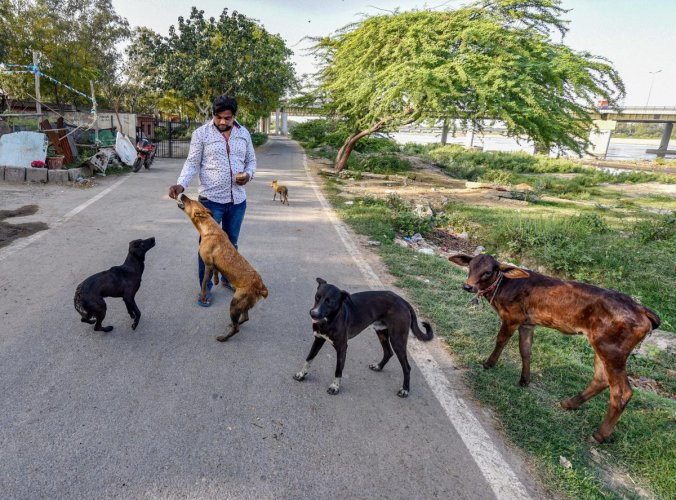
New Delhi, Mar 5: The Supreme Court has stayed a Delhi High Court order which laid down guidelines regarding feeding of stray dogs while observing that citizens have the right to feed community canines.
A bench of Justices Vineet Saran and Aniruddha Bose issued notices to the Animal Welfare Board of India, Delhi government and others on an appeal filed by an NGO against the High Court order.
"Issue notice, returnable in six weeks. Meanwhile, operation of the impugned order shall remain stayed," the bench said.
The top court was hearing an appeal filed by the Humane Foundation for People & Animals challenging the June 24, 2021 order of the High Court.
The NGO contended that the High Court's directions can lead to an increase in the menace of stray dogs.
"A dog under human supervision and control and dependent on its human caretakers for all of its needs can be prevented from biting and attacking people and other animals by physical restraint, confinement to private property and suppressing aggressive tendencies with care and training. This is not the case with stray dogs, therefore feeding in societies, streets or at any public places is a direct risk to citizens," the NGO said.
The High Court had said stray dogs have the right to food and citizens have the right to feed community canines while observing that in exercising this right, care and caution should be taken to ensure that it does not impinge upon others and causes no harassment or nuisance.
The High Court, while laying down guidelines regarding feeding of stray dogs, had said every dog is a territorial being and it has to be fed and tended to at places within their territory which is not frequented by the general public.
Any person having compassion for stray dogs can feed them at their private entrance or driveway of their house or any other place not shared with other residents but no one can restrict the other from feeding dogs, until and unless it is causing harm or harassment to them, it had said.
"Community dogs (stray/street dogs) have the right to food and citizens have the right to feed community dogs but in exercising this right, care and caution should be taken to ensure that it does not impinge upon the rights of others or cause any harm, hindrance, harassment and nuisance to other individuals or members of the society," the High Court had said.
It had said that street dogs perform the role of community scavengers and also control rodent population in the area, thus preventing spread of diseases like leptospirosis and they also provide companionship to those who feed them and act as their stress relievers.
Let the Truth be known. If you read VB and like VB, please be a VB Supporter and Help us deliver the Truth to one and all.
Congress using hijab issue to pacify minority anger, alleges Karnataka LoP R Ashoka

Bengaluru: Leader of Opposition in the Assembly R. Ashoka has accused the Congress government of using the hijab issue to placate what he described as discontent among minority voters after the Davanagere by-election.
In a post on X on Wednesday, Ashoka alleged that the state government, instead of addressing issues such as price rise, corruption, farmers’ distress and law and order, was attempting to retain its minority vote base by reviving the hijab issue.
Referring to the 2022 dress code introduced by the BJP government, which prohibited hijab in schools and colleges, Ashoka said the Karnataka High Court had upheld the policy and emphasised the importance of discipline in educational institutions.
He questioned the Congress government’s move to revisit the issue and asked whether setting aside the court-backed policy to benefit one community could be described as secularism.
Ashoka further alleged that while the government was willing to permit hijab, it continued to prohibit saffron shawls.
He accused the government of dividing students on religious lines rather than treating schools and colleges as spaces of equality.
Drawing a comparison with Mamata Banerjee’s government in West Bengal, Ashoka claimed that excessive appeasement politics had harmed the state and warned that the Congress in Karnataka could face a similar political response.
He said voters in Karnataka would teach the Congress a lesson for what he termed “vote-bank politics” and for compromising constitutional and judicial principles.