SC stays Rajasthan HC order for removal of liquor vends within 500 metres of national/state highways
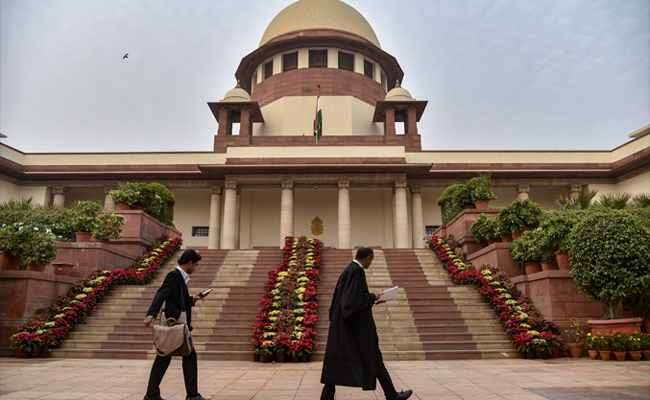
New Delhi (PTI): The Supreme Court on Monday stayed the Rajasthan High Court's order directing the state to remove or relocate all liquor shops within a 500-metre limit from national or state highways due to a surge in fatal road accidents.
A bench of Justices Vikram Nath and Sandeep Mehta, which issued notice on multiple pleas filed by liquor vendors and Rajasthan government, however, said that the high court's "concern was genuine" and the government may consider it while formulating its liquor policy in future.
"Issue notice. The effect and operation of the impugned order is stayed," the top court ordered.
Solicitor General Tushar Mehta, appearing for the state government, said that the apex court had earlier directed that there should not be any liquor vends within 500 metres of national and state highways, but a problem arose where these roads passed through the city.
"The order was later clarified that within municipal limits, there would not be any such ban on liquor shops," he said.
Senior advocate Mukul Rohatgi, appearing for liquor vends owners, said that the high court erred in passing the order without hearing the parties, and sought a stay on the directions.
He submitted that the high court was dealing with an issue pertaining to one village Sujangarh but went on to pass an order qua the entire state without even hearing other parties.
Justice Mehta said that the high court exercises jurisdiction throughout the state.
Rohatgi contended that the high court's view was contrary to the Supreme Court's direction that there was no such ban within municipal limits. "But the (HC) judge still says there will be a ban, irrespective of the apex court's direction," he said.
On November 24, 2025, the Jodhpur bench of the high court, taking note of the increasing number of accidents on the highways on account of alcohol consumption, directed the state to remove or relocate all liquor shops falling within the restricted limit of 500 metres from a national or state highway, within two months, irrespective of them falling under any municipal areas, local self-governing bodies or statutory development authorities.
It had also come down heavily upon the state for misusing the limited discretionary leverage granted by the apex court in granting permissions to liquor shops along the national and state highways.
The high court passed the order on a PIL filed in 2023 that highlighted a steep rise in the cases of drunken driving in Rajasthan.
It referred to the 2016 verdict of the apex court in the case of State of Tamil Nadu versus K Balu in which it was directed that no liquor shops shall be situated within 500 metres of the outer edge of a national or state highway.
However, in 2017, the apex court clarified that the order did not prohibit licensed liquor vends within the municipal areas and discretion was given to the state to determine whether the same principle should be extended to areas covered by local self-governing bodies and statutory development authorities.
The Rajasthan government has filed an affidavit in the high court stating that the state had permitted the operation of 1,102 liquor shops alongside national and state highways as they fall within municipal areas or local bodies and contribute Rs 2221.78 crore in revenue.
Taking note of the affidavit, the high court had said that the constitutional objective of safeguarding public life and safety cannot be subordinated to revenue considerations, and a careful balance must be struck wherein fiscal interests do not override the paramount requirement of protecting human life and ensuring road safety.
"This court expresses extreme concern regarding the manner in which the directions of the apex court have been diluted and the discretion granted to the state government has been misutilised.
"The admitted operation of 1102 liquor shops on national and state highways effectively nullifies the safety objective underlying the apex court's orders, as well as the road-safety considerations repeatedly emphasised by this court. Such deviation cannot be countenanced, particularly when the state is already witnessing alarming road-accident statistics," it had said.
Let the Truth be known. If you read VB and like VB, please be a VB Supporter and Help us deliver the Truth to one and all.
Prasoon Joshi appointed chairman of Prasar Bharati
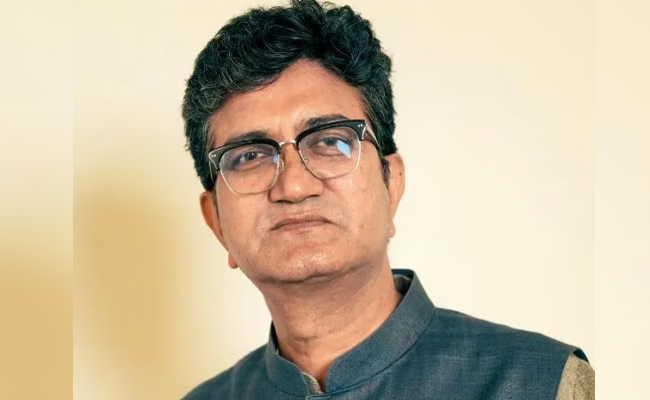
New Delhi (PTI): Noted lyricist, writer and communications expert Prasoon Joshi has been appointed as the chairman of Prasar Bharati, India's public service broadcaster.
The Ministry of Information & Broadcasting appointed Joshi to the key post, according to an official statement on Saturday.
Joshi, a distinguished creative professional with wide-ranging contributions across literature, advertising, cinema, and public communication, and known for his impactful writing and deep cultural sensibility, has played a significant role in shaping contemporary Indian media narratives, the statement said.
Joshi's body of work spans acclaimed film lyrics, advertising campaigns, and socially resonant storytelling that connects with diverse audiences across the country.
On his appointment, Union Minister of Information & Broadcasting Ashwini Vaishnaw said, "My heartfelt congratulations to Shri Prasoon Joshi ji on his appointment as chairman of the Prasar Bharati Board. Prasoon ji is a rare creative spirit celebrated across the world in advertising, literature, art and cinema, yet his heart beats unmistakably for India."
Vaishnaw said Joshi's words carry the fragrance of the country's soil, and his vision reflects the timeless essence of Indian culture.
"Under his stewardship, Prasar Bharati will discover renewed energy, deeper purpose, and a fresh creative voice. My very best wishes to him for a memorable and meaningful tenure ahead," the minister said.
Before this appointment, Joshi has served as chairperson, Central Board of Film Certification (CBFC), Mumbai since August 2017.
He contributed to strengthening film certification processes while engaging with stakeholders across the film industry and his tenure at CBFC reflected a balanced approach towards creative expression and regulatory responsibility, the statement said.
Earlier, he had also served as CEO, McCann World Group India and Chairman, McCann World Group Asia Pacific (a subsidiary of McCann Erickson). Joshi is also one of the Trustees of Indira Gandhi National Centre for Arts since 2016.
With his extensive experience in creative industries and public communication, Joshi is expected to bring a unique perspective to the leadership of Prasar Bharati at a time when public broadcasting is navigating rapid technological transformation and evolving audience expectations, it said.
Established under the Prasar Bharati (Broadcasting Corporation of India) Act, 1990, and operational since 1997, Prasar Bharati is India's statutory autonomous public service broadcaster.
It comprises two major divisions: All India Radio (AIR)-- one of the largest radio networks in the world, reaching millions across urban and rural India in multiple languages and dialects; and Doordarshan (DD) -- India's national television broadcaster, offering a wide range of programming including news, education, entertainment, and cultural content.