Is there no law left in country: SC on non-compliance of order asking telcos to pay Rs 1.47 lakh cr
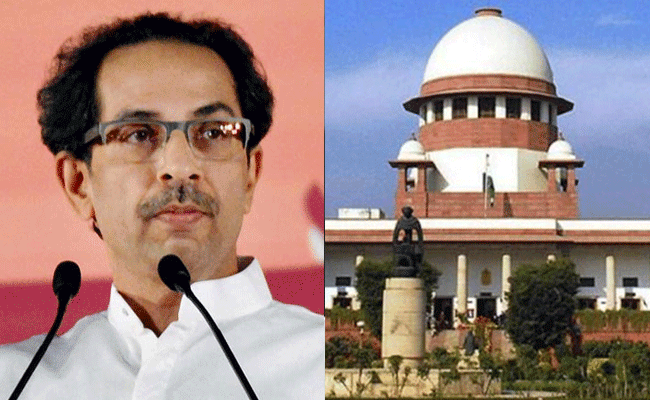
New Delhi: Is there no law left in the country, an "anguished" Supreme Court asked on Friday while directing the top echelons of telecom firms to explain why contempt action should not be taken against them for non-compliance of its order to pay adjusted gross revenue of Rs 1.47 lakh crore to the telecom department.
Taking strong note of the non-compliance of its order, the top court expressed displeasure over an order passed by the Department of Telecom's desk officer staying the effect of its verdict in the adjusted gross revenue (AGR) matter.
It said a desk officer wrote a letter to Attorney General K K Venugopal and other constitutional authorities, saying they should not insist on payment of money by telcom companies and others and to ensure that no coercive action was taken against them.
Hearing pleas filed by Vodafone Idea, Bharti Airtel, and Tata Teleservices seeking more time for payment of AGR related dues, the apex court expressed serious displeasure as to how a desk officer can pass such an order which stays the effect of the apex court's judgment.
"How can a desk officer do this to the Supreme Court's order. Is this the law of the country. Is this the way you treat the courts," the three-member Supreme Court bench said.
Justice Arun Mishra, who was heading the bench, said, "We don't know who is creating this nonsense. Who is generating all this? Is there no law left in the country? I am literally anguished. I feel I should not work in this court and in this system. I am very anguished. I am saying this with full sense of responsibility."
"I don't get angry like this, but I am totally lost how to work in this system and this country," he said.
Solicitor General Tushar Mehta tendered an apology before the bench also comprising Justice S Abdul Nazeer and Justice M R Shah, and said the desk officer cannot do this.
"As the solicitor general of the country, have you asked him (desk officer) to withdraw this? This cannot be tolerated. We cannot function in this fashion. Let us wind up the Supreme Court if your desk officer has this audacity. News reports are being published. Who is sponsoring all this?" the bench asked.
"I never bother about myself. You don't understand me, not even an inch. Your desk officer is staying the Supreme Court order. Is he sitting over the Supreme Court? How?," Justice Mishra said, adding it was "better not to live in this country, rather leave it".
"We have to draw contempt against this man (desk officer) and also against these companies. How are they behaving? We had dismissed the review plea and not even a single penny has been deposited yet. The desk officer is staying our order. We are concerned with the health of judiciary, of this country and of this system," the bench said.
Mehta requested the bench to defer the matter and said action should not be taken right now and they would file an explanation about the desk officer.
"What kind of applications are being filed? What kind of mentioning is being made? If you want to avoid us, you do it and we will recuse," the bench said.
It observed that the companies have violated its order in substance and this shows that they have scant respect for the order of the Supreme Court.
Referring to the desk officer's letter to the attorney general, the apex court bench said, "This is nothing but a device to oblige the companies. This kind of order could not have been passed by a desk officer."
The bench directed the managing directors and directors of the all the telcos and companies concerned to appear before it on next date of hearing on March 17 and explain why they have not deposited the money and why coercive action should not be taken against them.
The apex court also asked the desk officer of DoT to explain why appropriate action should not be taken against him for his act. It said the officers in the country must know where to stop.
The telecom companies want to negotiate a fresh payment schedule with the Department of Telecommunications (DoT), which has issued demand notices to them.
On January 16, a bench headed by Justice Arun Mishra had dismissed review petitions of telecom firms seeking review of its earlier order asking them to pay Rs 1.47 lakh crore in statutory dues by January 23, saying it did not find any "justifiable reason" to entertain them.
The apex court had on October 24 last year ruled that the statutory dues need to be calculated by including non-telecom revenues in AGR of telcos. It had upheld the AGR definition formulated by the DoT and termed "frivolous" the nature of objections raised by the telecom service providers.
Let the Truth be known. If you read VB and like VB, please be a VB Supporter and Help us deliver the Truth to one and all.
How Indian AI Is Booming with GEOX AI Leading the Next Wave of Geolocation Intelligence
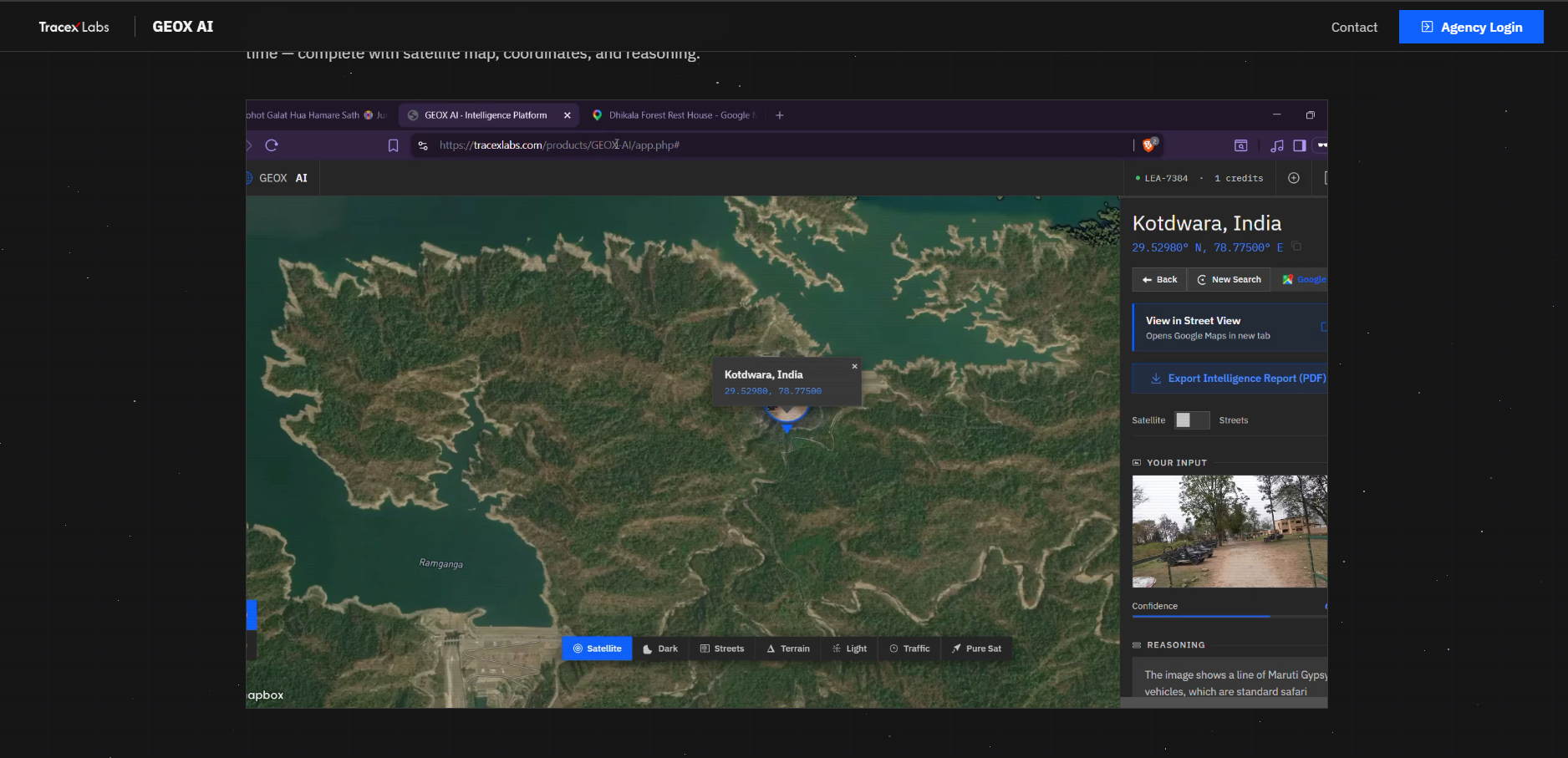
TraceX Labs has announced the launch of GEOX AI, an advanced artificial intelligence platform capable of identifying the real-world location where a photograph or video was taken using only the visual content within the media.
Positioned as an enterprise-grade intelligence solution, GEOX AI leverages advanced computer vision and multi-agent AI to analyze pixel-level details such as architecture, road patterns, vegetation, signage, lighting, and environmental context. By interpreting these visual clues, the system can estimate—and in many cases precisely determine—the origin of an image or video.
AI-Powered Geolocation Intelligence
Marketed under the concept of “Locate Anywhere From Any Image,” GEOX AI is designed for intelligence operations where speed, accuracy, and reliability are critical. The platform currently supports:
- 400+ analyses available
- <10 seconds average response time
- Up to 99% accuracy on landmark-based identification
- Global coverage across diverse terrains and environments
Core Capabilities
GEOX AI integrates multiple intelligence features into a single platform:
- Precise Geolocation:
Identifies exact geographic coordinates using visual landmarks, architecture, vegetation, and cultural indicators. - Satellite Map View:
Results are plotted on live satellite imagery with 2D/3D viewing options and multiple map styles for deeper analysis. - AI Reasoning Analysis:
Provides a detailed explanation of how the system arrived at a conclusion, including confidence scoring. - Multi-Result Analysis:
Returns multiple possible locations ranked by confidence, enabling cross-verification. - Intelligence PDF Export:
Allows one-click generation of professional reports containing maps, coordinates, analysis, and structured findings. - Credit-Based Access:
Agencies are allocated credits, with each analysis consuming one credit. Additional credits can be requested directly.
Speed Meets Intelligence
GEOX AI is designed to balance rapid processing with analytical depth:
- Fast Mode: Delivers results within seconds for clear and high-context images
- Advanced Mode: Performs deeper multi-step analysis for complex or ambiguous visuals
- Built for real-time decision-making in high-pressure environments
How GEOX AI Works
The platform follows a simple and efficient workflow:
- Upload any image or video frame
- AI analyzes visual clues such as structures, terrain, and environment
- The system identifies location with coordinates, confidence score, and reasoning
- Results are displayed on an interactive satellite map
- Export a professional intelligence report in one click
A Breakthrough for Investigations
GEOX AI is expected to have wide-ranging applications across multiple domains:
- Tracking the origin of images from social media and open sources
- Supporting digital forensics and cyber investigations
- Assisting law enforcement and intelligence operations
- Helping journalists and OSINT analysts verify visual content
- Providing support in missing person cases and threat intelligence scenarios
Enterprise Access and Deployment
GEOX AI is available to verified law enforcement agencies, intelligence organizations, and authorized enterprises. Access is provided through a structured system where organizations can request credentials and define their operational use cases.
Interested users can request access via tracexlabs.com or contact contact@tracexlabs.com, with response times typically within 24–48 hours.
Privacy Debate Intensifies
The launch of GEOX AI has also sparked renewed discussion around digital privacy. By demonstrating how location data can be extracted purely from visible elements within images, the platform highlights the potential risks associated with sharing photos online without considering what those visuals may reveal.
Conclusion
With GEOX AI, TraceX Labs is entering the rapidly evolving geolocation intelligence space with a platform that combines speed, precision, and real-world usability. As artificial intelligence continues to advance, tools like GEOX AI are expected to play a critical role in shaping the future of investigations, security, and digital intelligence.