SC terms as "unacceptable" contention that Article 370 ceased to operate after 1957
New Delhi, Aug 22: The Supreme Court Tuesday termed as "unacceptable" the submission that Article 370 of the Constitution ceased to operate once the term of the constituent assembly of Jammu and Kashmir ended in 1957 after drafting the state's Constitution.
The remark by a five-judge bench headed by Chief Justice DY Chandrachud came when senior advocate Dinesh Dwivedi, appearing for intervenor Prem Shankar Jha, argued that nothing of Article 370, which accorded special status to the erstwhile state, survived once the Constitution of J-K was enacted on January 26, 1957 and the term of the state's constituent assembly ended.
Jha, who has challenged the August 5, 2019 decision of the Centre to abrogate Article 370, raised the legal question about whether Article 370 ceased to operate or exist after the enactment of the Constitution of J&K and the dissolution of the constituent assembly.
This led the bench to raise queries on the legality of the submissions.
The bench, also comprising Justices Sanjay Kishan Kaul, Sanjiv Khanna, BR Gavai and Surya Kant told Dwivedi that the court has to look at the Indian constituent assembly debates and the intent of the makers of the Indian Constitution in a manner in which the Article 370 was framed.
"I am arguing somewhat differently from what my friends have argued. They want some part of Article 370 to survive. My argument is that nothing survives. All the powers conferred under Article 370, I would show, cease to operate once the Constitution of Jammu and Kashmir was enacted," Dwivedi said.
The CJI said the consequence of the argument will be that the Constitution of India and its application to Jammu and Kashmir would "stand frozen as of January 26, 1957".
"Therefore, no further development in Indian constitutional law can at all apply, according to you, to the state of Jammu and Kashmir after 1957. How can that be acceptable?" he said.
The bench told Dwivedi, "You are asking us to read what is not there in Article 370. Your submission is that it will be frozen after the constituent assembly of J-K frames the Constitution but that does not appear to be following. We have to look at the constituent assembly debates in a manner in which Article 370 was framed."
Dwivedi said when the Article was framed, Jammu and Kashmir was in turmoil and the only legal entity was the state government and, therefore, the provision said there should be "consultation and concurrence" on the matters related to Union and concurrent list and those which do not fall under the Instrument of Accession.
"The constituent assembly was about to be set up. Hence, all the decisions which were taken in consultation and concurrence with the state government were to be placed before the constituent assembly of J-K. Therefore, Article 370 was a temporary provision," he contended.
The senior lawyer said looking at the provision and the constituent assembly debates, it can be clearly inferred that Article 370 was temporary and ceased to exist after January, 1957.
The bench said what was being submitted was contrary to arguments advanced by others opposed to the abrogation as they said that the provision had acquired permanent status after the term of the state's constituent assembly ended.
"This is what is creating a problem. Perhaps our thinking in the manner which we have been tuned to think for the past 70 years is that there should be One Nation-One Constitution. But where is that prescribed? It should be prescribed in the Constitution which does not say so," the senior lawyer said.
CJI Chandrachud then asked can the court say that a speech made by a member of the constituent assembly, however weighty, represented the commitment of India to Jammu and Kashmir.
"This will have a bearing on the interpretation of the Constitution", the CJI said.
Justice Kaul also questioned Dwivedi on his line of argument and said according to him, Article 370 was a defunct provision and no purpose was served having it.
"Yet the provision continued to be there in the Indian Constitution. Constitution Orders (orders applying provisions of Indian Constitution to J-K) have been issued pre-1957 and post 1957. Yet nobody thought about removing it. The association of people with Article 370 was negatory and hence nothing survives. This is your argument?" Justice Kaul summed up Dwivedi's contentions.
Dwivedi told the bench that past practices would not justify the invalidity of a provision and this is a settled law.
"The law, as I understand, is that however long a past practice is if it is constitutionally illegal, it cannot be justified. What I am trying to show is the intent of our Constitution framers. We cannot read Article 370 dehors (other than) the intent is my question," he said.
Justice Kaul said it is difficult to accept that the constituent assembly debates amount to an assurance that Article 370 would dissolve itself after the Constitution of Jammu and Kashmir has been enacted and term of the state's constituent assembly comes to an end.
Senior advocate CU Singh, appearing for Mohammed Yousuf Tarigami and others challenged the enactment of the Jammu and Kashmir Reorganisation Act, 2019 and said the erstwhile state could not be divided into two union territories.
The hearing remained inconclusive and will continue on Wednesday.
Several petitions challenging the abrogation of the provisions of Article 370 and the Jammu and Kashmir Reorganisation Act, 2019, which split the erstwhile state into two union territories - Jammu and Kashmir, and Ladakh - were referred to a Constitution bench in 2019.
Let the Truth be known. If you read VB and like VB, please be a VB Supporter and Help us deliver the Truth to one and all.
Confident we are going to win Kerala: Shashi Tharoor
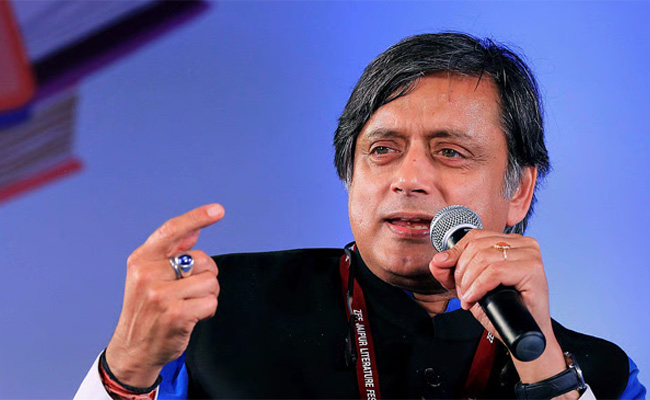
New Delhi (PTI): Congress leader Shashi Tharoor on Thursday expressed confidence in the victory of the United Democratic Front (UDF) in Kerala, saying the Congress-led alliance will win more than 75 seats out of the total 140 in the state.
Tharoor, who hails from Kerala, said he was not surprised to see the results of the exit polls, most of which predicted a victory for the UDF that has been out of power for 10 years in the state.
"We have been on the ground. I have campaigned in 59 constituencies across 12 districts out of 14. I was very confident we are going to win.
"Everything that I have picked up from not just my party colleagues and workers but also from other observers, media and others have always convinced me that we were going to score a comfortable win of above 75 seats. And all the (exit) polls have confirmed the same thing," he told reporters here.
The Thiruvananthapuram MP said he was not surprised to see the results of the exit polls but in general he was not a big fan of exit polls in India.
"Because ours is not purely a homogenous society. We have to take into account gender issue, caste issue, class issue, regional disparities. You never get a convincingly large enough sample to give an accurate poll and now there is the additional complication that we have heard about in West Bengal this year that many people are unwilling to answer the questions of the pollsters," he said.
The Congress leader said normally, it used to be below 10 per cent that people said that they would not answer.
"Even if you are a reputable exit pollster, in Bengal, one polling company has said 60 per cent of people refused to answer. So, what is the worth of a poll where 60 per cent of your respondents have not answered," he said.
Several exit polls on Wednesday predicted a comeback by the Congress-led UDF in Kerala after 10 years, dethroning the CPI(M)-led Left Democratic Front (LDF).
Polling for the 140-member Kerala assembly was held on April 9. Results of assembly elections in West Bengal, Tamil Nadu, Assam, Puducherry, besides Kerala, will be announced on May 4.