SC to examine if pleas challenging validity of sedition law needed examination by larger bench
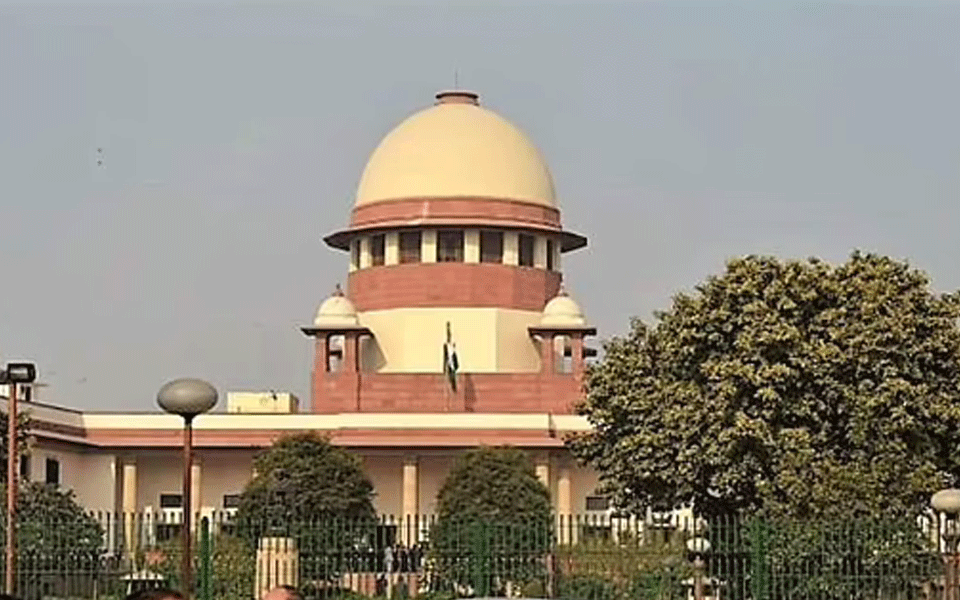
New Delhi(PTI): The Supreme Court on Thursday said it would hear arguments on May 10 on the legal question whether the pleas challenging the colonial era penal law on sedition be referred to a larger bench and granted time to the Centre to file its response.
A special bench comprising Chief Justice N V Ramana and Justices Surya kant and Hima Kohli, meanwhile, was told by Attorney General K K Venugopal, who was assisting in his personal capacity, that the misuse of the provision like it happened against a Maharashtra MP for reciting Hanuman Chalisa' has to be stopped by laying down guidelines.
However, there was no need to refer the five-judge bench verdict of the top court in the Kedar Nath case in 1962 to a bench of five or seven judges, the top most law officer said.
The apex court had upheld the constitutional validity of the sedition law in the Kedar Nath Singh case.
"Your lordships know what is happening in the country. Yesterday, somebody was detained under this Section just because they wanted to chant Hanuman Chalisa'. So guidelines have to be there, to prevent misuse. Referring the Kedar Nath verdict to a larger bench is not necessary. It is a well considered judgment, Venugopal said.
He was referring to MP Navneet Rana and her MLA husband Ravi Rana being booked for sedition in Maharashtra over the Hanuman Chalisa row.
Senior advocate Kapil Sibal, appearing as the lead counsel on behalf of the petitioners, said reference to a larger bench may not be necessary.
Sibal said a three judge bench can still go into the issue ignoring the 1962 judgement of the five-judge bench in the light of subsequent developments in the fundamental rights jurisprudence.
The bench commenced the hearing and heard arguments on a batch of pleas against the sedition law for some time before adjourning it to Tuesday.
At the outset, Solicitor General Tushar Mehta, appearing for the Centre, sought a few more days' time for filing the reply saying the draft response made by lawyers awaits approval by competent authority as the issue is of extreme importance.
Secondly, some fresh matters have been served recently and the contents of those pleas also needed response.
List this matter for next Tuesday at 2 pm. The Solicitor General to file a counter (affidavit) by Monday. No further adjournments (will be granted), the CJI said.
The bench, on April 27, had directed the Central government to file the reply saying it would commence the final hearing in the matter on May 5 and would not entertain any request for adjournment.
Concerned over the enormous misuse of the penal law on sedition, the top court in July last year had asked the Centre why it was not repealing the provision used by the British to silence people like Mahatma Gandhi to suppress the freedom movement.
Agreeing to examine the pleas filed by the Editors Guild of India and former Major General S G Vombatkere, challenging the Constitutionality of Section 124A (sedition) in the IPC, the apex court had said its main concern was the "misuse of law" leading to rise in number of cases.
The non-bailable provision makes any speech or expression that brings or attempts to bring into hatred or contempt or excites or attempts to excite disaffection towards the government established by law in India a criminal offence punishable with a maximum sentence of life imprisonment.
While issuing notice on the petitions in July last year, the top court had referred to the alleged misuse of the provision and had asked if the colonial era law was still needed after 75 years of Independence.
This dispute about law is concerning, it is a colonial law. It was meant to suppress the freedom movement. The same law was used by the British to silence Mahatma Gandhi, Tilak etc. Still, is it necessary after 75 years of Independence, the CJI had asked.
Some of the other petitioners include former union minister Arun Shourie and journalists Kishorechandra Wangkhemcha from Manipur and Kanhaiya Lal Shukla from Chhattisgarh.
Let the Truth be known. If you read VB and like VB, please be a VB Supporter and Help us deliver the Truth to one and all.
Compromised PM didn't sign trade deal with US, but a bargain for Adani's release: Rahul
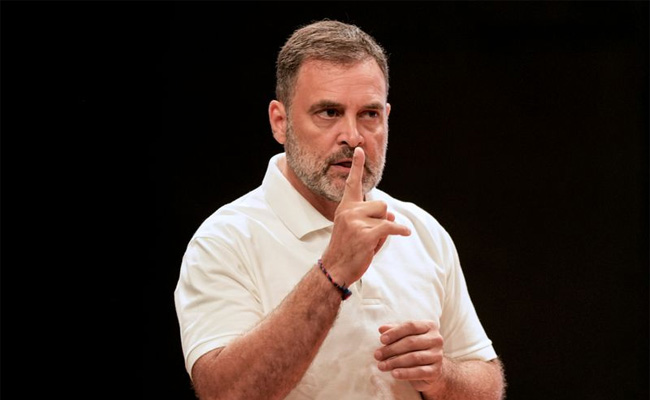
New Delhi (PTI): Congress leader Rahul Gandhi on Friday accused Prime Minister Narendra Modi of signing a trade deal with the US only to secure the "release" of billionaire businessman Gautam Adani.
"Compromised PM did not strike a trade deal, but a bargain for Adani's release," Gandhi said in a post in Hindi on X, after reports that the US has agreed to settle the lawsuit that accused Adani of hiding alleged bribery.
The US government has agreed to settle the lawsuit filed against Adani, who is accused of duping investors by concealing that his company's huge solar energy project in India was being facilitated by an alleged bribery scheme, according to court filings published Thursday.
Reacting to the reports, Congress general secretary in-charge communications Jairam Ramesh said it was now clear why the PM agreed to the "hopelessly one-sided Indo-US trade deal that was really a steal by the US".
"And it is also clear why he abruptly halted Operation Sindoor on May 10, 2025, acting on President Trump's threats rather than on our national interest. Reportedly, the Trump Administration is about to drop all charges of corruption against Modani," he said on X.
"How much more compromised can the PM get?" Ramesh asked.
In the lawsuit filed in late 2024, the Securities and Exchange Commission accused Adani Group Chairman Gautam Adani and his nephew Sagar Adani, who is a director at the group's renewable energy unit Adani Green Energy Ltd, of agreeing to pay about USD 265 million in bribes to Indian government officials between approximately 2020 and 2024 to obtain lucrative solar energy supply contracts on terms that expected to yield USD 2 billion of profit over 20 years.
It was alleged in the lawsuit that Adani Group raised USD 2 billion in loans and bonds, including from US firms, on the backs of false and misleading statements related to the firm's anti-bribery practices and policies.
The ports-to-energy conglomerate had denied the allegations.