SC to hear on Aug 14 plea for restoring Jammu & Kashmir statehood
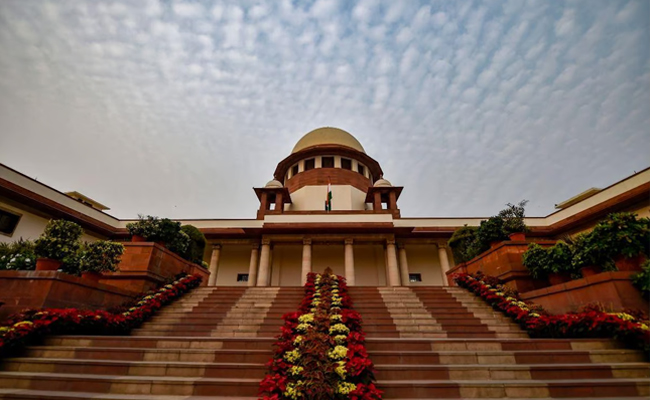
New Delhi (PTI): The Supreme Court would on Thursday hear a plea for the restoration of statehood to Jammu and Kashmir.
A bench of Chief Justice of India B R Gavai and Justice K Vinod Chandran is likely to hear the matter, according to the causelist.
On December 11, 2023, the Supreme Court unanimously upheld the revocation of Article 370, even as it ordered that assembly elections be held in Jammu and Kashmir by September 2024 and its statehood be restored "at the earliest".
Last year, a plea was filed in the top court seeking directions to the Centre for the restoration of statehood to Jammu and Kashmir within two months.
The application was filed by Zahoor Ahmad Bhat, an academician, and Khurshaid Ahmad Malik, a socio-political activist.
"It is submitted that the delay in the restoration of statehood would cause serious reduction of democratically elected government in Jammu and Kashmir, causing a grave violation of the idea of federalism which forms part of the basic structure of the Constitution of India," the application said.
The assembly elections and the Lok Sabha polls were conducted peacefully in Jammu and Kashmir without any incident of violence, disturbance or any security concerns being reported, it said.
"Therefore, there is no impediment of security concerns, violence or any other disturbances which would hinder or prevent the grant/restoration of the status of statehood to Jammu and Kashmir as had been assured by the Union of India in the present proceedings," the plea said.
The non-restoration of the status of statehood of Jammu and Kashmir, the plea said, would result in a lesser form of elected democratic government to the state, particularly given legislative assembly results were declared on October 8, 2024.
Despite the apex court's directions for the restoration of statehood to Jammu and Kashmir "at the earliest and as soon as possible", no steps have been taken by the Centre to provide any timeline for the implementation of such directions, it claimed.
"Jammu and Kashmir is being operated as a Union Territory for a period of almost five years now, which has caused many impediments and grave losses to the development of Jammu and Kashmir and has affected the democratic rights of its citizens," the plea added.
In its December 2023 verdict, the apex court held that Article 370, which was incorporated in the Indian Constitution in 1949 to grant special status to Jammu and Kashmir, was a temporary provision. The President of India was empowered to revoke the measure in the absence of the Constituent Assembly of the erstwhile state whose term expired in 1957, the court said.
Let the Truth be known. If you read VB and like VB, please be a VB Supporter and Help us deliver the Truth to one and all.
Rickelton's ton in vain as SRH beat MI by 6 wickets
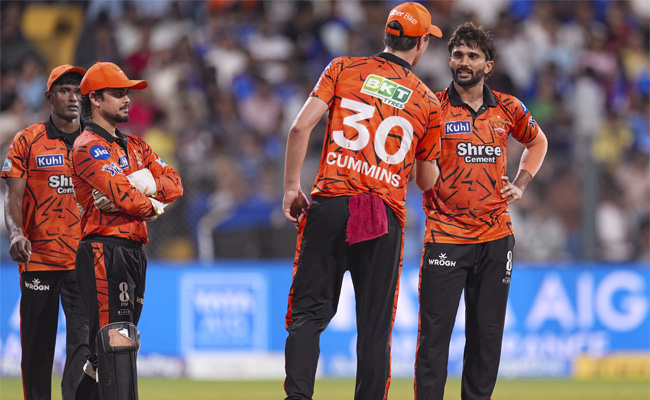
Mumbai (PTI): Ryan Rickelton's whirlwind unbeaten ton was overshadowed by Heinrich Klaasen's unbeaten 65 as Sunrisers Hyderabad defeated Mumbai Indians by six wickets in an IPL match here on Wednesday.
Chasing an imposing 244-run target, Travis Head (76 off 30) and Abhishek Sharma (45 off 24) shared 129 runs for the opening wicket to set the platform for SRH.
Klaasen (65 not out off 30 balls) then displayed his all-round hitting abilities to guide SRH home with the help of Nitish Kumar Reddy (21) and Salil Arora (30 not out off 10) in 18.4 overs.
Earlier, Rickelton's knock powered MI to 243 for five.
MI rode on a 93-run stand between Rickelton (123 not out off 55 balls) and Will Jacks (46 off 22) in 7.1 overs for the opening stand to power the side.
MI skipper Hardik Pandya scored a valuable 31 off 15 balls before being dismissed.
Praful Hinge (2/54), Eshan Malinga (1/29), Sakib Hasan (1/39) and Nitish Kumar Reddy (1/31) were the wicket-takers for SRH.
Brief Scores:
Mumbai Indian: 243 for 5 in 20 overs (Ryan Rickelton 123 not out; Praful Hinge 2/54).
Sunrisers Hyderabad: 249 for 4 in 18.4 overs (Travis Head 76, Heinrich Klaasen 65 not out; AM Ghazanfar 2/51).