SC to hear pleas concerning Places of Worship Act on February 17
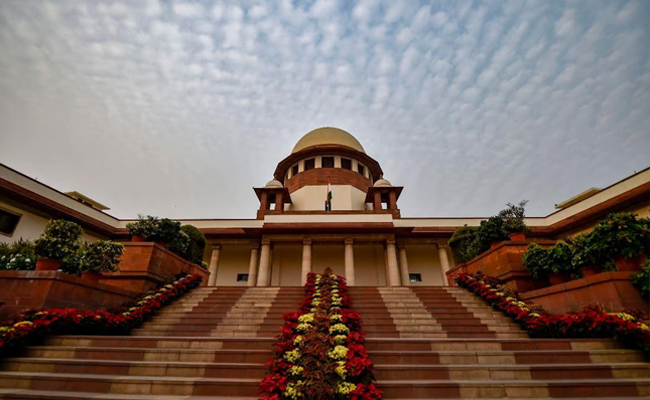
New Delhi (PTI): The Supreme Court will hear a batch of pleas relating to the Places of Worship (Special Provisions) Act, 1991, on February 17.
As per the causelist for February 17 uploaded on the apex court's website, a bench comprising Chief Justice Sanjiv Khanna and Justices Sanjay Kumar and K V Viswanathan is slated to hear the matter.
The Act prohibits conversion of any place of worship and provides for the maintenance of the religious character of any place of worship as it existed on August 15, 1947.
However, the dispute relating to the Ram Janmabhoomi-Babri Masjid issue in Ayodhya was kept out of its purview.
Some of the pleas filed in the apex court have challenged the validity of certain provisions of the 1991 law.
On January 2, the top court agreed to examine a plea filed by AIMIM chief Asaduddin Owaisi seeking effective implementation of the places of worship law.
On December 12 last year, a bench headed by the chief justice, while acting on a batch of pleas relating to the 1991 law, restrained all courts from entertaining fresh suits and passing any effective interim or final orders in pending cases seeking to reclaim religious places, particularly mosques and dargahs.
The bench was hearing petitions, including the lead plea filed by lawyer Ashwini Upadhyay, challenging various provisions of the 1991 law.
The top court through its December 12 order effectively stalled proceedings in about 18 lawsuits filed by various Hindu parties seeking survey to ascertain original religious character of 10 mosques, including the Gyanvapi in Varanasi, Shahi Idgah Masjid in Mathura and Shahi Jama Masjid in Sambhal, where four persons' lives were snuffed out in clashes last year.
"As the matter is sub judice before this court, we deem it appropriate to direct that, though fresh suits may be filed, no suits would be registered and no proceedings shall be undertaken therein till further orders of this court," it had said.
The top court also said the primary issue that arises for consideration was with regard to Sections 3 and 4 of the 1991 Act and its contours, as well as the width and expanse of the said provisions.
While Section 3 deals with barring conversion of places of worship, Section 4 pertains to declaration as to the religious character of certain places of worship and bar of jurisdiction of courts, etc.
There are several cross petitions which seek strict implementation of the 1991 law to maintain communal harmony and to preserve the present status of mosques, sought to be reclaimed by Hindus on the ground that they were temples before invaders razed them.
Various Muslim parties, including the Gyanvapi mosque management committee, moved the apex court to oppose several pending petitions that challenge the constitutional validity of the 1991 law.
The mosque committee listed a series of contentious claims made over the years concerning various mosques and dargahs (shrines), including the Shahi Idgah Masjid in Mathura, the Quwwat-ul-Islam Masjid near Delhi's Qutub Minar, and the Kamal Maula mosque in Madhya Pradesh, among others.
Let the Truth be known. If you read VB and like VB, please be a VB Supporter and Help us deliver the Truth to one and all.
Over 17,000 people went missing in Delhi in 2024: NCRB
New Delhi (PTI): A total of 23,058 people, comprising 9,482 men and 13,576 women, were reported missing in Delhi in 2024, according to the latest National Crime Records Bureau (NCRB).
Of the total, 5,491 were children below the age of 18 — 1,571 boys, 3,920 girls.
The city recorded 17,567 fresh adult missing persons cases in 2024, comprising 7,911 men and 9,656 women.
According to the NCRB data, released on Wednesday, 14,637 men, 18,238 women and six transgender persons were still missing from previous years.
At the latest count, in 2024, Delhi had a total of 55,939 missing persons cases — 24,119 men, 31,814 women and six transgender persons.
In 2024, police traced or collected 28,392 missing persons, including 12,182 men, 16,208 women and two transgender persons.
Only half of the men and half of the women who went missing could be traced.
A total of 27,547 missing persons – 11,937 men, 15,606 women, four transgender persons — were yet to be untraced by the end of the year, the data showed.
The data also revealed that 5,352 children from previous years remained untraced at the beginning of 2024.
The number of still missing boys was 1,621, and the number of missing girls was 3,729. Two transgender children were yet to be found.
After adding the pending cases from previous years, the total number of missing children cases handled in 2024 rose to 10,843.
The police traced or recovered 6,762 missing children — 2,030 boys, 4,732 girls.
The recovery rate stood at 63.6 per cent for boys and 61.9 per cent for girls, while no transgender child was traced.
By the end of 2024, a total of 4,081 children remained untraced, 1,162 of them boys, 2,917 girls, and two transgender children.