SC to hear wife's plea challenging Sonam Wangchuk's detention on Monday
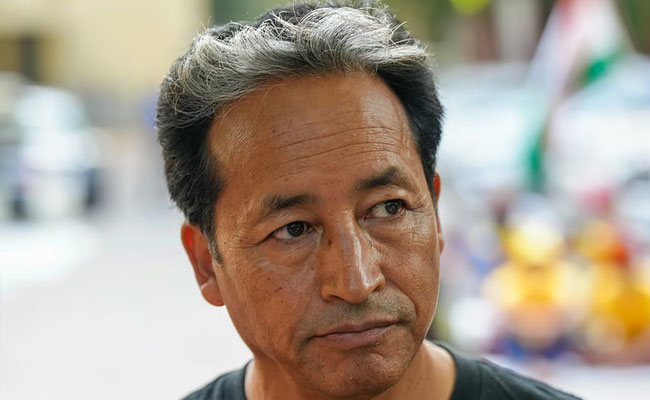
New Delhi (PTI): The Supreme Court will on Monday hear a plea filed by Gitanjali J Angmo, wife of jailed climate activist Sonam Wangchuk, terming his detention under the National Security Act “illegal, and an arbitrary exercise violating his fundamental rights”.
A bench of Justices Aravind Kumar and N V Anjaria is likely to hear the matter.
On November 24, the top court had deferred the matter after Solicitor General Tushar Mehta, appearing for the Centre and the UT of Ladakh, sought time to respond to the rejoinder filed by Angmo.
On October 29, the top court sought responses from the Centre and the Ladakh administration on an amended plea of Angmo.
According to the amended plea, “The detention order is founded upon stale FIRs, vague imputations, and speculative assertions, lacks any live or proximate connection to the purported grounds of detention and is thus devoid of any legal or factual justification...
“Such arbitrary exercise of preventive powers amounts to a gross abuse of authority, striking at the core of constitutional liberties and due process, rendering the detention order liable to be vitiated by this court.”
The plea said it is wholly preposterous that after more than three decades of being recognised at the state, national, and international levels for his contributions to grassroots education, innovation, and environmental conservation in Ladakh and across India, “Wangchuk would suddenly be targeted”.
Angmo said the unfortunate events of violence in Leh on September 24 cannot be attributed to the actions or statements of Wangchuk in any manner.
Wangchuk himself condemned the violence through his social media handles and categorically stated that violence would lead to the failure of Ladakh's "tapasya" and peaceful pursuit of five years, Angmo said, adding that “it was the saddest day of his life”.
Wangchuk was detained under the stringent National Security Act (NSA) on September 26, two days after violent protests demanding statehood and Sixth Schedule status for Ladakh left four people dead and 90 injured in the Union territory. The government had accused him of inciting the violence.
The NSA empowers the Centre and states to detain individuals to prevent them from acting in a manner "prejudicial to the defence of India". The maximum detention period is 12 months, though it can be revoked earlier.
Let the Truth be known. If you read VB and like VB, please be a VB Supporter and Help us deliver the Truth to one and all.
CM Siddaramaiah alleges ‘criminal conspiracy’ in Sringeri recount, vows legal action
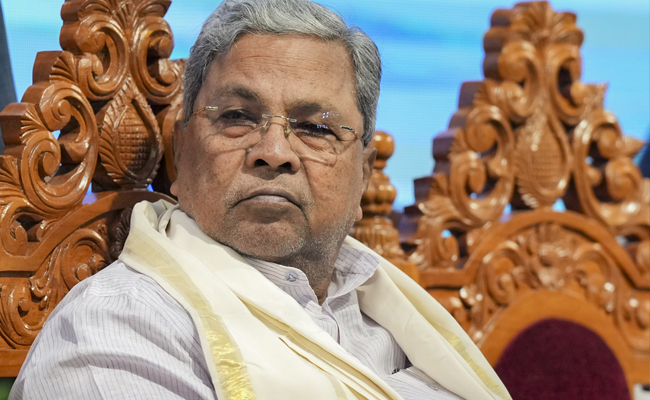
Bengaluru (PTI): Alleging a “criminal conspiracy” by BJP candidate D N Jeevaraj in the Sringeri Assembly poll recounting, Karnataka CM Siddaramaiah on Tuesday said the outcome was manipulated after valid postal ballot votes in favour of Congress leader T D Raje Gowda were tampered with during the recounting process.
Following a Karnataka High Court order on an election petition filed by Jeevaraj, challenging Raje Gowda’s election, the reverification and recounting were conducted on Saturday.
After the reverification and recount of postal ballots for the Sringeri Assembly constituency, votes polled in favour of Raje Gowda were reduced by 255, the returning officer said.
A report on the matter has been submitted to the Election Commission of India for further action, the officer added.
Congress leader Raje Gowda had won the 2023 Assembly polls from Sringeri by 201 votes, defeating his nearest rival Jeevaraj.
Addressing a press conference in Bengaluru, Siddaramaiah said the High Court had directed the recounting of postal ballots and that irregularities were noticed during the exercise conducted on May 2.
“This is a clear case of criminal conspiracy,” Siddaramaiah said, alleging that valid votes cast in favour of Raje Gowda were altered after being accepted by counting agents of all parties, including Congress, BJP, and JD(S).
He claimed that during the recounting of postal ballots, 255 votes were initially accepted as valid by all agents but were later tampered with by subordinate officials.
“There is a second mark on the votes polled in favour of Raje Gowda. They had accepted these as valid votes. Subsequently, another mark was made by officials. This is a clear case of criminal conspiracy,” he said.
When asked who was behind the alleged conspiracy, the CM replied, “It was hatched by Jeevaraj and others. It is planned.”
Siddaramaiah further alleged that the returning officer acted improperly by declaring the result despite the presence of an Election Commission observer during the recounting.
“Immediately after the counting, the returning officer announced the result. He should not have done so; this is against the law,” he said.
He pointed out that Raje Gowda had originally won by 201 votes, but after the recounting, the BJP candidate was declared the winner by 52 votes.
“The BJP has committed a criminal act of conspiracy. This is not vote chori but vote dacoity,” he alleged.
The CM said a police complaint had already been filed by Raje Gowda’s election agent, Sudhir Kumar, and emphasised the need for electoral integrity.
“We want transparency and free and fair elections. That is what our Constitution mandates,” he added.
Stating that the government would pursue legal remedies, Siddaramaiah said, “We are preparing an appeal challenging the returning officer’s announcement in a court of law.”
Responding to a separate query on elections in other states, the CM said there appeared to be an anti-incumbency factor in West Bengal, while results in Tamil Nadu were “surprising,” adding that Vijay’s party was emerging as the largest there.
Following the victory of party candidates in Bagalkote and Davanagere South, Siddaramaiah expressed confidence about future electoral prospects in Karnataka.
“Even in 2028, we will win the Assembly elections. We will come back,” the CM said.
Siddaramaiah added that he would order a forensic examination into the alleged tampering of postal ballots.