
SC upholds validity of West Bengal Madrasah Service Commission Act
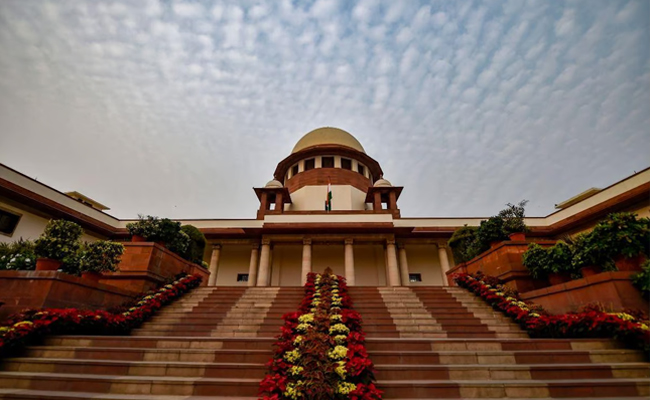
New Delhi, Jan 6: The Supreme Court on Monday upheld a law framed by the West Bengal government in 2008 to constitute the Madrasah Service Commission for appointment of teachers in madrasas, saying the selection of teachers and their nomination by the panel was not violative of the rights of minority educational institutions.
The apex court held that the West Bengal Madrasah Service Commission Act, 2008 ensured that the panel, comprising experts in the field, screened talent across the state, adopted a fair selection procedure and selected the best available candidates purely on the basis of merit.
It said the commission also ensured that even while nominating, the interests of the minority institutions were taken care of.
A bench of justices Arun Mishra and U U Lalit said the state legislature had taken care to see that the composition of the commission would ensure compatibility of the teachers, who would be selected to impart education in the madrasah education system, which was also emphasised in the statement of objects and reasons.
"The statutory provisions thus seek to achieve excellence in education and also promote the interest of minority institutions," the top court said.
Holding that the provisions of the Act were not violative of the rights of minority educational institutions, the bench said the selection of teachers and their nomination by the commission would satisfy national interests as well as the interests of such institutions.
"However, the additional feature in the present matter shows that the composition of the commission, with a special emphasis on persons having a profound knowledge in Islamic culture and theology, would ensure that the special needs and requirements of the minority educational institutions will always be taken care of and thus, the present case stands on a different footing.
"We hold that the provisions of the Commission Act are not violative of the rights of minority educational institutions on any count," it said.
The top court said selection of meritorious students was accepted to be in national interest and a minority institution could not, in the name of right under Article 30(1) of the Constitution, disregard merit or merit-based selection of students.
It set aside the Calcutta High Court verdict, which had held the legislation as unconstitutional.
"We declare all nominations made by the commission in pursuance of the provisions of the Commission Act to be valid and operative. However, if after the disposal of the matters by the high court any appointments are made by the concerned madrasahs, such appointments of teachers shall be deemed to be valid for all purposes.
"But the commission shall hereafter be competent to select and nominate teachers to various madrasahs in accordance with the provisions of the Commission Act and the rules framed thereunder," the bench said.
It added that any departure from the concept of merit and excellence would not make a minority educational institution an effective vehicle to achieve what has been contemplated in various decisions of the apex court.
"Further, if merit is not the sole and governing criteria, the minority institutions may lag behind the non-minority institutions rather than keep in step with them," the bench said.
Several petitions were filed in the Calcutta High Court challenging the validity of the law, contending that the government, which funds or provides aid to minority institutions, can formulate guidelines for appointments of teachers but cannot itself appoint them.
The high court had declared the Act unconstitutional, saying it was violative of Article 30, which stated that all minorities shall have the right to establish and administer educational institutions of their choice.
The high court verdict was challenged in the top court by teachers who were appointed under the new law.
The Supreme Court, while agreeing to hear the batch of pleas challenging the high court verdict, had granted the petitioners interim relief and directed the state government not to remove them from their jobs till the final order.
In 2018, the top court had allowed the West Bengal government to fill the vacant posts subject to the final outcome of the case.
Let the Truth be known. If you read VB and like VB, please be a VB Supporter and Help us deliver the Truth to one and all.
Attack on Constitution defeated, says Rahul Gandhi as bill to amend women’s quota law fails LS test
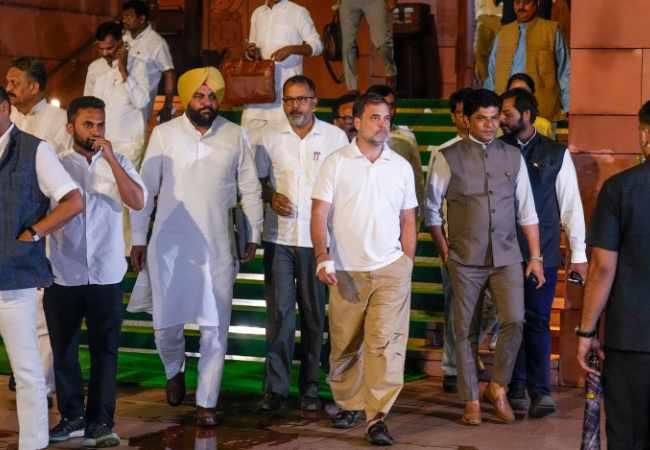
New Delhi (PTI): Congress leader Rahul Gandhi on Friday said the Constitution amendment bill brought by the government to tweak the women’s quota law was an attack on the Constitution, which the opposition has defeated.
The bill was not aimed at providing women reservation, but an attempt to change India's electoral structure, the leader of opposition in Lok Sabha said.
Talking to reporters after the Constitution amendment bill failed to secure two-third majority in the Lok Sabha, Gandhi also said that if the prime minister is serious in providing women reservation in Parliament, he should bring the 2023 law and the opposition would extend its support outrightly.
"As I have said, it was an attack on the Constitution and we defeated that,” he said outside Parliament.
"We clearly said that this was not a women's bill, but an attempt to change India's electoral structure which we have stopped," he added.
In a direct message to Prime Minister Narendra Modi, Gandhi said if he wants the women's bill to be implemented, he should bring the 2023 law and implement it from today.
"The entire opposition will support you and ensure women's reservation from today itself," he said.
Later, in a post on X in Hindi, Gandhi said, "The amendment bill has fallen. They used an unconstitutional trick in the name of women to break the Constitution."
"India has seen it. INDIA has stopped it. Hail the Constitution," the Congress leader said.
Congress general secretary Priyanka Gandhi Vadra said the manner in which the government sought to link the bill to delimitation can never be accepted.
"The way the Modi government presented women's reservation made its passage impossible. The BJP government linked women's reservation to delimitation and the old census, in which the OBC category was not included.
"We can never agree to this. What happened today is a huge victory for the country's democracy and its integrity," she told reporters.
Asked about the BJP leaders accusing the Congress of being anti-women, Priyanka said, "Those who did nothing in Hathras, those who did nothing in Unnao, those who did nothing in Manipur and those who did nothing for women wrestlers are now talking about anti-woman mindset?"
The Constitution amendment bill to implement 33 per cent reservation for women in legislatures in 2029 and increase the number of Lok Sabha seats was defeated in the Lower House on Friday.
While 298 members voted in support of the bill, 230 MPs voted against it. Out of 528 members who voted, the bill required 352 votes for a two-third majority.
The bill proposed to increase the number of Lok Sabha seats to a maximum of 850 from the current 543 to "operationalise" the women's reservation law before the 2029 parliamentary polls, following a delimitation exercise based on the 2011 Census.
Seats were also to be increased in states and UT assemblies to accommodate 33 per cent reservation for women.
_vb_33.jpeg)
_vb_18.jpeg)