SC verdict on validity of Article 370 abrogation gets varied reactions in J-K
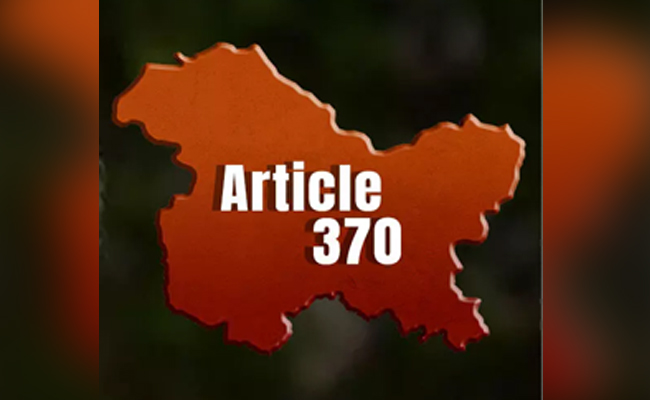
Srinagar/Jammu (PTI): The Supreme Court upholding the Centre's decision to abrogate Article 370 evoked varied reactions from political parties in Jammu and Kashmir with the National Conference vowing to continue its struggle while the BJP welcomed it and said the judgment will be honoured in "letter and spirit".
The ruling sparked a range of reactions, reflecting the complex and deeply held views on the issue.
As the apex court's Constitution bench finished delivering its verdict, National Conference Vice-President Omar Abdullah expressed his disappointment on X but vowed to continue the struggle.
The former chief minister of the erstwhile state acknowledged that it took the BJP decades to reach this point, emphasising their preparedness for the long haul.
"Dil na-umid to nahin nakam hi to hai, lambi hai gham ki shaam magar shaam hi to hai (I grieve but I do not despair, the dusk of sadness is long, but it's just a dusk, that's all)," the National Conference leader said.
J-K BJP chief Ravinder Raina welcomed the verdict, stating that they honour and respect it in letter and spirit. He reiterated the Centre's commitment to holding assembly elections and restoring statehood to J-K.
"We are proud of our country, Constitution and our judiciary. We respect and honour the judgment of the Supreme Court in true letter and spirit," Raina told PTI.
He said the Centre has made it clear it is ready to hold assembly elections but the decision has to be taken by the Election Commission.
Sunil Sethi, the J-K BJP's chief spokesperson, said it is better not to give a political colour to the judgment.
"This is a historic judgment as it puts to rest the questions raised on the complete integration of J-K," Sethi said.
PDP chief Mehbooba Mufti, however, described the verdict as a "death sentence" not only for J-K but also for the idea of India.
She urged people not to lose hope, emphasising that the struggle in the region has been a political fight spanning decades.
Democratic Progressive Azad Party Chairman Ghulam Nabi Azad termed the verdict "sad and unfortunate".
He expressed disappointment that the sentiments of the people of J-K and the historical significance of Article 370 were not considered.
Peoples Conference chief Sajjad Lone found the verdict disappointing. He emphasised that while Article 370 may have been legally obliterated, it will remain a part of their political aspirations.
The displaced Kashmir Pandits welcomed the decision, saying it was a historic judgment to bury Article 370 once for all.
"It (verdict) has put to rest all the controversies surrounding it. We are happy about the decision," Chairman of Panun Kashmir Dr Ajay Chrungoo told PTI.
"In ruling in favour of the validity, the court eloquently dismantled the constitutional nuances surrounding Article 370," constitutional expert and editor of Epilogue News Network Tito Ganju said.
He said the verdict underscored the erosion of national sovereignty, glaring inequality among states, and the peril it posed to national integration.
Former general secretary of the All State Kashmiri Pandit Conference Dr TK Bhat said it is a red letter day for all the marginalised communities that have suffered for the past seven decades in Jammu and Kashmir due to Article 370.
The SOS International, an organisation representing the displaced population of Pakistan-occupied Kashmir (PoK), welcomed the verdict, saying "there was nothing left in the act" over the years.
SOS International Chairperson Rajiv Chuni, however, wished that the apex court should have given a timeframe for the restoration of statehood instead of leaving it to the BJP-led central government.
Deepak Kapoor, who heads the PoJK Visthapit Sewa Samiti, welcomed the Supreme Court verdict and said the abrogation of Article 370 in 2019 facilitated domicile certificates to 27,000 people settled in other parts of the country.
"They were all residents of Pakistan-occupied Jammu and Kashmir but settled in different parts of the country after their migration in 1947. They were never given their due rights on the pretext of Article 370," he said.
Dogra scion Vikramaditya Singh welcomed the verdict as a "significant step" towards the complete integration of J-K into the Indian Union.
Singh, the grandson of the last Dogra ruler Maharaja Hari Singh, called upon all stakeholders to work together towards building a peaceful and prosperous J-K.
The verdict also brought relief to West Pakistan refugees, Gorkhas and Valmikis.
Community members expressed gratitude to the central government, emphasising the finality of the decision endorsed by the Supreme Court.
Labha Ram Gandhi, the West Pakistan Refugees Action Committee chairman, emphasised that the fear of Article 370's return has now been dispelled.
"The scrapping of Article 370 was necessary for ensuring equal rights and opportunities for all residents of J-K, including West Pakistan refugees, Gorkhas, Valmikis and others," he said.
Gorkha leader Narayan Singh said, "With this verdict, our community will for the first time vote in assembly elections."
Valmiki Samaj leader Garu Bhatti said, "The abrogation of Article 370 came as a lifeline for our younger generations."
Let the Truth be known. If you read VB and like VB, please be a VB Supporter and Help us deliver the Truth to one and all.
AI, IndiGo, SpiceJet seek ATF price relief; say airline industry on verge of 'stopping operations'
Mumbai (PTI): Air India, IndiGo and SpiceJet have told the government that the country's airline industry is under extreme stress and on the verge of "stopping operations", as they sought revision in ATF pricing and financial support.
The West Asia turmoil has pushed up oil prices, and airspace restrictions have increased airlines' operating costs, especially on long-haul routes. Aviation Turbine Fuel (ATF) accounts for around 40 per cent of a carrier's operational expenses.
Against this backdrop, the Federation of Indian Airlines (FIA) has written to the civil aviation ministry, seeking steps to extend the same fuel pricing mechanism uniformly across both domestic and international operations as was done in the past with the establishment of the crack band.
ALSO READ: Tharoor junks Rijiju's claim that he agreed Cong is 'anti-women'; hails his party
With an unprecedented rise in jet fuel prices and exorbitant crack/differential between crude and ATF, the federation said the operation of airlines is being challenged in totality.
"... any ad hoc pricing (domestic vs international) and/or irrational increase in the price of ATF will result in unsurmountable losses for airlines and will lead to grounding of aircraft, resulting in cancellation of flights," the federation, which represents Air India, IndiGo and SpiceJet, said.
"In order to survive, sustain and continue operation, we request your urgent intervention for immediate and meaningful financial support to tide over the current situation," it said in a letter on April 26.
Also, the airlines have sought temporary deferment of excise duty on ATF, which is at 11 per cent.
"With the abnormal increase in ATF prices from the pre-crisis period, adding rupee depreciation to the increased prices, the 11 per cent excise duty also increases manifold for the airlines and adds to the ATF price as a big impact on airlines," they said.
Last month, the government limited the hike in ATF price to Rs 15 per litre for domestic operations, but for international operations, the price rose by Rs 73 per litre.
The airlines said the situation has practically made international operations, along with domestic operations, completely unviable and resulted in significant losses for the aviation sector in April.
Seeking urgent intervention on the current ATF ad hoc pricing, FIA said the current situation is creating a severe imbalance in domestic and international operations and rendering airline networks unviable and unsustainable.
"The airline industry in India is under extreme stress and is on the verge of closing down or of stopping its operations."
The federation has pitched for a transparent pricing framework under the crack band mechanism (USD 12–22/BBL) that was implemented in October 2022, saying there was a fair and reasonable margin for Oil Marketing Companies (OMCs).
According to FIA, the country's largest aviation hub Delhi has the second-highest value-added tax (VAT) of 25 per cent on jet fuel, while the highest rate is 29 per cent levied in Tamil Nadu.
"The other major aviation cities, viz. Mumbai, Bangalore, Hyderabad, and Kolkata range between 16 per cent and 20 per cent. These 6 cities cover more than 50 per cent of airlines' operations within India," the federation said.