Scientists strike note of caution as 'Made in India' vaccine programme gains momentum

New Delhi: India's COVID-19 vaccine programme has gained sudden traction but it is imperative to strike a balance between giving it high priority and rushing into a process that takes months, even years, several scientists said on Saturday, a day after the ICMR announced it envisaged a preventive by next month.
There was hope but caution too as the Indian Council of Medical Research on Friday said it aims to launch the world's first COVID-19 vaccine by August 15. The same day, Ahmedabad-based Zydus Cadila announced it has got the Drugs Controller General of India's (DCGI) nod for human clinical trials for a potential vaccine.
Fast tracking a vaccine trial in four weeks for safety, immunogenicity and efficacy is just not possible if things are to be done correctly, Shahid Jameel, virologist and CEO of the Wellcome Trust/DBT India Alliance, a public charity that invests in building biomedical sciences and health research framework, told PTI.
Immunogenicity is the ability of a foreign substance, such as an antigen, to provoke an immune response in the body of a human or other animal, he explained.
Virologist Upasana Ray added that an accelerated launch or promise for launch of a vaccine against the novel coronavirus deserves applause but it is important to ask whether we are rushing too much . We must rush albeit carefully. Giving this project high priority is absolutely important. However, excess pressure might not necessarily lead to a positive product for public use, the senior scientist at CSIR-IICB, Kolkata, told PTI.
India's premier medical body ICMR has said 12 clinical trial sites for the indigenous Covaxin, being developed in collaboration with the Hyderabad-based Bharat Biotech and the National Institute of Virology (NIV), have been identified.
It asked medical institutions and principal investigators to ensure that the subject enrolment is initiated no later than July 7.
"It is envisaged to launch the vaccine for public health use latest by August 15 after completion of all clinical trials, ICMR Director General Balram Bhargava said in his letter to the principal investigators of the 12 sites.
The tone of the letter and the haste it indicated had some scientists worried. They questioned the timeline of the announcement mentioned in the letter, and advised against subverting the due vaccine development process.
The ICMR 'letter' is, to say the least, a deeply inappropriate letter, in tone and content, both in terms of the integrity of due processes of product development, and in terms of technically realistic estimates, immunologist Satyajit Rath told PTI.
Vaccine development is a multi-phase process. Phase 1 trials are small-scale, usually involving few participants, to assess whether the vaccine is safe for humans. Phase 2 trials often involve several hundred subjects, and mainly evaluate the efficacy.
The final phase involves thousands of people to further assess the efficacy of the vaccine over a defined period of time, and can last several months.
Ray added that a vaccine normally takes at least 12-18 months to pass all necessary clinical trial phases. From now till August 15, the company has just over a months' time to wrap up everything that normally a vaccine development process requires for releasing a vaccine for clinical use, she said.
How can such a sharp timeline be even decided? Where does the evidence come from that by such a short time all the essential steps will be completed? What about the safety and efficacy, the fundamental steps of any drug development? Have even the pre-clinical studies been completed? Too much rush comes with possible risks, she said. Ray noted that there are some broad mandatory steps for developing a vaccine. Preclinical tests in small animals and mammals, she stressed, are essential to assess neutralising antibody titers and that itself can take at least a month or two.
A titer is a laboratory test that measures the presence and amount of antibodies in blood.
Next, we check for safety. Then is the human trial. Even if we are in a deep rush we have to wait for some time for immunised individuals to start generating antibodies. After that a population needs to be monitored over time to investigate if people are still being infected, she explained. Skipping steps could either be dangerous or lead to poor product, Ray said.
We must not compromise with the standard, the quality. We don't need to be the first to launch a drug but what we need is a Made in India vaccine that the entire world can rely on, she added.
The vaccine landscape in India has been also bolstered after the approval for Zydus Cadila's vaccine candidate. It was fast-tracked following a recommendation by the subject expert committee on COVID-19, considering the emergency and unmet medical need during the pandemic.
"DCGI Dr V G Somani has given approval for the phase I and II clinical trials (on humans) of the potential novel coronavirus vaccine developed by Zydus Cadila Healthcare Ltd on Thursday after its animal studies were found to be successful," an official source said.
Jameel, winner of the 2000 Shanti Swarup Bhatnagar Prize for Science and Technology, one of the highest Indian science awards, noted that it is a vaccine funded by Biotechnology Industry Research Assistance Council (BIRAC) and the Department of Biotechnology. Congratulations to Cadilla, BIRAC and DBT. We would look forward to properly conducted trials and good news in due course, he told PTI.
I am glad that a locally made vaccine candidate is making the same progress that others elsewhere in the world are making, not just with SARS-CoV-2 vaccine candidates but with DNA-based SARS-CoV-2 vaccine candidates, and I will look forward to the results, added Rath from Delhi's National Institute of Immunology (NII).
Gautam I. Menon, professor from the Departments of Physics and Biology at Ashoka University, said Zydus Cadila's vaccine appears to have shown safety and efficacy in animal trials and so they have been allowed to go to the next step, to human trials. This is the standard procedure. It is the human trials that are time-consuming and it is important to get this right, Menon told PTI.
In another development, Serum Institute of India (SII) CEO Adar Poonawalla told The Tribune newspaper that the Covid-19 vaccine being developed at the University of Oxford will hit the market by the year-end.
ChAdOx1 nCoV-19 is made from a virus (ChAdOx1), which is a weakened version of a common cold virus (adenovirus) that causes infections in chimpanzees, and has been genetically changed so that it is impossible for it to reproduce in humans.
I think it is likely that the ChAdOx1-S vaccine candidate which has entered a phase 3 clinical trial in Brazil, will give at least somewhat promising results by late this calendar year, Rath said.
Whether this will lead to the 'vaccine' becoming available in the market, and in the public health system, more importantly, by the end of this calendar year in India is much more uncertain, Mr Poonawala's welcome optimism notwithstanding, he added.
Let the Truth be known. If you read VB and like VB, please be a VB Supporter and Help us deliver the Truth to one and all.
Putin meets Iran's FM Araghchi, says Russia ready to do its best to help bring peace to West Asia
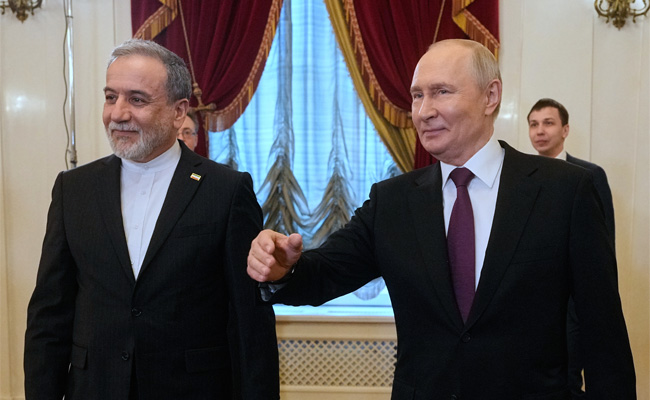
Moscow (PTI): Iran's Foreign Minister Abbas Araghchi on Monday met Russian President Vladimir Putin, who hailed the Iranian people for fighting bravely and heroically for their sovereignty and said Moscow is ready to do its best to help bring peace to West Asia as soon as possible.
Araghchi, who held talks with Omani and Pakistani leadership before arriving in Russia, met Putin in St. Petersburg and thanked him for supporting Iran, state-owned TASS news agency reported.
"Russia is ready to do everything in its power to ensure that peace in the Middle East is achieved as soon as possible," Putin said during his meeting with Araghchi, which was also attended by Russian Foreign Minister Sergey Lavrov.
Revealing that he received a message from Iranian Supreme Leader Mojtaba Khamenei last week, Putin asked Araghchi to convey his "gratitude for this message and best wishes for his health and well-being."
He praised the Iranian people for fighting "bravely and heroically" for their sovereignty, Iran's state-run PRESS TV reported.
"We really hope that, based on the courage and desire for independence, the Iranian people, under the guidance of the new leader, will weather this difficult period of trials and peace will come,” Putin said.
He also stressed that Russia “intends to maintain” its strategic relations with Iran.
Araghchi said that the world witnessed Iran’s strength in countering the US during the recent war, and that the Islamic Republic is a "stable and powerful establishment."
"With their courage, the Iranian people succeeded in resisting the US aggression and will be able to endure it,” he said.
He said that it became clear that Iran has “great friends and allies” like Russia, and conveyed “warmest greetings” from Supreme Leader Mojtaba Khamenei and President Masoud Pezeshkian to the Russian leader.
Araghchi said relations between Moscow and Tehran represent a “strategic partnership at the highest level” and will continue to develop "regardless of circumstances."
"We are grateful to you for the solid and strong positions in support of the Islamic Republic of Iran," he said.
Foreign Minister Lavrov said that the talks between President Putin and the Iranian Foreign Minister were "useful and constructive."
Kremlin Spokesman Dmitry Peskov later said that Russia is "ready to provide any good offices, any mediation services that are acceptable to the parties."
"We will be ready to do everything so that ultimately peace ensues, guaranteed peace, and that there is no return to hostilities," Peskov was quoted as saying by TASS.
He was asked how Moscow can assist in future negotiations on the Iranian settlement.
Araghchi arrived in Russia after his whirlwind trip to Islamabad, which, according to him, was “very productive” and involved “good consultations" with Pakistan's Army Chief Field Marshal Asim Munir, amid uncertainty over the second round of peace talks to resolve the war in West Asia.
"We held good consultations with our friends in Pakistan. The trip was successful. We assessed the outcome of our recent (meetings) and discussed in what direction and under what conditions talks can move on,” Araghchi said in a video posted on his Telegram channel upon his arrival in St Petersburg.
Referring to the second round of talks between the US and Iran to resolve the conflict in West Asia, Araghchi said: "Developments have taken place in the negotiations."
"Despite some progress in earlier rounds, the talks failed to reach their objectives due to the Americans' approach, the excessive demands they made, and the wrong approaches they adopted. Therefore, it was necessary to consult with our friends in Pakistan to review the latest situation,” Iran's official news agency IRNA quoted him as saying.
He said that the trip to Pakistan was a good opportunity to review developments related to the US-Israeli war against Iran, expressing confidence that “these consultations and coordination between the two countries will be highly significant.”
Araghchi arrived at St. Petersburg's Pulkovo Airport early Monday, where he was welcomed by Russian officials and Iran’s ambassador to Russia, Kazem Jalali, the report said.
The first round of peace talks between Iran and the US, held on April 11 and 12, failed to bring the desired result for the parties to the conflict.
The Iranian minister arrived in Islamabad for the second time on Sunday after a short visit to Oman, where he held talks with Sultan Haitham bin Tariq al-Said on security in the Strait of Hormuz and diplomatic efforts to end the Iran-US conflict.
After Araghchi left Pakistan for Oman on Saturday, President Donald Trump announced that US negotiators Steve Witkoff and Jared Kushner would no longer be going to Islamabad for talks with Iran, contending that Washington held all the cards on the matter.
Trump on Sunday reiterated that the US and Iranian officials can talk by phone for a peace solution to the conflict.
On Tuesday, Trump extended the two-week ceasefire with Iran indefinitely to give Tehran more time to prepare a unified proposal to end the war, just hours before the truce was set to expire.
The war began when the US and Israel jointly attacked Iran on February 28, killing Iranian Supreme Leader Ayatollah Ali Khamenei and several top commanders. The retaliation by the Islamic Republic extended the war to the entire Gulf region.