SEBI chief Madhabi Buch earned revenue in potential rules violation: Report
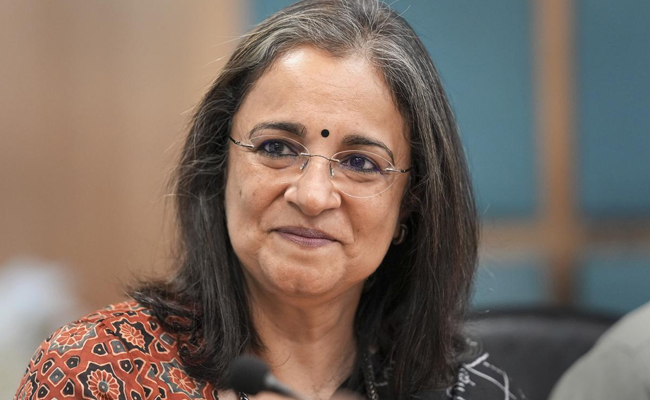
New Delhi: Madhabi Puri Buch, chairperson of the Securities and Exchange Board of India (SEBI), is facing scrutiny over a potential conflict of interest following revelations about her 99% ownership in a consultancy firm. According to Reuters, Agora Advisory Pvt Ltd, in which Buch holds a significant stake, earned Rs 3.71 crore over the past seven years since she joined SEBI as a whole-time member. This financial relationship could violate SEBI's 2008 policy that prohibits board members from engaging in profit-making activities.
Buch has been accused by U.S. short seller Hindenburg Research of having a conflict of interest in her investigations of the Adani Group due to previous investments. Buch has denied these allegations, calling them an attempt at "character assassination."
Hindenburg’s latest report highlights Buch and her husband operated two consultancy firms, Agora Partners in Singapore and Agora Advisory in India. Despite Buch’s claims that she transferred her shares in Agora Partners to her husband in March 2022, records show she still holds shares in Agora Advisory.
Her holdings potentially violate a 2008 SEBI policy that prohibits whole-time members from holding an office of profit or engaging in other professional activity which entails salary or professional fees.
Former SEBI board member Subhash Chandra Garg criticized Madhabi’s consultancy ties and termed it as a “very serious” breach of conduct. He told Reuters that there is no justification for her to continue to own the firm after she joined the board. He added that this makes her position completely untenable at the regulator.
The allegations levelled by Hindenburg Research has sparked a political firestorm with several parties calling for Madhabi’s resignation.
Let the Truth be known. If you read VB and like VB, please be a VB Supporter and Help us deliver the Truth to one and all.
Vartha Bharati–Sankalp predictions align closely with Karnataka bypoll results
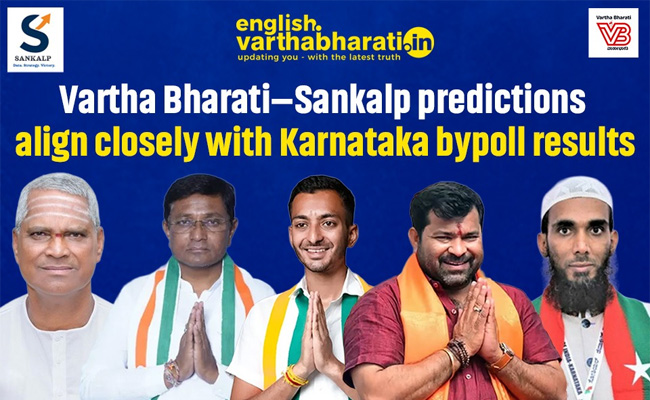
Bengaluru: The Vartha Bharati–Sankalp election analysis has shown a high level of accuracy in predicting the outcome of the recent Karnataka Assembly by-elections held in May 2026, correctly calling winners in both constituencies and closely estimating vote share trends.
The by-elections were held in Bagalkot and Davanagere South, drawing significant political attention as both seats were seen as key tests for the ruling Congress and opposition BJP.
According to the analysis, Vartha Bharati–Sankalp had made three major projections ahead of the results the winning party, vote share percentages, and margin of victory.
In both constituencies, the platform accurately predicted that the Congress would emerge victorious. The outcome matched the projections, with Congress candidates winning in Bagalkot and Davanagere South.
In terms of vote share, the predictions were largely in line with the final results. In Bagalkot, the BJP’s vote share was forecast in the range of 40 to 46 per cent, while the actual figure stood at 42.9 per cent. The Congress vote share, however, exceeded expectations, with the party securing 55.4 per cent against a projected range of 43 to 48 per cent.
The margin of victory in Bagalkot turned out to be significantly higher than anticipated. While the projection had placed the margin between 2,000 and 3,500 votes, the final margin was around 22,332 votes.
In Davanagere South, the predictions also remained largely accurate. The Congress vote share was projected between 43 and 51 per cent, and the final figure stood at 43.9 per cent. The BJP was expected to secure between 42 and 50 per cent but ended with 40.3 per cent.
The analysis had also identified the role of SDPI as a potential spoiler in the constituency. While its vote share was estimated around 6 per cent, the party eventually secured around 12 per cent of the vote.
The margin of victory in Davanagere South was predicted to be between 1,500 and 2,600 votes. The actual margin was higher at around 5,708 votes, though the contest remained relatively close as anticipated.
Overall, the performance of Vartha Bharati–Sankalp stood out for correctly identifying the winning parties in both seats and maintaining close accuracy in vote share estimates, with only limited deviations in specific cases.