Secularism has become pejorative for those now in power: Sonia Gandhi
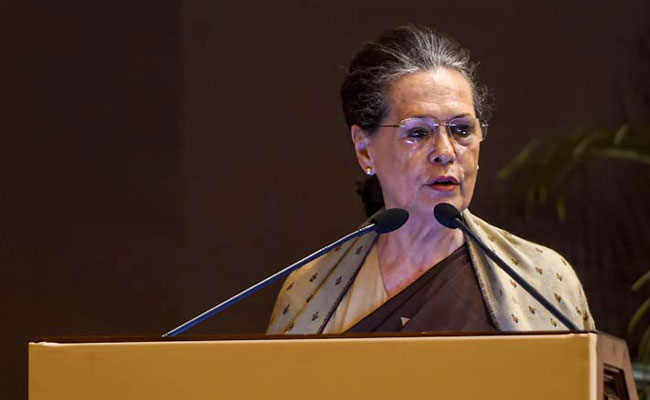
Thiruvananthapuram (PTI): Describing secularism as a foundational pillar of India's democracy, Congress leader Sonia Gandhi said the word secular is being used as a "pejorative" by those now in power, resulting in increased polarisation in the society.
"They say they are committed to 'democracy', but at the same time, they weaken the safeguards meant to ensure its smooth working. The train tracks meant to guide our nation to harmony are being damaged and the results are already being seen in the increased polarisation in society," Gandhi wrote in a signed article for Manorama Yearbook 2024.
Democracy and secularism are deeply interconnected -- like two rails on a track, guiding the government of the day to the ideal of a harmonious society.
"We are all familiar with these words, which we encounter in debates, speeches, civics textbooks, and the Preamble to the Constitution. Despite this familiarity, the deep meanings behind these concepts are often elusive. A clear understanding of these terms will help every citizen better understand India's history, the challenges of the present, and the path to the future," the former Congress chief said.
Gandhi pointed out that secularism can be interpreted in several ways but the meaning most relevant to India was the one laid down by Mahatma Gandhi in his famous term, 'sarva dharma sama bhaava'.
"Gandhiji perceived the essential unity of all religions. Jawaharlal Nehru was deeply conscious of India being a multi-religious society, so he constantly strove to establish a secular state," she is quoted as saying in a release issued by Malayala Manorama here.
She also said that India's Constitution makers, led by Dr B R Ambedkar, developed and applied this idea to the government, creating a unique secular democracy.
"The government protects the religious beliefs of all. It has special provisions to protect the welfare of minorities. The guiding principle of Indian secular democracy is always to promote harmony and prosperity between all the diverse groups in our society," the senior Lok Sabha MP said.
Gandhi, who was the longest serving president of the Congress party for over 20 years (from 1998 to 2017 and from 2019 to 2022), said India has always been defined by its extraordinary diversity.
"In fact, in our society it makes more sense to speak of 'diversities' instead of just 'diversity' since they encompass faiths and beliefs, languages and cultural practices, regions and ecologies, histories and traditions. Yet there has always been a sense of overarching unity that led our Founding Fathers to give us the legacy of Unity in Diversity," she argued.
"Diversity strengthens our unity and solidarity when it is celebrated as indeed it is in our magnificent Constitution that is now under assault," she said.
Gandhi also raised an important issue regarding the functioning of democracy. In a democracy, the government is formed by a majority of votes.
"But if a majority of people agree, can they always have a way over the remainder? What happens if the core interests of a small group are hurt? What is the remedy if a temporary majority insists on taking a decision which may have grave future consequences? On the other hand, if an enduring but slim majority is formed, do they have the right to govern unchallenged?" she said.
This question is especially grave in diverse countries such as India, where people share so many different identities which are precious to them.
"If people worry that their language or religious practice or way of life could be permanently threatened only because they were not many in number, it does not help peace or harmony in society," she noted.
Gandhi said democracy is not a perfect system, and quoted Jawaharlal Nehru's observation: "Democracy is good. I say this because other systems are worse It has good points and also bad."
The freedom fighters knew from the experience of democracy in other countries that the system is prone to ailments and laid down principles to guard against these illnesses, such as a written Constitution, Fundamental Rights of citizens against the government, and the principle of secularism.
Noting that progressive people in India have always tried to find solutions to the challenges of the times, she said, adding: "It is time for us too, to find our own solutions to the challenges of today, and in so doing, serve and honour our nation."
Let the Truth be known. If you read VB and like VB, please be a VB Supporter and Help us deliver the Truth to one and all.
Dalit outfits call state-wide hartal over dental student’s death
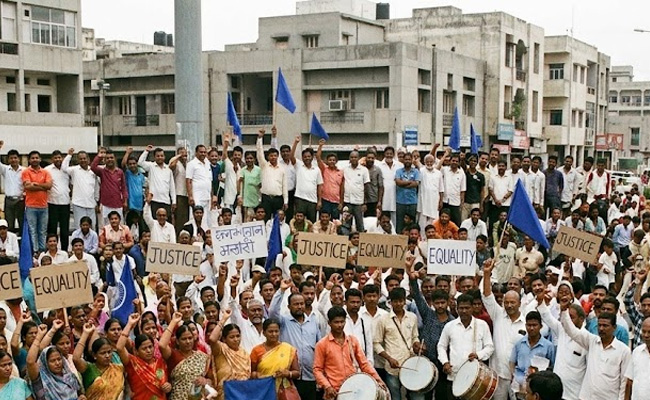
Thiruvananthapuram (PTI): Various Dalit organisations on Monday announced a state-wide hartal seeking justice in the death of Kannur Dental College student Nithin Raj.
The hartal will be observed on Tuesday from 6 am to 6 pm.
As many as 52 Dalit organisations, including Justice for Nithin Raj Action Council, have announced the strike.
Organisations requesting cooperation for the strike said that no vehicles will be forcibly stopped and that all essential services are exempted.
Raj, a first-year BDS student at a private dental college in Anjarakkandy in Kannur district, was found critically injured after falling from a building on April 10 and later succumbed to his injuries.
Police have registered a case against two faculty members on charges of abetment of suicide and under provisions of the SC/ST (Prevention of Atrocities) Act, following allegations by the student’s family that he was subjected to caste- and complexion-based harassment.
Kerala Pinnokka Samudaya Munnani (KPSM), one of the organisations supporting the hartal, alleged in a statement that police had shown apathy in the investigation and were attempting to protect the accused in the case.
KPSM state president K V Padmanabhan and general secretary S Anwar alleged that the probe into Raj’s death was being deliberately misdirected and delayed.
While the family has firmly alleged that caste discrimination and mental harassment by faculty members led to the student’s death, police were attempting to divert the investigation towards loan app borrowings, they claimed.
The organisation alleged that this was a planned move to shield the real accused.
KPSM further alleged that by deliberately delaying the arrest of the accused teachers, police enabled them to secure anticipatory bail.
They said there was no confidence in the present police investigation and demanded that the case be handed over to an independent agency at the earliest.