Selling Army's valour for political mileage: Cong targets BJP over PM's pic on railway tickets
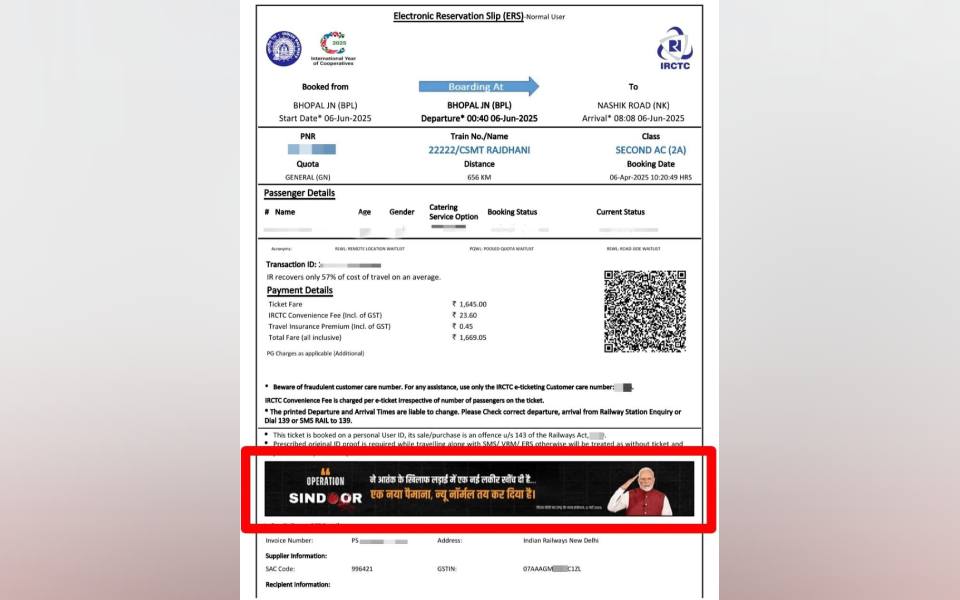
Bhopal, May 19 (PTI): The Congress on Monday alleged that using Prime Minister Narendra Modi's photo on Railways tickets featuring 'Operation Sindoor' is like selling the valour of the Army as a product for political gains.
Madhya Pradesh Leader of the Opposition, Umang Singhar, posted a ticket with Modi's picture on his X account.
"Even the valour of the Army is being sold like a product for political gains. Here's a fresh example of how the Central government has become advertisement-dependent. Operation Sindoor is being used as a tool for the Prime Minister's promotion on railway tickets," he stated.
"Until now, only BJP leaders from Madhya Pradesh were disrespecting the Army, but now even the Prime Minister has joined their ranks," he alleged.
He was apparently referring to controversies surrounding two ministers from Madhya Pradesh over their remarks on Col Sophiya Qureshi and the armed forces.
The BJP faced a barrage of criticism after state Tribal Affairs Minister Vijay Shah purportedly termed Colonel Quereshi, the face of media briefings on Operation Sindoor, a 'sister of terrorists', during his public speech.
The controversial remarks not only invited wide-scale condemnation from various sections of society and the Opposition, but also led to the registration of an FIR against the minister on the orders of the High Court.
Even before the political firestorm could die down, MP Deputy Chief Minister Jagdish Devda said on Friday that Indian armed forces and all soldiers are 'natmastak' (bowing down with their heads at the feet) at Prime Minister Narendra Modi for giving a befitting reply to terrorists and Pakistan.
He claimed his remarks were twisted.
In further embarrassment to the BJP, its first-time MLA from Rewa district, Narendra Prajapati, has claimed that the UN had ordered India to "cease fire" with Pakistan.
"सेना के पराक्रम को भी अपनी राजनीति चमकाने के लिए एक प्रोडक्ट की तरह बेचा जा रहा है"
— Umang Singhar (@UmangSinghar) May 19, 2025
केंद्र सरकार कितनी विज्ञापनजीवी हो चुकी है, इसका ताज़ा उदाहरण देखिए — रेलवे टिकट पर "ऑपरेशन सिंदूर" का इस्तेमाल प्रधानमंत्री के प्रचार के तौर पर किया जा रहा है।
अब तक तो सिर्फ मध्यप्रदेश के… pic.twitter.com/6oMP9IJ912
Let the Truth be known. If you read VB and like VB, please be a VB Supporter and Help us deliver the Truth to one and all.
Cong performed better in Kerala, anti-incumbency trends influenced WB, TN: CM Siddaramaiah
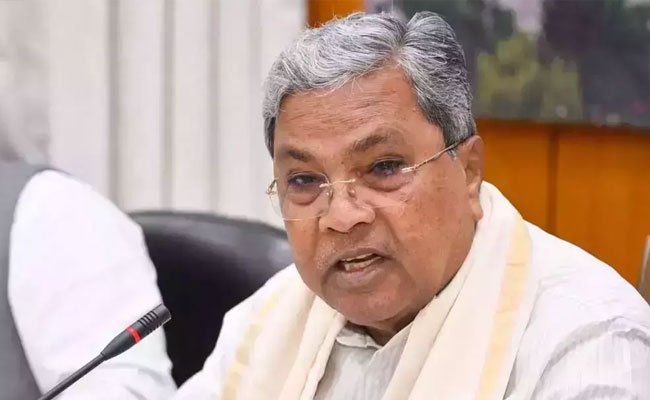
Bengaluru (PTI): Karnataka Chief Minister Siddaramaiah on Monday said the Congress had largely met or exceeded expectations in several States, even as results in some regions reflected shifting voter sentiments.
Speaking to reporters in Bengaluru, he said the party accepted the mandate in Assam while performing better than anticipated in Kerala.
He also pointed to possible anti-incumbency trends influencing outcomes in West Bengal and Tamil Nadu.
“In Assam, we got the expected result, and we accept the people’s mandate. In Kerala, we have won more seats than expected. We anticipated around 76 to 80, but we have gone up to around 95,” Siddaramaiah said.
In West Bengal and Tamil Nadu, there may have been an anti-incumbency trend, and that could have influenced the results, he added.
Siddaramaiah also extended his congratulations to a new political entrant in Tamil Nadu, noting the emergence of a different electoral dynamic in the State.
“I congratulate the new entrant who has achieved success there,” he added.
Deputy Chief Minister D K Shivakumar said electoral outcomes in some States had diverged from the party’s internal assessments, reflecting evolving voter expectations.
“We expected a certain trend, but the results have been different. Political reading was wrong in some places,” he said.
“People were looking for change in some States, and that has been reflected in the results,” Shivakumar, who is also the Congress Karnataka unit president, said.
Referring to Kerala, he said the Congress-led alliance had benefited from public sentiment.
“There was already an expectation based on local body elections, and people had shown confidence in us. That has translated into a strong result,” the Deputy Chief Minister said.
On Tamil Nadu, he acknowledged that the scale of political shift had come as a surprise.
“We expected to secure around 30 to 40 per cent of the vote share, but such a major shift was not anticipated. It shows that voter expectations were different,” he said.
Shivakumar added that electoral outcomes underscored the need for better political assessment in future.
“We have to understand these changes carefully. Political reading cannot go wrong like this,” he said.