Sexual assault in 7th standard left me disturbed for long time: Actor Piyush Mishra
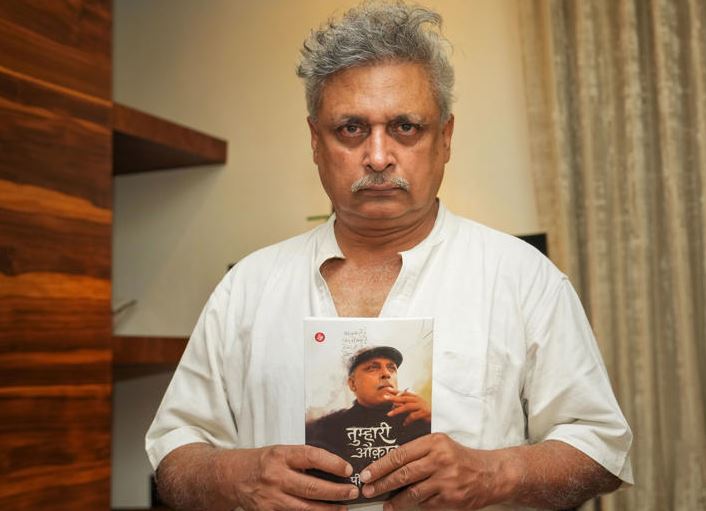
New Delhi, Mar 3: One summer day some 50 years ago, a young Piyush Mishra faced sexual assault at the hands of a distant female relative. The incident scarred him for life, something that he has written about in his just released autobiographical novel "Tumhari Auqaat Kya Hai Piyush Mishra".
Mishra says he has changed only the names and kept the truth intact in his book, published by Rajkamal Prakashan, as "revenge" was not his purpose.
"It left me shocked, I was surprised at what had happened," Mishra told PTI while reflecting on the incident that had happened when he was studying in the 7th standard.
"Sex is such a healthy thing that your first encounter with it should be good, otherwise it scars you for life, it disturbs you for life. That sexual assault gave me complex throughout my life and it took me a long time and several partners to come out of it," the multi-hyphnate personality said.
The book that traces his journey from narrow alleys of Gwalior to Delhi's cultural centre of Mandi House and eventually to Mumbai.
"I wanted to hide the identity of some people. Some of them are women, and some men who are now well established in the film industry. I did not want to take revenge against anybody, or to hurt anyone."
In the book, the noted actor, singer, and composer narrates his life through the autobiographical character of Santap Trivedi, or Hamlet, as he was known in his alma mater, the National School of Drama (NSD).
Hailing from a middle class family in Gwalior, Mishra showed promise as a multidimensional artiste from his childhood by quickly taking to vocal and instrumental music, paintings, sculptures, poetry and eventually theatre.
According to the book, even as his father pressured him to pursue a career in medical science, Mishra dropped out and decided to join NSD at the age of 20. It would start a lifelong romance with theatre and acting.
Initially reluctant to leave Delhi while friends went on to establish careers in Mumbai, Mishra eventually made the shift to the city of dreams in early 2000s.
He quickly made his mark as an actor, songwriter, singer, scriptwriter in films such as Vishal Bhardwaj's "Maqbool" (2004), Anurag Kashyap's "Gulaal" (2009) and most notably, "Gangs of Wasseypur in 2012, where he played the narrator.
Not just his acting, Mishra's songs have also connected with listeners, especially the younger generation. And the lyricist and singer of music band 'Ballimaaraan' is surprised by the recall value some of his songs have.
"Maybe it is the way I say things that connects me with the youth, or that I talk about them, their issues... It is also possible that they see in me somebody who doesn't use heavy words and that I don't carry an air of superiority around me. And the more I can relate with them the better for me," he said.
Mishra has written, composed and sung for films like "Gulaal" and "Gangs of Wasseypur". His earlier songs "Ghar", written for a theatrical adaptation of West Side Story - "Jab Shehar Hamara Sota Hai", and "Husna" were later featured by international music franchise Coke Studio.
But, who does he listen to?
While Kishore Kumar is the top favourite, ghazal legends like Mehdi Hasan, Ghulam Ali and Jagjit Singh also feature in his playlist, the artiste said.
Having fiddled with and excelled at different aspects of film and theatre, Mishra has set himself a new milestone to achieve - film direction.
"I wanted to write a novel for a long time, but now it is out of the way. I don't want to stay as a music director, neither do I want to sing. I don't want to just act... Now, I have film direction on my mind. That is something I want to explore. Let's see when that happens," the 60-year-old theatre veteran said.
Mishra is happy that he has not been typecast as an actor and credits his selective nature for that.
"I don't think I have been typecast because I have always done different roles no matter their size. I had small but different roles in 'Tamasha', 'Rockstar', 'Maqbool', 'Gulaal' and 'Gangs of Wasseypur'.
"I don't have a problem in getting roles. I keep rejecting a lot of stuff. I turn down roles that I feel I won't enjoy."
On a question about his days in NSD and how the institute is faring now, Mishra said like everything else, the premiere theatre school is also facing decline.
"What do I say, everything goes through a decline and that's the case with every educational institute in India. What we had 30 years ago is no longer there... There are big walls around the campus now. That was not the case when we were studying.
"We would climb the wall for a tea outing or to eat 'bhutta'. But these things have disappeared now. You don't have that liberty now. But still it is our institute and we visit it whenever we feel like."
Let the Truth be known. If you read VB and like VB, please be a VB Supporter and Help us deliver the Truth to one and all.
Allahabad HC orders probe into 'reinstatement' of teacher in UP's Barabanki
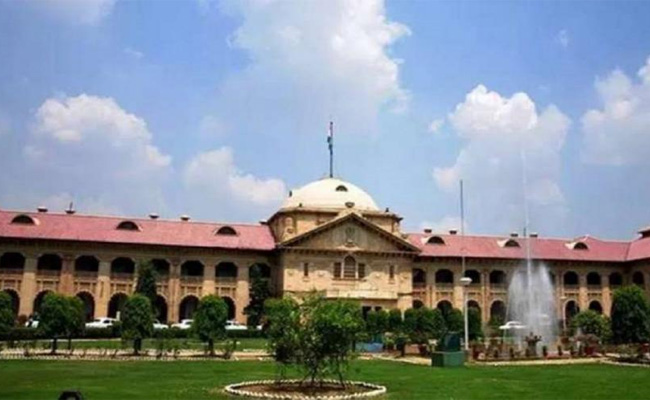
Lucknow (PTI): The Lucknow Bench of the Allahabad High Court on Friday ordered a probe by the special task force (STF) into alleged irregularities in the rejoining of a teacher at City Intermediate College in Barabanki, observing that the reinstatement appeared to be prima facie illegal.
The court also directed the recovery of the salary paid to the teacher during the disputed period.
A bench of Justice Rajeev Singh passed the order on a petition filed by the college management committee. The court expressed doubts over the roles of the District Inspector of Schools (DIOS), Barabanki, the college principal and the teacher concerned and hence, directed a detailed inquiry into the matter.
Taking note of alleged manipulation of records and misleading submissions, the court ordered the immediate transfer of the Barabanki DIOS to ensure a fair probe. It also directed the initiation of disciplinary proceedings against the then joint director of education of the Ayodhya division.
In its order, the court found that the teacher, Abhay Kumar, was initially appointed as an assistant teacher in 2018 but joined an Eklavya Model Residential School in Chhattisgarh as a lecturer in June 2024 without obtaining permission from the management. His subsequent request to retain the lien was rejected.
Despite this, he was allowed to rejoin the Barabanki College in September 2025 on the directions of the joint director of education and the DIOS, and was even paid the salary for October 2025. The court termed the rejoining "wholly illegal" and lacking any legal basis.
The bench also expressed concern over lapses in communication within the education department and directed the Uttar Pradesh chief secretary to ensure that official orders are communicated through email and WhatsApp as well, to prevent disputes.
The matter is next listed for hearing on May 28 when a compliance report is sought.