SFI demands Education minister's resignation, enforces strike on university campuses in West Bengal
_vb_90.jpeg)
Kolkata (PTI): Activists of the CPI(M)'s student wing SFI gathered on university campuses across West Bengal on Monday morning to enforce a strike demanding the resignation of Education Minister Bratya Basu.
Two students were injured when a car in the convoy of Basu grazed past them during a melee in Jadavpur University on March 1 as Leftists students tried to prevent the minister from leaving the campus, demanding a discussion on the conduct of student union polls. Basu sustained injuries as the windshield of his car was damaged by the protesters.
Campuses of Jadavpur and Presidency universities in Kolkata wore a deserted look on Monday morning as common students, faculty members and other staffers stayed away while Students' Federation of India (SFI) members gathered on the campuses to enforce the day-long strike that began at 10 am.
Campuses of other higher educational institutions such as Calcutta University, Rabindra Bharati University, North Bengal University and Burdwan University were partially affected as some classes were not held even though semester examinations were conducted, officials said.
However, fewer SFI activists were seen on these campuses, unlike at JU and Presidency University.
Activists of Trinamool Chhatra Parishad, the students' wing of the ruling TMC, were also seen on the campuses.
The strike did not affect vehicular movement so far as the SFI activists did not cause any disruption to road traffic and candidates proceeded smoothly to various examination centres across the state since the morning hours. West Bengal board class 12 examinations also began on Monday.
Saturday's incident took place on JU campus when Basu was leaving the premises after attending the AGM of West Bengal College and University Professors Association (WBCUPA) as the chairman of the TMC-aligned teachers' body.
"Outsiders sheltered by the TMC had instigated the violence and vandalism on the Jadavpur University campus on Saturday during the AGM of WBCUPA in the presence of Basu," SFI state committee member Shuvajit Sarkar alleged.
Tracing the chain of events on the Jadavpur University campus on March 1, Sarkar told PTI, "The students only wanted to have a discussion with the education minister in the presence of vice-chancellor but he behaved in a high-handed manner with them and tried to leave the campus in a huff."
Despite the students demanding an audience with the minister, he, accompanied by TMC musclemen and outsiders, boarded his car and his driver accelerated the vehicle without concern about the safety of the students who were protesting near the vehicle. His car injured two students, one of them seriously, and he did not bother to look back but sped away, Sarkar alleged.
"Basu is responsible for the injuries to the two students and we demand his resignation from the state cabinet and police action against him for fuelling fire on Jadavpur University campus," he said.
The SFI will extend its help to the smooth conduct of the higher secondary examinations, which began on Monday, and will organise camps near examination centres to assist the candidates, he added.
Let the Truth be known. If you read VB and like VB, please be a VB Supporter and Help us deliver the Truth to one and all.
Sujit Nair raises concerns over speculation of DMK-AIADMK understanding to block TVK
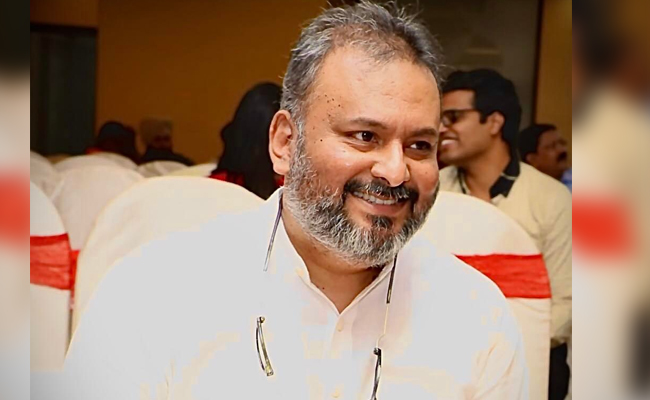
Chennai: Journalist and political commentator Sujit Nair has expressed concern over speculation that the Dravida Munnetra Kazhagam and the All India Anna Dravida Munnetra Kazhagam could explore a post-poll understanding to prevent Vijay-led Tamilaga Vettri Kazhagam from forming the government in Tamil Nadu.
In a social media post, Sujit Nair said the election verdict in Tamil Nadu reflected a clear public demand for political change and argued that the mandate should be respected irrespective of political preferences.
Referring to reports and political discussions surrounding a possible understanding between the DMK and AIADMK, he said he hoped such developments remained only speculative conversations and did not turn into reality.
Nair stated that if such an alliance were to take shape, it would raise serious questions about ideological politics in the country. He said TVK had emerged through a democratic electoral process and that the legitimacy to govern in a parliamentary democracy comes from the people’s verdict.
According to him, attempts to prevent an electoral winner from forming the government through unexpected political arrangements may be constitutionally valid, but many people could view them as politically opportunistic.
He further said that such a move could particularly affect the political image of the DMK, which has historically projected itself around ideology, social justice and opposition politics. Nair said that in ideological terms, the DMK appeared closer to TVK than to the AIADMK, and joining hands with its long-time political rival only to remain in power could weaken its broader political narrative.
He added that the same questions would apply to the AIADMK as well, as the party had spent decades positioning itself against the DMK and such an arrangement could create discomfort among its cadre and supporters.
Drawing a comparison with Maharashtra politics in 2019, Nair said he had expressed similar views when the Shiv Sena formed an alliance with the Indian National Congress and the Nationalist Congress Party after the Assembly elections.
He said post-poll alliances between long-standing political rivals often create a public perception that ideology and electoral mandates become secondary when political power equations come into play.
Nair also said such developments increase public cynicism towards politics and reinforce the belief among voters that ideology is often sidelined after elections.
He maintained that the Tamil Nadu verdict was emphatic and said respecting both the spirit and substance of the mandate was important for the credibility of democratic politics.