
Amit Shah moves CAB in RS, says Indian Muslims 'were, are and will remain' Indians
Rajya Sabha briefly stops telecast during Citizenship Bill debate as opposition members heckle Shah
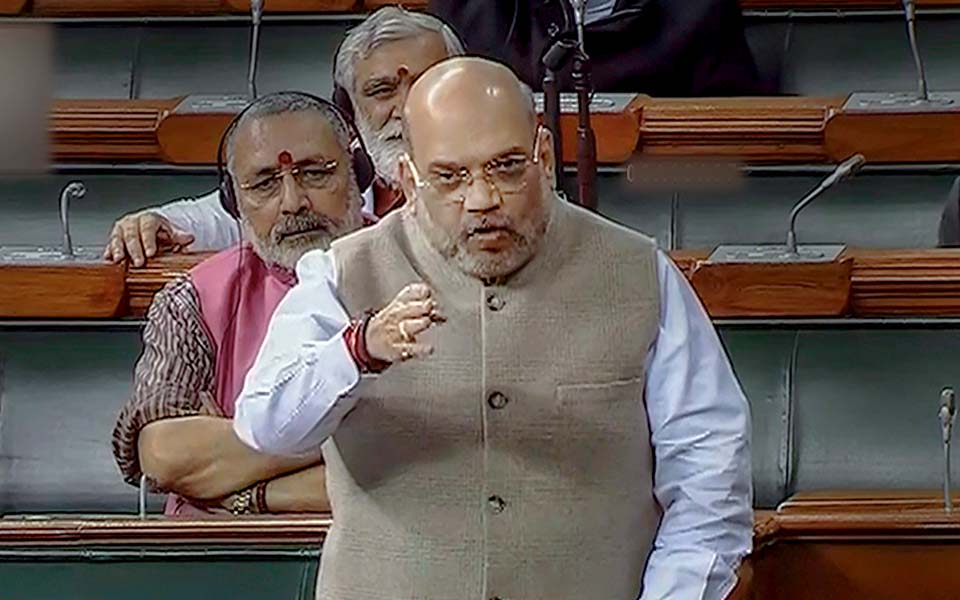
New Delhi, Dec 11: Home Minister Amit Shah on Wednesday moved the controversial Citizenship (Amendment) Bill in the Rajya Sabha, saying Indian Muslims "were, are and will remain Indian citizens".
Moving the bill that provides Indian citizenship to non-Muslim migrants from Pakistan, Bangladesh and Afghanistan, Shah said minorities in the three nations do not get equal rights.
The population of minorities in these countries has reduced by as much as 20 per cent, either by way of elimination or because they migrated to India, he said, adding that these migrants did not get rights to jobs and education.
The bill provides citizenship to these persecuted minorities, Shah said.
The legislation, which allows citizenship for Hindus, Sikhs, Buddhists, Jains, Parsis, and Christians who illegally migrated to India from Afghanistan, Bangladesh, and Pakistan, was passed by Lok Sabha on Monday.
Several MPs of opposition parties moved a motion to send the bill to the select committee of the Upper House.
The bill and the opposition motion will be put to vote after a debate on it.
Shah rejected the charge of vote bank politics, saying the BJP had declared its intention to bring such a legislation in its election manifesto for the 2019 general election and won the people's approval.
He said Indian Muslims have nothing to worry about as they "were, are and will remain Indian citizens".
Non-Muslim minorities from three nations who came to India after Independence will be given Indian citizenship, the home minister said, adding that Muslim migrants from the world over cannot be given citizenship.
The BJP government will protect the interests of Assamese, Shah said.
Rajya Sabha TV briefly stopped the telecast of proceedings when opposition members heckled Shah over his claims of protecting Assamese interests.
The bill, which prevents Muslim migrants from neighbouring countries from receiving citizenship, has sparked protests and fear around the country.
The citizenship law goes hand in hand with a contentious programme that began in Assam this year -- all 3.3 crore residents of the state had to prove, with documentary evidence, that they or their ancestors were Indian citizens. About 20 lakh people were left off the state's citizenship rolls after that exercise.
This is the second attempt by the Modi government to amend the citizenship law. In January, the legislation was passed in the lower house but lapsed as the Rajya Sabha didn't take it up before dissolution of the 15th Lok Sabha.
A group of 900 scientists and scholars issued a joint statement against it saying use of religion as a legal criterion for determining Indian citizenship is disturbing.
Let the Truth be known. If you read VB and like VB, please be a VB Supporter and Help us deliver the Truth to one and all.
Karnataka issues nutrition advisory for govt events; recommends millets, healthier options
_vb_61.jpeg)
Bengaluru (PTI): The Karnataka government on Monday issued a nutrition advisory recommending healthier food and beverage options at meetings, functions, and other official gatherings held in the state.
The advisory has been issued by the Department of Karnataka Health and Family Welfare Services to promote healthy dietary and nutritional habits among officials and staff, noting that food, refreshments and beverages served in government offices and official programmes are "often not aligned with nutrition standards."
The advisory recommends serving snacks such as millet-based, low-fat and low-sugar foods, fresh fruits, vegetable salads, sprouts, roasted nuts and seeds during in-house office meetings and breaks.
Beverages such as green tea, low-fat buttermilk, and locally filtered or boiled water served in glass bottles or steel flasks have also been suggested.
According to the advisory, for larger government events, conferences and exhibitions, departments have been advised to include at least one millet-based item during snacks and a minimum of two millet dishes in meals, along with local cuisine and at least one regional recipe.
It also recommends the use of brown rice instead of white rice, freshly prepared vegetable salads, and fresh fruits or low-sugar fruit juices.
If non-vegetarian food is served, it should consist of well-cooked lean or white meat, the advisory stated.
In eateries operating within government office campuses, the department has recommended millet-based foods, fresh vegetable salads, boiled pulses such as horse gram or chickpeas, and low-fat beverages.
It suggests serving food using reusable metal plates and glasses.
The advisory also recommends avoiding microwave-heated food, industrially processed food, fried snacks, high-fat or heavily spiced dishes, carbonated drinks, high-sugar fruit juices, and alcoholic beverages.
It further discourages serving milk-based tea or coffee and plastic-bottled water during official events.
“Overall, hygiene and cleanliness should be maintained while serving food and water. Local cottage industries, self-help groups, prison kitchens, nutri-gardens and others should be preferred for placing food and beverage orders,” the advisory added.
_vb_54.jpeg)
_vb_07.jpeg)
_vb_34.jpeg)