Shah to spell out Bengal poll strategy in Saturday's Kolkata rally
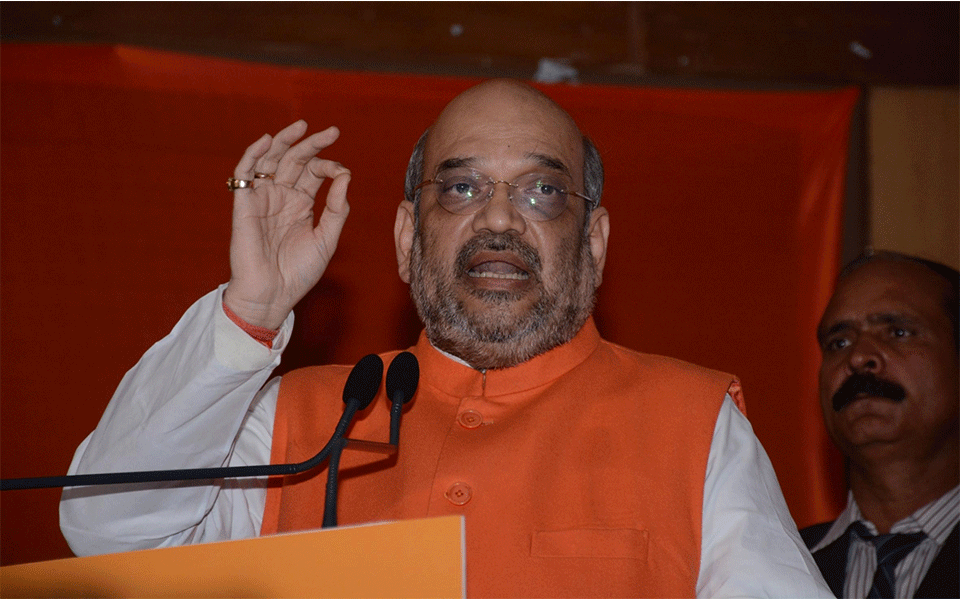
Kolkata, Aug 10 : Amid heightened security in the backdrop of the canopy collapse tragedy in Prime Minister Narendra Modi's meeting less than a month back, BJP chief Amit Shah is slated to address his first public rally in the city this year on Saturday, when he is expected to set the tone for his party's political battle against the Mamata Banerjee-led Trinamool Congress (TMC) ahead of the 2019 general elections.
Convened under the banner of the Bharatiya Janata Party (BJP)'s youth wing Bharatiya Janata Yuva Morcha (BJYM), the rally has been given a huge build-up by the party, which is fast emerging as the principal challenger to the state's ruling TMC. All prominent state BJP leaders are scheduled to share the dais with Shah.
Political circles are according great significance to the rally -- to be held on Mayo Road in the heart of Kolkata -- in the backdrop of the recent publication of the first complete draft of the National Register of Citizens (NRC) in Assam, which has pitted Banerjee in a high decibel war of words with Shah.
The state BJP leaders have already started talking of the need for a similar NRC for Bengal -- a state bordering Bangladesh -- to identify infiltrators, and Shah's speech could give an idea on how and up to what extent the BJP plans to project the issue in the poll campaign.
The BJP President previously came to Bengal on a two-day visit towards June-end. He had then addressed the intellectuals here, besides meeting the families of three slain party workers in Purulia, where he claimed that the BJP would win more than 22 out of the 42 Lok Sabha seats in Bengal next year. The party had bagged two LS seats in 2014.
BJP National Secretary Rahul Sinha said Shah might talk about low employment generation in the state during his address, besides flaying the Mamata Banerjee government for the poor law and order situation and frequent atrocities of the ruling party workers on the BJP activists.
"Employment is a major issue in the state. No one is looking for Banerjee's favours. The people of Bengal do not want rice at the rate of two rupees per kilogram. They want opportunities to earn their livelihood and live a good life. This government has failed to provide that," Sinha told IANS.
The BJYM is hoping to assemble close to four lakh activists and supporters to listen to Shah, and has even changed the direction of the stage from the one originally planned so as to accommodate the large audience on the scenic tree-lined road.
"Till Thursday morning we were expecting a crowd of about three lakhs for the rally and made arrangements accordingly. However, another 80,000 supporters are willing to attend the rally. We can't ask them not to come. So, we have decided to reverse the direction of stage to accommodate more people on the road," Bengal President of BJYM Debjit Sarkar told IANS.
Taking a lesson from the incident of canopy collapse in Modi's rally in Midnapore town last month that left nearly 90 people injured, the organisers as also the city police are leaving no stone unturned to beef up security measures.
The venue is being turned into a fortress, and Sarkar said they would have their own arrangement for crowd management and security apart from the steps taken by the police.
The state BJYM chief said they would deploy 550 volunteers for managing the crowd, and a system would be put in place so that the volunteers are easily identifiable among the general public.
The organisers will be flying multiple drone cameras too to monitor security of the much-awaited rally, irrespective of the city police's permission for the same.
"Kolkata Police has not clarified its stand about our decision to use drone cameras during the rally. However, there is no security caution notice or an act of Kolkata Police that can stop one from flying a drone above the city. So, legally they cannot stop us from using drones," the BJP leader claimed.
Several senior officers of Kolkata Police -- including DC Traffic, Officer in-charge of two police stations, Special Branch, Intelligence Bureau (IB), Central IB, and officials of state Public Works Department (PWD), CRPF and CISF -- held a meeting with the state BJP leaders on Thursday evening to chalk out the security blue print for Saturday's rally and assured them of adequate security, a party insider said.
Let the Truth be known. If you read VB and like VB, please be a VB Supporter and Help us deliver the Truth to one and all.
Two injuries, one DNF, a DQ as India end messy World Relays campaign
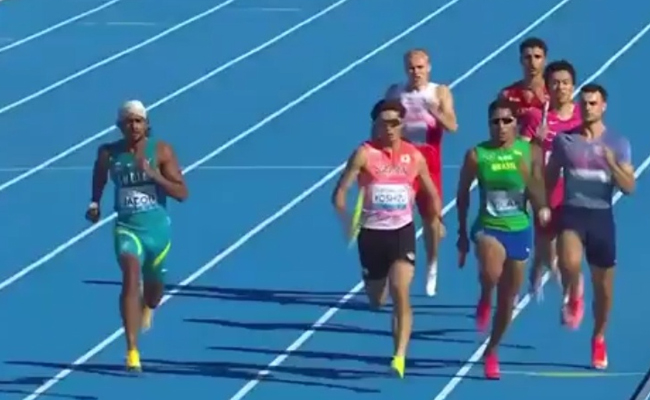
Gaborone (Botswana) (PTI): Amoj Jacob and Ragul Kumar got injured during the men's 4x400m and 4x100 races respectively as India ended their World Athletics Relays campaign in disappointment on the second day of competitions here on Sunday.
The Indian camp had high hopes of making the 2027 World Championships in the men's 4x400m relay but the team did not finish (DNF) the race as Jacob suffered cramps and pulled out of the race after taking the baton from the first leg runner Dharamveer Choudhary. Rajesh Ramesh and Vishal TK were to run in the third and fourth legs.
Those teams which could not qualify for the 2027 Beijing World Championships by reaching the final round of each of the six relay events on Saturday were given another chance in the second qualification round on Sunday.
The top two teams in each of the two heats (in all six relay events) booked the Beijing ticket on Sunday.
India will now have to try and qualify for the World Championships through the Top Lists of the World Athletics, which is a long and tedious process.
In the men's 4x100m race, third leg runner Ragul Kumar fell down the track after failing to hand over the baton inside the exchange zone to fourth leg runner Gurindervir Singh, which clearly showed the lack of coordination among the runners.
Harsh Santosh Raut and Animesh Kujur ran the first two legs.
The Indian quartet was disqualified and Kumar was seen being taken away from the Field of Play with the help of the volunteers.
It was a comedy of errors in the case of the women's 4x100m race, which saw the baton being dropped during an exchange between first leg runner Tamanna and second runner Nithya Gandhe, though the Indians finished the race in 53.09 seconds.
Gandhe started running quite a distance, but after realising that the baton was not in her hand, she turned and ran back to pick it up.
The only silver-lining for the Indian contingent was the national record time in the mixed 4x100m relay race, though the quartet of Ragul Kumar, Nithya Gandhe, Animesh Kujur and Sneha SS finished sixth in heat number two with a time of 41.35 seconds, bettering the previous national mark of 42.30 seconds set in March in Chandigarh.
The mixed 4x400m relay quartet of Theerthesh P Shetty, Kumari Saloni, Nihal William and Rashdeep Kaur ended at fifth in heat number one with a time of 3 minutes and 19.40 seconds.
On Saturday, all the five Indian relay teams had failed to make it to the respective final rounds and thus missed out on the 2027 World Championships berths.