'Shall I shoot myself too'? RPF cop asked wife after killing 4 in train; said he made 'big mistake'
Mumbai (PTI): Moments after allegedly gunning down four persons in a train near Mumbai, including a senior colleague, dismissed Railway Protection Force (RPF) constable Chetansinh Chaudhary called up his wife and said he had committed a "big mistake" and asked her if he should "shoot" himself, too, according to her statement which is part of the case's chargesheet.
Chaudhary's wife, Priyanka, has made this claim in a statement given to the police after the July incident which is part of the chargesheet filed by the Government Railway Police (GRP), the probe agency in the case.
Her statement also mentioned that the accused had a "blood clot" in the brain and was taking medicines for the same.
The GRP on October 20 filed a chargesheet before a magistrate's court here against Chetan Chaudhary (34), accused of fatally shooting a senior colleague and three passengers on board a moving Mumbai-bound express train on July 31 near Palghar railway station on the outskirts of the metropolis.
He has been booked under Indian Penal Code (IPC) sections 302 (murder), 153-A (promoting enmity between different groups on grounds of religion, race, place of birth, residence, language, etc) and others, as well as relevant provisions of the Railways Act and the Maharashtra Prevention Of Defacement of Property Act.
Priyanka Chaudhary, in the statement, said on the day of the shooting incident, her husband phoned at around 6:30 am and told her about his murderous act.
"Maine teen logon ko, aur ek SI (sub-inspector) to maar dia hai Mujse badi galti hogai hai..tum bolo toh apne AAP ko goli maar doon kia (I have killed three people and SI.. Have made a big mistake shall I shoot myself too?)," constable Chaudhary told his wife, according to the statement. She asked her husband to surrender before the police, the statement said.
Priyanka Chaudhary said her husband's father, who was also in the RPF, died on duty in 2007 and Chetan Chaudhary was then studying in Class 10. After completion of 18 years, Chetan Chaudhary joined the RPF on compensatory grounds and was posted in Ujjain, Madhya Pradesh.
In 2018, he was transferred to Gujarat where he stayed in a village called Radavav near the coastal town of Porbandar. In April this year, the RPF constable was transferred to Mumbai, the statement said.
Priyanka Chaudhary told the police that when her mother-in-law went to meet Chetan Chaudhary in Porbandar in February, she found his "behaviour abnormal".
As per her mother-in-law, the RPF constable used to suddenly start blabbering, something without any provocation, and also used to bang his head against the wall, the statement said.
On February 13 this year, Chetan Chaudhary was taken to a neurosurgeon in Mathura, Uttar Pradesh. After initial tests and MRI (magnetic resonance imaging), it was diagnosed that there was a minor blood clotting in his brain, she said.
The statement said the doctor gave him medicines for ten days. After the first course, when the doctor re-examined him, he found some improvement in his condition. Hence, he was advised to continue the same medications.
Chetan Chaudhary's uncle, in a statement to the police, said the accused was disturbed because he was transferred from Porbandar to Mumbai, whereas he wanted posting in either Mathura or Agra.
The chargesheet has statements of several witnesses, including co-passengers of the Jaipur-Mumbai Central Express, where the gruesome incident took place.
After killing the four persons, the RPF cop had threatened another passenger, saying chant "jai mata di or I'll shoot you". Hence, the GRP have added the charge of promoting enmity against him.
The 34-year-old RPF constable was nabbed with his weapon after passengers pulled the chain of the train which stopped near Mira Road station (on the Mumbai suburban network).
He shot dead RPF Assistant Sub-Inspector Tika Ram Meena, who was travelling with him in the train, and a passenger in B5 coach with his automatic weapon, according to the GRP.
Chetansinh Chaudhary then killed another passenger in the pantry car and one more traveller in S6 coach next to the pantry car after 5 am, said the probe agency.
His lawyer Amit Mishra said they will comment on the chargesheet only after going through the document.
Let the Truth be known. If you read VB and like VB, please be a VB Supporter and Help us deliver the Truth to one and all.
ICSE, ISC results: Girls outperform boys, pass rate over 99%
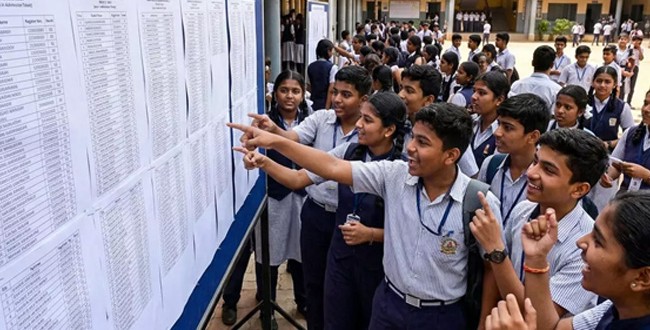
New Delhi (PTI): The Council for the Indian School Certificate Examinations on Thursday announced the Class 10 and Class 12 results for 2026, with overall pass percentages of 99.18 per cent and 99.13 per cent, respectively.
A total of 2,58,721 candidates appeared for the Indian Certificate of Secondary Education (ICSE), or Class 10, examination.
About 1,03,316 students took the Indian School Certificate (ISC), or Class 12, exam.
Girls outperformed boys in both examinations.
In ICSE, girls recorded a pass percentage of 99.46 per cent compared to 98.93 per cent for boys.
In ISC, girls achieved a 99.48 per cent pass percentage, while those of boys stood at 98.81 per cent.
Students can now access their scorecards on the official website cisce.org.