Shanghai becomes world's first district with 5G coverage
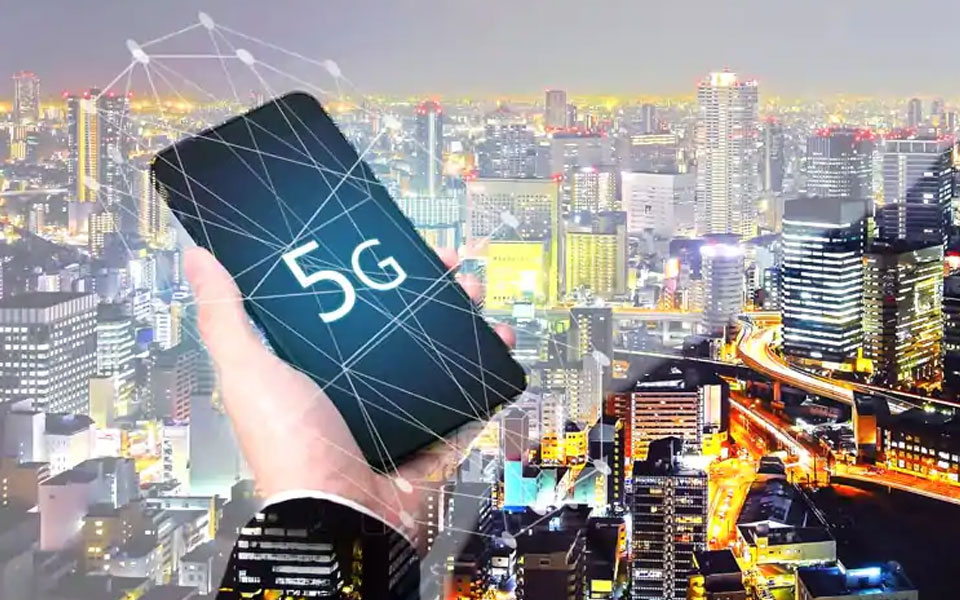
Beijing: Shanghai claimed on Saturday that it has become the world's first district using both 5G coverage and broadband gigabit network as China seeks to establish lead over the US and other countries in the race to develop next generation cellular mobile communications.
5G is the next generation of cellular technology with download speeds that are 10 to 100 times faster than 4G LTE networks.
Shanghai has developed what it claims to be the first district boasting both 5G coverage and a broadband gigabit network, the state-run China Daily reported.
Trial runs of the 5G network, backed by state-run telecom carrier China Mobile, officially started the service in Shanghai's Hongkou on Saturday, where 5G base stations had been deployed over the last three months to ensure full coverage, the report said.
During a launch ceremony, Shanghai vice-mayor Wu Qing made the network's first 5G video call on an Huawei Mate X, the world's first 5G foldable, AI phone, it said.
When fully operational, subscribers stand to avail of the same service without having to upgrade their SIM cards, it said.
Huawei, China's telecom technology giant, whose revenue in 2018 crossed USD 100 billion, is battling a wave of opposition to its 5G trials from the US and different countries.
The 5G stations are being installed in different parts of China, including Tibet, as part of Huawei's plans to lead the 5G trials despite the opposition.
The US has been pressurising countries it has closer ties to ban Huawei and other Chinese telecom firms from providing gear used to build 5G wireless networks.
Huawei has denied official links with the Chinese government.
China has also protested to the US about its efforts to extradite Huawei's CFO, Meng Wanzhou, who has been arrested in Canada to face prosecution for violations of US sanctions against Iran.
Meng, daughter of Huawei owner Ren Zhengfei has been accused of allegedly misleading banks about the company's business dealings there.
Zhang Jianming, deputy director of the Shanghai Municipal Economic and Informatisation Commission, the local telecom and industry regulator, said Shanghai city aims to build over 10,000 5G base stations by the end of this year, and that figure is expected to surpass 30,000 in 2021.
A comprehensive deployment of the network, which transmits at least 10 times faster than 4G at peak rates, will help develop industrial manufacturing, internet-connected cars, healthcare and smart city management, Zhang said.
Zhang further said that these are all strategically critical industries for both Shanghai and China.
"Shanghai also targets to nurture over 100 innovative companies specialised in exploring 5G-related application scenarios, whose industrial output is expected to reach 100 billion yuan (USD14.9 billion) by 2021," he said.
Jian Qin, vice-president of China Mobile, said it has invested the most in Shanghai to date to help the city expand its 5G trial network and related applications.
"China Mobile has invested the most in Shanghai to date to help the city expand its 5G trial network and related applications, because it is the most developed city in China with rather solid infrastructure in many aspects," he said.
Liang Zhiqiang, China Mobile's Shanghai deputy general manager, said the city's sound economic environment, systematic industrial outlay, huge market potential and vast talent pool have given it a unique edge in information technology.
In February, Shanghai announced a 5G deployment program in Hongqiao Railway Station, where users will be able to watch live broadcasts of town hall meetings and avail of lightning-quick downloads of high-resolution movies, when mobile devices such as 5G-powered phones and tablets become available.
Apart from speed, 5G also enables high-definition transmissions in real time (which means low latency) and will bolster development in the internet of things industry.
Let the Truth be known. If you read VB and like VB, please be a VB Supporter and Help us deliver the Truth to one and all.
EAM Jaishankar meets Jamaican PM, gifts over 10 BHISHM Cubes
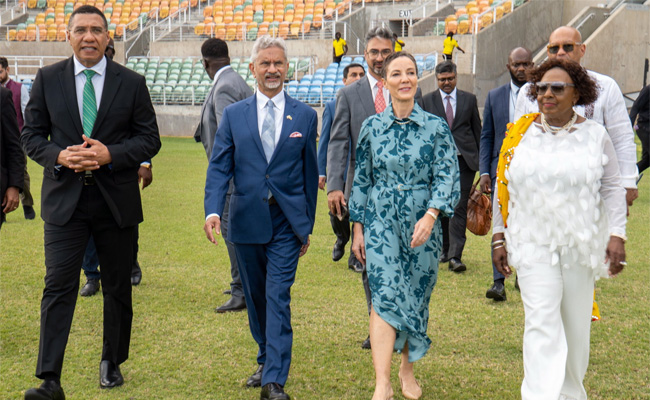
Kingston (PTI): External Affairs Minister S Jaishankar on Monday met Jamaican Prime Minister Andrew Holness and discussed ways to further deepen "political, economic and people-to-people cooperation."
Jaishankar also conveyed greetings from Prime Minister Narendra Modi to Holness.
"Pleased to call on Prime Minister @AndrewHolnessJM in Kingston. Conveyed the greetings of PM @narendramodi," Jaishankar posted on X.
"Discussed deepening our political, economic and people-to-people cooperation. Value his commitment towards further strengthening India-Jamaica relations," the post further read.
Also, the external affairs minister handed over 10 BHISHM (Bharat Health Initiative for Sahyog Hita & Maitri) Cubes as a gift to Jamaica.
"Formally handed over 10 BHISHM Cubes as a gift from India to Jamaica, in the presence of PM @AndrewHolnessJM, Health Minister @christufton and FM @kaminajsmith," Jaishankar posted on X.
"The BHISHM Cube mobile hospital system, designed for rapid deployment, will help Jamaica during disasters and emergencies. The gift of these cubes is a statement of friendship, a commitment to disaster preparedness, and an outcome of innovation," the post said.
Jaishankar arrived in Kingston on Saturday evening, marking the first leg of his nine-day tour of Jamaica, Suriname, and Trinidad and Tobago, aimed at further strengthening India's strategic and cultural ties with the Caribbean nations.
Earlier in the day, he interacted with the Indian diaspora and discussed India's ongoing transformation in infrastructure, human development and technology-driven governance and entrepreneurship with them.
He also highlighted the cricket bond between both countries as India gifted a scoreboard to Jamaica.
A scoreboard was dedicated at Sabina Park in Kingston. It is the home of the Jamaica cricket team and is the only Test cricket ground in the Caribbean island nation.
The minister expressed hope that the new scoreboard would witness many memorable innings, including those symbolising the enduring friendship between the two countries.
Cricket has long been a strong cultural bridge between India and Jamaica, which is part of the West Indies cricket team.
Jamaican players, including Chris Gayle, Courtney Walsh and Michael Holding, have played a major role in shaping the legacy of West Indies cricket in the international arena, contributing to its dominance in earlier decades and its continued global appeal.