Shirtless protest: Delhi court sends 3 IYC workers arrested from Shimla to 3-day police custody
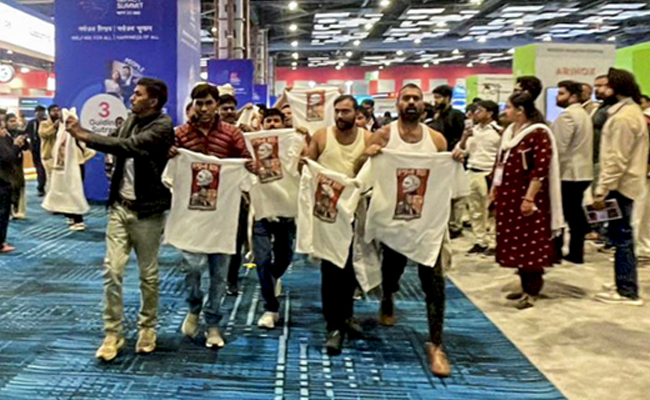
New Delhi (PTI): A Delhi court on Thursday sent three accused brought to the capital after a dramatic 24-hour standoff with the Shimla police following their arrest in the hill state over the shirtless protest at the AI Impact Summit here last week to three-day police custody.
Chief Judicial Magistrate Mridul Gupta passed the order on Delhi Police’s plea seeking five-day custodial interrogation of the three accused Youth Congress activists.
The magistrate said the accused trio needs to be produced in court on completion of their police remand on March 1.
The accused were produced in the court amid heavy security arrangements.
During the proceedings, the public prosecutor said that Saurabh and Arbaz Khan from Uttar Pradesh, and Sidharth Avdhut of Madhya Pradesh were “hiding in Himachal Pradesh”, and that they were arrested from a resort around 6:40 am on Wednesday.
The prosecutor said the trio was produced before a magistrate in Shimla around 1:40 pm the same day, who allowed Delhi Police’s plea seeking transit remand, and directed their production in the Delhi court concerned within 18 hours.
He said that while Sidharth designed the T-shirt displayed by the Youth Congress workers at the Summit venue on February 20, Saurabh created a WhatsApp group. Saurabh and Arbaz were present during the protest, he said.
“More than one lakh T-shirts were printed… We need to find the printing source, ascertain the origin and mechanism of the conspiracy, confront them with the co-accused, effect recovery, find the names of others involved…,” the prosecutor said.
The counsel for the accused claimed Delhi Police had engaged in “witch-hunting” by arresting those carrying out a peaceful protest.
“No recovery has been effected, there is non-compliance with rules. If you see the FIR, it mentions the same sentence as in the JNU case: ‘Tukde-Tukde’. What kind of precedent are we setting?” the advocate asked.
He also claimed that “political targeting of certain people belonging to the main opposition party.
“They are trying to set an example for political parties,” the counsel said.
The court also extended the police remand by three days of two other accused, Ajay Kumar and Raja Gujar, arrested earlier and produced in court on Thursday on completion of their three-day police custody.
The arrests sparked a high-voltage standoff between police teams of Delhi and Shimla, which ended after a dramatic 24 hours on Thursday morning, when the Delhi Police team was finally cleared to head back to the capital along with the three accused.
In the stalemate, the Delhi Police team was "detained" for about five hours even after procuring transit remand from the ACJM.
Let the Truth be known. If you read VB and like VB, please be a VB Supporter and Help us deliver the Truth to one and all.
'Sarke Chunar' row: Sanjay Dutt apologises; to sponsor education of 50 tribal girls
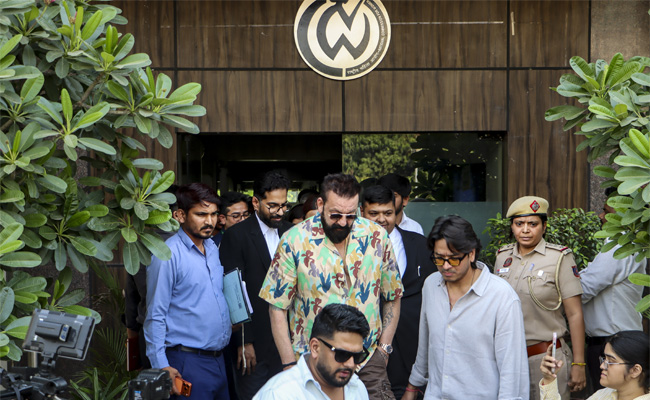
New Delhi (PTI): Actor Sanjay Dutt on Monday appeared before the National Commission for Women (NCW) in connection with the controversy over the song 'Sarke Chunar Teri Sarke' and submitted a written apology, expressing regret for any "unintended" harm caused to society.
During the hearing, held under NCW chairperson Vijaya Rahatkar, the commission raised concerns over alleged vulgarity and indecent representation of women in the song from the movie "KD The Devil" and questioned issues of intent, awareness and accountability.
The chairperson emphasised whether adequate due diligence was undertaken before participating in content that could be perceived as promoting objectification of women, while also underlining the responsibility of senior and influential public figures in ensuring that their work remains within the bounds of legal and societal standards.
As a corrective measure, Dutt committed to sponsoring the education of 50 tribal girl children as part of efforts towards social welfare and women's empowerment, the NCW said in a statement.
He also assured the commission that his future artist agreements would include mandatory legal due diligence provisions to ensure dignified and appropriate representation of women and children in films and related creative projects.
Actor Nora Fatehi, who was also summoned, could not appear as she is currently abroad and has sought a fresh date for the hearing.
On April 6, other individuals associated with the song, including director Kiran Kumar alias Prem, lyricist Raqueeb Alam and representatives of KVN Production Company Gautam K M and Suprith, appeared before the commission and submitted their apologies.
The NCW underscored that while artistic freedom is important, it must be exercised with responsibility and sensitivity, reiterating the need for accountability in content reaching wide public audiences and reaffirming its commitment to safeguarding the dignity and representation of women.
The Hindi version of the song, released on March 15 on YouTube, drew public ire for its sexually explicit lyrics.
After the outrage, the makers deleted the Hindi version of the song from YouTube, although it was widely played and shared across various platforms.
Fatehi, in a video later, distanced herself from the song, saying she shot the video for the Kannada version and her permission was not taken to use it in the Hindi version. The lyricist, singer and the director also apologised.
The issue was brought up in Lok Sabha during Question Hour by Samajwadi Party (SP) MP Anand Bhadoria last month.
Union Information and Broadcasting Minister Ashwini Vaishnaw said the song was already banned and the government was ready to take action against such vulgarity.
"KD The Devil" is a Kannada film, dubbed in four languages, including Hindi. It will release on April 30. The film features Dhruva Sarja, V Ravichandran, Ramesh Aravind, Shilpa Shetty, and Dutt.