Siang project not just for generating power but mitigating flood risks posed by China: Arunachal CM
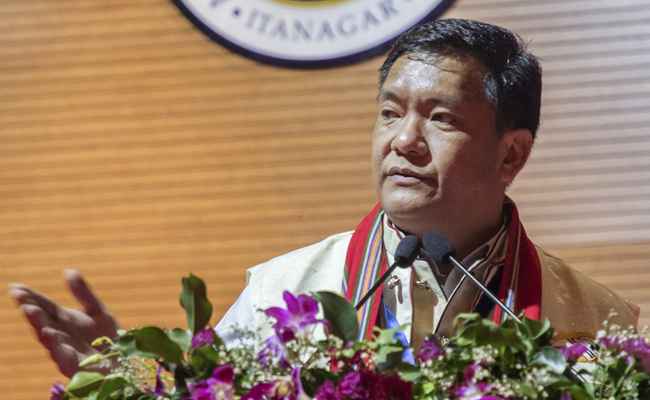
Itanagar (PTI): Arunachal Pradesh Chief Minister Pema Khandu said the Siang Upper Multipurpose Project (SUMP), estimated to cost Rs 1.13 lakh crore, was being planned by the Centre not just for generating electricity but to maintain the natural flow of the river all year round and mitigate risks of flooding if China released excess water.
Khandu's remarks came in the wake of China approving the construction of the world's largest dam, at a cost of USD 137 billion, on the Brahmaputra river in Tibet close to the Indian border. The dam is to be built at a huge gorge in the Himalayan reaches where the Brahmaputra river makes a huge U-turn to flow into Arunachal Pradesh and then to Bangladesh.
"The SUMP, with an estimated installed capacity of 11,000 mw, is not just about generating power, but also about maintaining the natural flow of the Siang river and mitigating potential flood risks from water releases by China," Khandu told PTI in an interview.
Describing SUMP as a project of national importance, he said hydropower generation is only the secondary goal of it.
"The real objective of the project is to save the Siang river and the communities that have depended on it for generations," he said.
The survey for preparing the pre-feasibility report of the projects is yet to be done amid stiff opposition from locals who are concerned about displacement, loss of livelihoods, and environmental impact of the mega dam.
Warning of severe consequences if China's project moves ahead "without safeguards", Khandu said the neighbouring country's plans to divert water from the Brahmaputra into its arid regions could drastically reduce the flow of the Siang river during winters.
"In such a scenario, the volume of water could decrease so much that one might be able to cross the mighty river on foot," he claimed.
"The proposed Siang project would create a reservoir capable of storing 9 billion cubic meters of water. This would ensure the river maintains a consistent flow, even during dry seasons. Additionally, the reservoir would act as a buffer in case of sudden water releases from upstream Chinese dams, potentially averting catastrophic flooding in Arunachal Pradesh, Assam and Bangladesh," he said.
Acknowledging the ongoing bilateral discussions between India and China, the CM cautioned against "complacency".
"China is unpredictable and can do anything," Khandu said, underscoring the need for India to remain vigilant.
"We cannot take chances when it comes to national security and the welfare of our people," he said.
The Chinese government approved the construction of the hydropower project in the lower reaches of the Yarlung Zangbo river, the Tibetan name for the Brahmaputra. It is expected to generate more than 300 billion kWh of electricity each year – enough to meet the annual needs of over 300 million people.
The total investment in the dam could exceed one trillion yuan (USD 137 billion), which would dwarf any other single infrastructure project on the planet, including China's own Three Gorges Dam, regarded as the largest in the world.
On the concerns of the locals, Khandu said the government would conduct extensive surveys before finalising the plans.
"Only after these studies, we will know the exact location of the dam, its height, and the submergence area," he said, adding that a public hearing will be held to listen to people's concerns.
The CM said India was a democratic country, and it does not believe in "forcing" things on its people.
However, he criticised activists, accusing them of spreading misinformation among villagers about the project.
He claimed that these activists were instigating people without providing accurate information about the project's benefits.
"I urge people to come forward and get their confusions addressed through dialogue," he said.
Khandu also spoke about the state's broader hydropower development plans.
He said the Cabinet Committee on Economic Affairs (CCEA) recently sanctioned Rs 1,750 crore for the 186 mw Tato-I Hydro Electric Project and Rs 1,939 crore for the 240 mw Heo Hydro Electric Project in the Shi Yomi district.
The CM said the state has signed agreements with NHPC, NEEPCO, THDCIL, and SJVN to develop 13 hydropower projects with a combined capacity of over 11,000 mw. Once completed, these projects are expected to generate substantial revenue for the state.
The Centre has also approved a significant equity support scheme to boost hydropower development in the Northeast, he said.
Under this initiative, Rs 4,136 crore has been allocated to northeastern states to develop hydroelectric projects with a cumulative capacity of 15,000 mw by 2032.
"This initiative will transform the hydroelectric landscape of Arunachal Pradesh and the northeast region," Khandu said, adding the Centre has also agreed to increase the Local Area Development Fund (LADF) contribution from power projects to over 2 per cent.
"We are taking steps to ensure that Arunachal Pradesh becomes a powerhouse for the nation while protecting the interests of our people and environment," he added.
Let the Truth be known. If you read VB and like VB, please be a VB Supporter and Help us deliver the Truth to one and all.
Air India resorts to cost-cutting ways amid 'tough times'; layoffs not anticipated
New Delhi/Mumbai (PTI): Hit hard by Pakistan airspace closure and Iran war, Air India has resorted to cost-cutting measures, including holding back annual increments for staff and asking them to cut discretionary spending as well as non-critical expenditures, warning of "tough times".
On Friday, Air India Chief Executive Officer & Managing Director (CEO & MD) Campbell Wilson told the staff it is going to be a "very, very difficult year" if things don't improve on the Middle East front.
A day after the loss-making airline's board discussed various cost-saving steps, Wilson, along with Chief Financial Officer (CFO) Sanjay Sharma and Chief Human Resources Officer (CHRO) Ravindra Kumar GP, addressed the employees during a townhall on Friday where the emphasis on the need to keep a close watch on costs.
With higher jet fuel prices due to the West Asia conflict and airspace curbs, the loss-making airline's expenses have spiralled in recent times and against this backdrop, Sharma also told staffers that FY26 has seen a softening in revenue amid heightened external uncertainties.
Calling for a relentless focus on costs in these tough times, Wilson urged employees to suspend discretionary spending, renegotiate rates where feasible, and defer non-critical expenditures.
"There must be a laser-sharp focus on eliminating wastage and leakages," he said.
Stressing the need to tighten the belt for a while, Wilson sounded optimistic that travel demand would rebound and the industry would continue on its upward path.
CHRO Ravindra Kumar told staff that the airline will proceed with variable pay for the last financial year and continue with planned promotions while noting that annual increments will be deferred by at least one quarter.
"We don't anticipate layoffs," he said.
At the airline's board meeting on Thursday, various cost-saving steps, including likely furloughs, were discussed. The Tata Group-owned airline has around 24,000 employees.
Generally, furlough refers to sending staff on unpaid leaves by companies during a tough financial situation.
During the townhall, CFO Sanjay Sharma said while strong revenue growth and fleet expansion drove financial momentum through FY25, FY26 has seen a softening in revenue amid heightened external uncertainties.
Air India has seen around 40 per cent CAGR (Compounded Annual Growth Rate) in revenue between 2022 and 2025, he added.
The airline was acquired by the Tata Group from the government in January 2022.
The Air India CEO mentioned the external challenges being facing the aviation industry as a whole, including the continued closure of Pakistan airspace that is expected to persist for the foreseeable future and geopolitical conflicts leading to disruptions and airspace closures across West Asia.
Wilson, who is set to step down later this year, also flagged a sharp depreciation of the rupee and a 2.5-3 times increase in jet fuel prices, and added that these factors have adversely affected travel sentiment and consumer confidence, as per the sources.
If the Strait of Hormuz opens, oil prices fall and consumer as well as business confidence come back, there is a decent chance of a solid recovery, Wilson said, adding that unless those circumstances happen, it was going to be "a very, very difficult year".
"I feel somewhat responsible that we ended up with probably the biggest surprise of the year in the external environment which was a full-scale war in our neighbouring region in the Gulf. That has had a huge impact on airspace," he said.
For Air India, Wilson said the situation is compounded by the fact that the airline cannot fly over the neighbouring country and has to take a much longer routing for any west-bound destination.
"Every airline is reporting that they are under some sort of financial pressure as a result of higher fuel prices and economic uncertainty. So, it is unfortunately not a great environment to be running an airline," the Air India CEO said.
The Air India Group -- Air India and Air India Express -- is projected to have incurred more than Rs 22,000 crore loss in the financial year ended March 2026.
At the townhall, Wilson also highlighted various initiatives, including completion of the retrofit of its legacy narrow-body aircraft and rapid network optimisation to redeploy capacity more efficiently.