Sikkim flash flood: Search for 105 missing people continues, IAF begins rescuing stranded tourists
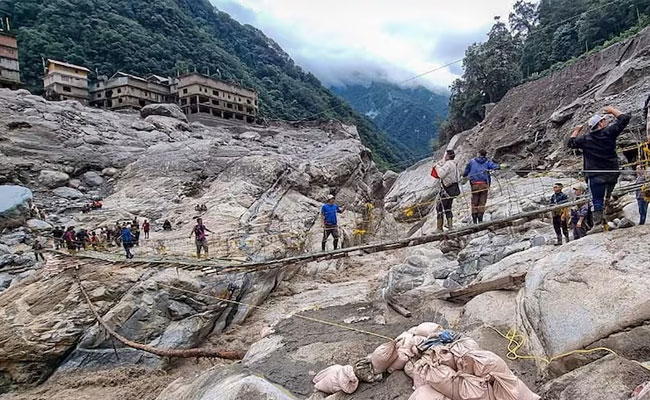
Gangtok (PTI): The death toll in Sikkim's flash flood has risen to 34, officials in the state said on Monday, while the administration in adjoining northern West Bengal said that 40 bodies have been fished out from the downstream of Teesta River.
Officials, however, warned that the figures reported by Sikkim and West Bengal will have some duplication even as both states were keeping each other informed of their respective rescue efforts.
Ten army jawans are among the deceased, while the search for 105 people who are still missing is underway.
The Indian Air Force has started rescue and relief operations in the Himalayan state, airlifting the first batch of stranded tourists from Lachen to Mangan in North Sikkim. As many as 77 tourists, including seven children, were also airlifted from Lachung to Pakyong airport.
Chief Minister Prem Singh Tamang held a review meeting with Chief Secretary VB Pathak, Chief of Army Staff General Manoj Pande, who has reached Gangtok, and other officials for coordinated relief and rescue operations along with armed forces.
Chief Secretary Pathak on Monday held another meeting with the members of the Inter-Ministerial Central Team (IMCT) and briefed them about the scale of destruction.
Of the 34 deaths reported in Sikkim, Pakyong district reported the maximum number of fatalities at 22, including 10 army personnel, followed by six in Gangtok, four in Mangan and two in Namchi.
A total of 105 people have been missing six days after a cloudburst over Lhonak Lake in Mangan district caused an upsurge in Teesta River, flooding several towns on the river basin across four districts in the Himalayan state.
Of the missing people, 63 are from Pakyong, 20 from Gangtok, 16 from Mangan and six from Namchi, according to a bulletin of the Sikkim State Disaster Management Authority.
As many as 3,432 houses, both kuccha and pucca, have been damaged. A total of 5,327 people have been rescued and evacuated. Altogether 14 bridges have been either washed out or submerged, affecting road communication in the state.
A total of 6,505 people have been rendered homeless by the flash flood and sheltered at 26 relief camps in four districts. The number of people affected by the flash flood stood at 85,870.
Meanwhile, CM Tamang convened a high-level meeting at his official residence where he reviewed the ongoing relief and rescue operations with Chief Secretary VB Pathak, Chief of Army Staff General Manoj Pande and other officials.
The meeting was held to ensure swift rescue of stranded people while working hand-in-hand with defence forces, an official said.
The Indian Air Force has started humanitarian aid and disaster relief operations in Sikkim, and rescued the first batch of stranded tourists from Lachen to Mangan aboard a helicopter, a Defence official said.
It also carried emergency service personnel and essential supplies to Lachen.
The exact number of tourists rescued in the first batch is not immediately known but the MI-17 helicopter used in the operation has a capacity to transport 25-30 people.
Also, 77 tourists were airlifted by MI-17 and Chinook helicopter from Lachung to Pakyong airport on Monday and a bus was made available to them for transportation to Siliguri in neighbouring West Bengal, an official said.
"The IAF commenced its humanitarian aid and disaster relief operations from Air Force Station Bagdogra for the flood victims of Sikkim on the Air Force Day," the Defence official said.
The air force started carrying Garud commandos, communication equipment, fuel, medicines, search and rescue equipment by Chinook and MI 17 V5 helicopters to the state from Sunday, he said.
Stating that the Eastern Air Command is coordinating the humanitarian aid and disaster relief (HADR) operations, the official said that the IAF is fully geared up to reach out to the victims of the flash floods that left the small Himalayan state in disarray.
The army, in a release, said, "The focus of the operations is towards restoring connectivity with North Sikkim through Chungthang, which was the worst affected during the devastating flood. Troops of the Indian Army undertook a challenging operation through difficult terrain and have reached the isolated village of Rabom, northwest of Chungthang and rescue of 150-200 civilians is underway."
"All locals and tourists in Chaten, Lachen, Lachung and Thangu areas in North Sikkim have been accounted for. A list of 2,000 tourists, including 63 foreign nationals, has been compiled and assistance is being provided to them. With the improvement in weather, air evacuation of tourists has started on October 9," it added.
The Met Department on Monday forecast light to moderate rain in many places accompanied by thunderstorms and lightning in sub-Himalayan West Bengal and Sikkim over the next five days.
Meanwhile, Pathak, in his meeting with the IMCT team, urged them to take a sympathetic view while making their recommendations to the Centre, seeking special relaxation of norms to restore vital infrastructure such as temporary bailey bridges in critical places which have been completely cut off.
The IMCT team is scheduled to visit Bardang, Golitar, Singtam and Dikchu areas in East Sikkim on Monday and Mangan, Naga, and Chungthang in North Sikkim on Tuesday.
Let the Truth be known. If you read VB and like VB, please be a VB Supporter and Help us deliver the Truth to one and all.
Ladakh a living land of dharma for centuries: Amit Shah
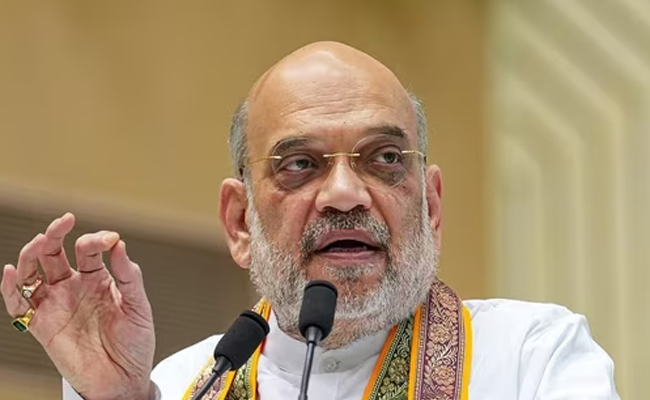
Leh/Jammu (PTI): Union Home Minister Amit Shah on Friday described the return of sacred relics of Lord Buddha to Ladakh after 75 years as a "historic reunion" and said that the Union Territory has remained a "living land of dharma", preserving and nurturing Buddhist knowledge for centuries.
Stressing the relevance of Buddha's teachings in modern times, Shah said the message of peace, compassion and the middle path was even more important today than it was 2,500 years ago.
"Ladakh has been a living land of dharma for centuries. When the Dalai Lama comes here, he says this land is not merely a geographical land but a living laboratory of Buddhist culture and compassion," Shah said, speaking after the inauguration of the sacred holy relics exposition of Tathagata Buddha and the 2569th Buddha Purnima celebrations at Jivetsal in Leh during his two-day visit to Ladakh.
Calling Ladakh a land of compassion, he said this land has preserved and nurtured knowledge. "Whenever Buddhism faced crises, this land worked to protect the teachings of Buddha. And when peace returned, it helped to expand and carry forward that preserved wisdom," he added.
"Unless one internalises knowledge and makes it a part of oneself, liberation is not possible. Knowledge is incomplete without spiritual practice, while spiritual practice without knowledge is blind. Therefore, the union of spiritual practice and knowledge is the right path. Even after all this, if there is no moral discipline, one cannot lead a truly wise life. The basis of a life of wisdom is moral discipline," he said.
Shah said it was through Ladakh and adjoining routes that the teachings of Tathagata Buddha, which originated in India, spread to China and several other countries.
"The message that emerged from the land of Ladakh has become a guiding force for many people around the world to take their lives forward. The presence of these sacred relics in Ladakh reminds us that India's civilisation has, for thousands of years, given the message of peace and coexistence," he said.
He said that in a diverse region like Ladakh and Kargil, this message becomes even more relevant. "This heritage still tells us today that amidst conflict and unrest, only the path of peace and compassion can provide solutions."
He said the return of the relics on Buddha Purnima had enhanced the significance of the festival for the people of Ladakh.
"These sacred relics have come to Ladakh after 75 years. It is as if Buddha himself is present here today," Shah said, adding that followers of Buddhism and people of other faiths in Ladakh and Kargil would draw spiritual energy from the relics.
Highlighting Ladakh's role in the spread of Buddhism, Shah said Kashmir was once an ancient centre of Buddhist studies, Mahayana philosophy and Buddhist art, from where Ladakh first came into close contact with Buddhism.
He said Emperor Ashoka's envoys laid the foundation of Buddhist influence in Ladakh through Kashmir and Gandhara, while Mahayana Buddhism expanded in the region during the Kushan period between the first and third centuries CE.
The Silk Route linking Kashmir, Leh, Yarkand, Khotan and Tibet became a channel not only for trade but also for ideas, monks, manuscripts and artistic traditions, Shah said.
He added that later, Tibetan influence between the seventh and tenth centuries further enriched Ladakh through Mahayana and Vajrayana traditions.
Stressing the relevance of Buddha's teachings in modern times, Shah said the message of peace, compassion and the middle path was even more important today than it was 2,500 years ago.
"Amid conflict and unrest, only the path of peace and compassion can provide solutions," he said.
Shah also appealed to the Ladakh administration to ensure complete arrangements so that followers of all faiths, especially Buddhists, could visit and pay obeisance to the relics.
#WATCH लेह, लद्दाख: केंद्रीय गृह मंत्री अमित शाह ने कहा, "जब दलाई लामा यहां आते हैं तो वे कहते हैं कि यह भूमि केवल भौगोलिक भूमि नहीं है। यह भूमि बौद्ध संस्कृति और करुणा की जीवंत प्रयोगशाला है। इस भूमि पर ज्ञान का संरक्षण हुआ है... भारत की सभ्यता हजारों वर्षों से शांति का संदेश… https://t.co/2nwG0w2CE6 pic.twitter.com/W13itRBqeX
— ANI_HindiNews (@AHindinews) May 1, 2026