Since demonetisation in 2016, about 50 lakh men have lost their jobs: Report
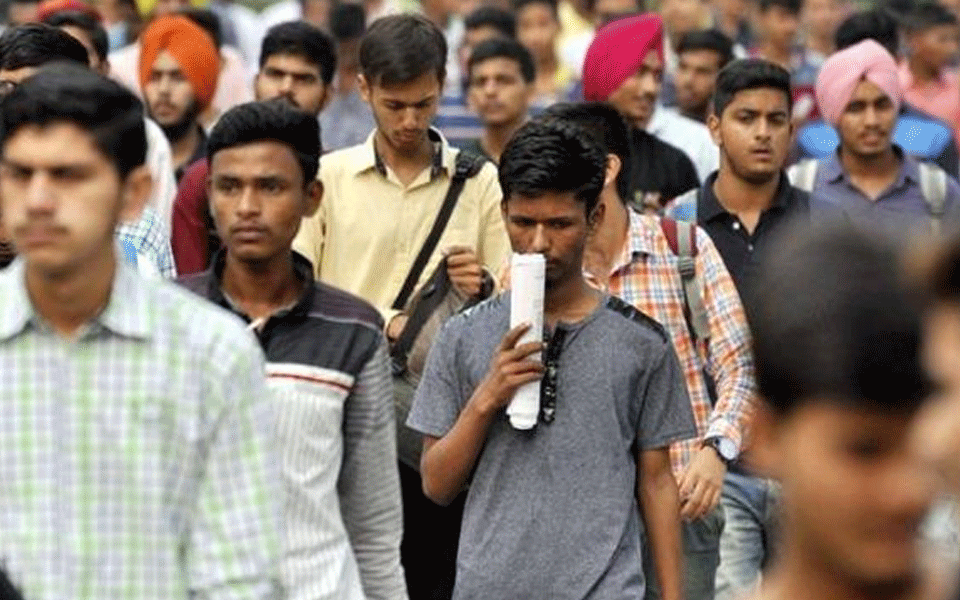
NEW DELHI: 50 lakh men lost their jobs in the past two years beginning November 2016, when Prime Minister Narendra Modi announced an overnight ban on high value currency, according to a new report. The timing of the start of the decline in jobs coincides with demonetisation but no "causal link" can be established based on the available data, says the "State of Working India 2019", released Tuesday by the Centre for Sustainable Employment, Azim Premji University, Bengaluru.
The job losses are higher when women are taken into account.
"Whether or not this decline was caused by demonetisation, it is definitely a cause for concern and calls for urgent policy intervention," the report says.
It assesses that unemployment, in general, has risen steadily post 2011 and the higher educated and the young are vastly over-represented among the unemployed.
In addition to open employment among the educated, the less educated have seen job losses and reduced work opportunities over this time period. The numbers, says the report, clearly demonstrate why unemployment has emerged as the primary economic issue in the election.
A government report leaked earlier this year had said the country's unemployment rate rose to a 45-year high in 2017-18.
The National Sample Survey Office's Periodic Labour Force Survey, conducted between July 2017-June 2018, showed the unemployment rate at 6.1 percent, the highest since 1972-73. The report was withheld by the government but accessed by the Business Standard newspaper.
But NITI Aayog vice chairman Rajiv Kumar said the report was "not verified" and the "veracity of the data is not known".
The latest report says the decline in the labour force participation rate (LFPR) and workforce participation rate (WPR) has largely been driven by less-educated men in both urban and rural areas.
"Clearly, there is a large differential impact by level of education. This is consistent with the idea that the informal sector, where we can expect the share of less educated men to be higher, was hit hardest by demonetisation as well as the introduction of GST."
The report says joblessness is not only a problem limited to the educated sections of the labour force. "While open unemployment may still be low among the less educated, there has been a marked tendency to drop out of the labour force for this section, presumably due to loss of work opportunities," it says.
courtesy: ndtv.com
Let the Truth be known. If you read VB and like VB, please be a VB Supporter and Help us deliver the Truth to one and all.
11-year-old dies by suicide after sexual assault in Bareilly; accused arrested

Bareilly (UP) (PTI): A 26-year-old man has been arrested for allegedly sexually assaulting an 11-year-old girl, who later died by suicide due to trauma, police said on Wednesday.
The post-mortem report confirmed sexual assault and multiple injuries on the minor's body, including bite marks and nail scratches. The cause of death was found to be hanging, they said.
According to ASP (South) Anshika Verma, the incident came to light on 27 April, when the girl, a Class 8 student, was found hanging at her home in Deoria Abdullaganj village under the Mirganj police station area. Initially, the family reported the death as suicide and was reluctant to pursue police action.
"The autopsy report changed the course of the investigation. It confirmed sexual assault and noted severe physical trauma. The cause of death was confirmed as hanging," Verma said.
A breakthrough in the case came from the statement of the victim's younger sister, who told police that the accused, Zeeshan (26), a resident of the same village, frequently loitered near the minor's school and allegedly gave her small sums of money to keep his interactions with her a secret, she said.
Police said that on the day of the incident, the accused allegedly lured the minor and assaulted her. Distressed by the incident, the child later took her own life while her mother was away, police said.
"Based on technical surveillance, CCTV footage, and statements from the family, we established Zeeshan's involvement. He was arrested near the Mirganj weekly market on Tuesday," they said.