SIT reaches Sabarimala for fresh sample collection in gold loss probe

Pathanamthitta (Kerala) (PTI): The Special Investigation Team (SIT) probing the alleged loss of gold from artefacts at the Sabarimala temple reached the hill shrine on Thursday as part of fresh sample collection for scientific analysis, police sources said.
The team, led by SP S Sasidharan, reached Pampa, the base camp of Sabarimala, in the morning and later proceeded to Sannidhanam by afternoon, officials said.
The SIT decided to collect fresh samples for scientific analysis after being granted permission by the Kerala High Court on Monday.
According to police sources, the Sabarimala temple will open for the monthly pooja at 5 pm on Thursday and close on February 17 at 10 pm, as per the schedule.
ALSO READ: Modi to inaugurate Seva Teerth, Kartavya Bhawan 1, 2 on Friday
The SIT is expected to collect samples after the temple closes for the day following various poojas at the Sannidhanam, sources said.
Officials said the SIT would be assisted by personnel from the Legal Metrology Department, the forensic laboratory and skilled artisans to remove the gold-plated covering of artefacts in the Sreekovil and its pillars.
The SIT is probing two cases related to the alleged loss of gold from the Dwarapalaka (guardian deity) idol plates and the doorframes of the Sreekovil (sanctum sanctorum).
The SIT had submitted before the Kerala High Court that advanced scientific analysis was indispensable to establish, with precision and objectivity, the extent of material alteration, the nature of metallurgical manipulation, and the quantum of gold originally present and subsequently depleted.
It had proposed to conduct X-ray Fluorescence Spectroscopy (XRF) to determine surface elemental composition, Inductively Coupled Plasma Mass Spectrometry (ICP-MS) for ultra-trace impurity and elemental profiling, and Optical Emission Spectroscopy (OES) to analyse alloy composition and metallurgical uniformity.
The SIT had informed the court that it had approached premier national research institutions and laboratories, including the Bhabha Atomic Research Centre in Mumbai, the National Metallurgical Laboratory in Jamshedpur, and the Defence Metallurgical Research Laboratory in Hyderabad, to undertake the specialised tests.
Earlier, the SIT had collected similar samples last year for analysis at the Vikram Sarabhai Space Centre, but such facilities were not available there.
While granting permission, the Kerala High Court had observed that allegations involving the removal and substitution of precious gold cladding from the holy shrine strike at the very sanctity of the temple and cannot rest solely on testimonial assertions or documentary records, which may be susceptible to omission, manipulation or interpretative dispute.
The court had said it was satisfied that advanced forensic and metallurgical examination was absolutely essential and that the results would form the bedrock of the prosecution’s case.
The court has directed the SIT to file a report on February 19, updating it on the samples collected from the Sabarimala temple and the agencies to which they were sent for scientific analysis.
Let the Truth be known. If you read VB and like VB, please be a VB Supporter and Help us deliver the Truth to one and all.
Rickelton's ton in vain as SRH beat MI by 6 wickets
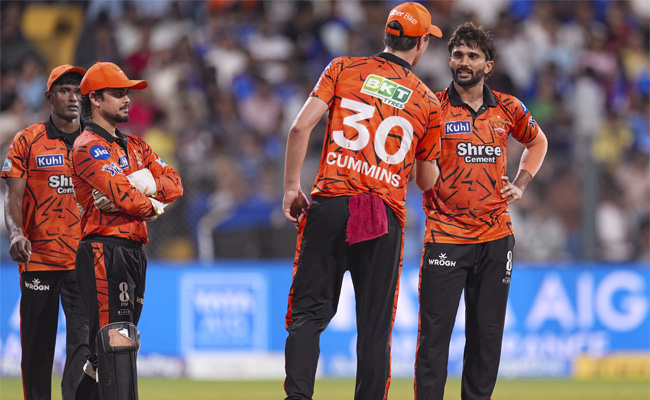
Mumbai (PTI): Ryan Rickelton's whirlwind unbeaten ton was overshadowed by Heinrich Klaasen's unbeaten 65 as Sunrisers Hyderabad defeated Mumbai Indians by six wickets in an IPL match here on Wednesday.
Chasing an imposing 244-run target, Travis Head (76 off 30) and Abhishek Sharma (45 off 24) shared 129 runs for the opening wicket to set the platform for SRH.
Klaasen (65 not out off 30 balls) then displayed his all-round hitting abilities to guide SRH home with the help of Nitish Kumar Reddy (21) and Salil Arora (30 not out off 10) in 18.4 overs.
Earlier, Rickelton's knock powered MI to 243 for five.
MI rode on a 93-run stand between Rickelton (123 not out off 55 balls) and Will Jacks (46 off 22) in 7.1 overs for the opening stand to power the side.
MI skipper Hardik Pandya scored a valuable 31 off 15 balls before being dismissed.
Praful Hinge (2/54), Eshan Malinga (1/29), Sakib Hasan (1/39) and Nitish Kumar Reddy (1/31) were the wicket-takers for SRH.
Brief Scores:
Mumbai Indian: 243 for 5 in 20 overs (Ryan Rickelton 123 not out; Praful Hinge 2/54).
Sunrisers Hyderabad: 249 for 4 in 18.4 overs (Travis Head 76, Heinrich Klaasen 65 not out; AM Ghazanfar 2/51).