Six decades on, the trip ends for Mumbai's iconic Premier Padmini' taxis
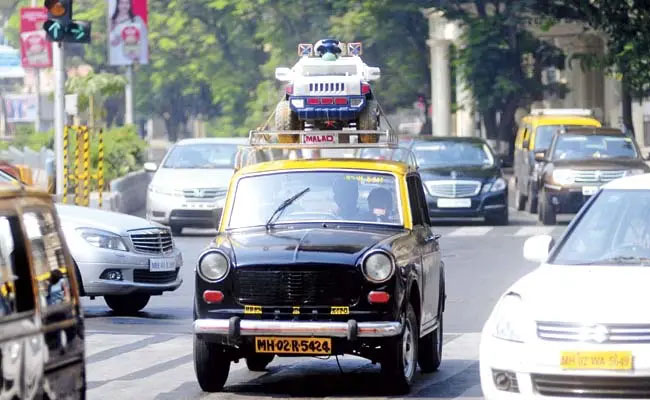
Mumbai (PTI): For decades, if one had to conjure up a picture of Mumbai, the imagery would be incomplete without the city's Premier Padmini' taxis. For, the public carriers, fondly called kaali-peeli', were more than just a mode of transport. They were attached to every aspect of the city.
Giving way to newer models and app-based cab services, these black-and-yellow taxis will now bow out from Mumbai's streets, following the path of retirement recently taken by the BEST's legendary red double-decker diesel buses.
A transport department official said the last Premier Padmini was registered as a black-and-yellow taxi at the Tardeo RTO, which has jurisdiction over the island city of Mumbai, on October 29, 2003. As the age limit for cabs in the city is 20 years, Mumbai officially won't have a Premier Padmini taxi from Monday onwards.
"Yeh Mumbai ki shaan hai aur hamari jaan hai (it is the pride of Mumbai and life of mine)," said Prabhadevi resident Abdul Kareem Karsekar, who owns the last registered Premier Padmini taxi of Mumbai, bearing registration number MH-01-JA-2556.
This transition comes shortly after the phasing out of the last iconic diesel-powered double-decker buses in the fleet of public transporter Brihanmumbai Electric Supply and Transport (BEST) undertaking due to the end of their 15-year codal life.
The retirement of two once-ubiquitous and crucial modes of public carriers in a matter of weeks has left Mumbai's transportation enthusiasts heavy-hearted, with some demanding that at least one Premier Padmini' be preserved on the road or in a museum.
Classic car enthusiast Daniel Sequeira said these sturdy cabs have been a part of the city's landscape for more than five decades and hold sentimental value for several generations.
"In the city, we are preserving several old monuments. Similar to those, we also need to preserve these iconic cabs, which are living monuments," said Sequeira, who has added an old taxi mechanical fare meter to his collection due to his love for these cabs.
A few years ago, the Mumbai Taximen's Union, one of the biggest taxi driver unions in the city, had petitioned the government to preserve at least one kaali-peeli, but without any success.
Pradeep Palav, a Parel resident and art lover, said nowadays Premier Padmini taxis can only be seen in murals on walls in Mumbai. Though it has slowly vanished, it has conquered a place in people's imagination and hearts, he said.
"Presently, we have scores of car models as taxis, but when it comes to painting a taxi only the black-and-yellow Premier Padmini pops up in our mind, as it ruled Mumbai's streets for almost five decades and gave a face or identity to the city's taxis," Palav said.
Mumbai now has over 40,000 black-and-yellow cabs, though, in the late '90s, it had about 63,000 of them, including the air-conditioned "cool cabs" with their distinctive blue and silver' colour scheme.
AL Quadros, general secretary of the Mumbai Taximens Union, recalled that Premier Padmini's journey as a taxi started in 1964 with the model Fiat-1100 Delight', a powerful 1200-cc car with a steering-mounted gear shifter. It was small compared to "big taxis" like the Plymouth, Landmaster, Dodge, and Fiat 1100, called by locals as dukkar Fiat'.
In the 1970s, the model was rebranded as "Premier President" and subsequently as "Premier Padmini", after the legendary Indian queen Padmini. Thereafter, the car manufactured by Premier Automobile Limit (PAL) never went through a name change until its production stopped in 2001, he said.
Some 100-125 Premier Padmini taxis remained unregistered due to lack of availability of spare parts or other reasons, for a long time after production ceased. However, in 2003, car dealers managed to secure their registration and the last taxi registered then will now be scrapped, Quadros said.
In the '60s, Mumbai and Kolkata would get 25-30 Fiat-1100D or Ambassador cars as taxis every second month, he said.
"The government had set the quota for two cities, but cabbies of Mumbai were reluctant to buy Ambassador and the same was the case with Fiat in Kolkata. Therefore, the union got the quota exchanged with Kolkata and consequently, Mumbai got only Fiat taxis," Quadros said.
The octogenarian union leader said that Premier Padmini's number was at its peak in the '90s, but a big chunk of them went off the roads after the Maharashtra government set a 25-year age limit for cabs in 2008 and then brought it down to 20 years in 2013.
"Premier Padminis were popular among cabbies due to their smaller size, reliable engines, easy maintenance, and comfortable interiors, but after their production stopped, unavailability of spare parts became the main problem," he said.
Cabbies then started adopting various hatchback models of Maruti Suzuki and Hyundai, he added.
Premier Padmini cabs were not just a mode of daily commute, but also a part of Mumbai's cultural heritage as they featured in numerous Bollywood movies, including Taxi No. 9211', Khaali-Peeli', and Aa Ab Laut Chale'. In many old Bollywood films, Premier Padmini cars and double-decker buses would be shown at the beginning to establish Mumbai.
Bharat Gothoskar, a city chronicler and founder of the KHAKI Heritage Foundation, said Mumbai's taxis are yellow and black in colour due to VB Gandhi, a freedom fighter who later became an MP.
Gandhi had recommended to former prime minister Jawaharlal Nehru that the upper part of the cabs should be painted yellow so that they can be spotted from a distance and the lower part black to hide any stains, said Gothoskar.
"Just after independence, there were many car models in India but later it was restricted to just two Premier Padmini and Ambassador. Probably the tendency of Mumbaikars is to optimise space and hence the taxi drivers in the city would have preferred the Padmini as the kaali-peeli," he said.
Karsekar, who owns the last Premier Padmini taxi of Mumbai, said it is difficult to maintain the vehicle due unavailability of spare parts, but he still wants to preserve his cab at own expense, if the government permits.
Karsekar, who has been driving taxis since 1988 and once owned seven Premier Padminis, said that even though his cab is old, people still admire it and prefer it over modern alternatives for the nostalgic experience they derive out of it.
"Once I was in Dadar near Babubhai Bhavanji. A well-dressed individual in a high-end car hailed my cab, directing his driver to follow us. When I inquired why he did so, he said he wanted to savour the experience of this iconic ride, which he might not get in future," said Karsekar.
He shared a few more heartwarming stories of passengers choosing to travel in his cab, keen to preserve memories of the iconic taxis.
Karsekar said recently a man from South India flagged down his taxi and travelled from Dadar to Tata Mill, where he brought out his octogenarian parents and captured their photographs with the cab. He then handed Rs 500 to Karsekar as a tip.
Raees Ahmed, another taxi driver, whose Premier Padmini recently got age-barred, said he drove the model for 15 years and only because of it he could run his house and complete the education of his brothers and now his kids.
Let the Truth be known. If you read VB and like VB, please be a VB Supporter and Help us deliver the Truth to one and all.
Vaishnaw flags off Jammu-Srinagar Vande Bharat, services from May 2
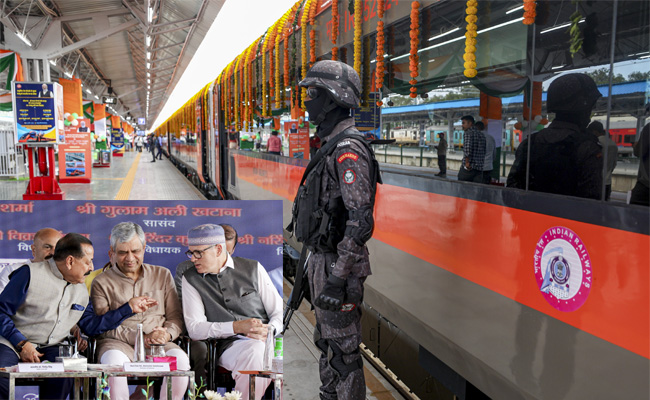
Srinagar (PTI): Railways Minister Ashwini Vaishnaw on Thursday flagged off the 20-coach Vande Bharat Express train between Jammu and Srinagar, the first direct train between the twin capitals of Jammu and Kashmir.
Chief Minister Omar Abdullah and Minister of State in the Prime Minister's Office, Jitendra Singh, were among the dignitaries present at the flagging off ceremony.
The direct train services between Srinagar and Jammu will reduce travel time between the twin capitals of Jammu and Kashmir, and boost tourism, besides providing an all-weather surface transport link.
Prime Minister Narendra Modi inaugurated the first direct train service between Katra and Srinagar on June 6, 2025. This service is now being extended up to the Jammu Tawi Railway Station.
The work on the Rs 43,780-crore rail project, linking Kashmir to the rest of the country, began in the late 1990s, with the first train operating in the Kashmir Valley in October 2008.
While train services had reached Udhampur by 2005, the treacherous terrain through the mountainous Pir Panjal range made it tough to link the valley with the rest of the country until 2025.
"The modern 20-coach Vande Bharat train will commence its maiden journey from Jammu Tawi, traversing the route up to Srinagar while connecting the challenging geographical terrains of the Valley," an official said, adding that a train from Srinagar has also started moving towards Jammu simultaneously.
Before the commencement of the Jammu-Srinagar service, a trial run of the Vande Bharat was conducted on Tuesday from Jammu to Shri Mata Vaishno Devi Katra railway stations, officials said.
The inaugural Vande Bharat train, equipped with state-of-the-art amenities and comprising 20 coaches, will cover a total distance of 267 kilometres.
The Jammu-Srinagar train service -- scheduled to start on May 2 -- will operate six days a week. There will be no train service on this route on Tuesdays.
"Constructed using indigenous technology, this Vande Bharat Express will offer passengers a world-class travel experience," Senior Divisional Commercial Manager Uchit Singhal said.
"It features amenities such as the 'Kavach' safety system for passenger security, a GPS-based information system, and comfortable rotating seats. This service will not only reduce travel time but also provide a massive boost to the local economy and tourism," he added.
The extension of the Vande Bharat to Jammu Tawi is the latest milestone in a decade-long effort to transform railway connectivity in Jammu & Kashmir.
The Udhampur-Katra section was commissioned in 2014. The Kashmir Valley saw its first electric train in February 2024, while a dedicated Jammu Railway Division was created in January 2025.
Stations at Jammu Tawi, Katra, Udhampur, and Budgam are being redeveloped under the Amrit Bharat Station Scheme.
The Udhampur-Srinagar-Baramulla Rail Link, built at a total cost of Rs 43,780 crore with 36 tunnels spanning 119 km and 943 bridges, is the connective tissue that makes all of this possible, an official said.