New Delhi, April 24: Harried over re-reading the syllabus and anxious whether they will match or improve their previous performance, about 600,000 class 12 CBSE students across the country will appear for their re-exam for economics paper on Wednesday.
The exam, which was earlier cancelled by the CBSE after the question paper got leaked, will be conducted at 4,000 centres across the country.
The board had exempted the foreign students from appearing for the exam again, since in its investigation, it did not find the leak to have impacted their results.
"About six lakh students will appear for the exam on Wednesday at 4,000 centres," an official from the Central Board of Secondary Education told IANS, adding that the board has taken some extra security measures for the conduct of the exam, which, for the sake of security, cannot be revealed.
Despite appearing for the second time, many students, whom IANS talked to, said they were a little worried, not on account of being ill-prepared but because of the possibility of a tougher question paper this time.
"It is very irritating to have to repeat the paper again. I am just as prepared for it as I was last time. But can't say if they set a tough question paper," said Srishti, a student of Tagore Senior Secondary School, Mayapuri.
"I am fully prepared and making sure to revise the question paper which came last time also. The only worry is that the question paper last time was very easy. I knew it all. It's not about just passing. I want to make sure that I better my previous performance," said Yatin of New Delhi Public School, Vikaspuri.
Another student from Tagore School, Manpreet, complained of having to accord time for this exam's revision, which he could have used to prepare for other competitive exams.
"One of my main worry is that I had done so well last time and the paper was easy. So there is some psychological pressure of course. And also, I could have spent this time on preparing for other entrance exams," he said.
The paper, earlier, was conducted on March 26, but was cancelled and rescheduled to April 25 after the news of the question paper-leak broke.
Let the Truth be known. If you read VB and like VB, please be a VB Supporter and Help us deliver the Truth to one and all.
Centre spent Rs 76.13 lakh on print media ads for RSS centenary, reveals RTI
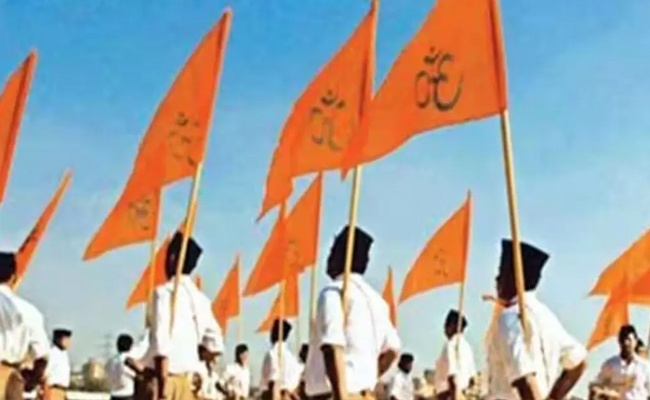
New Delhi: The Union Ministry of Culture allegedly spent Rs 76.13 lakh on print advertisements marking the 100-year celebrations of the Rashtriya Swayamsevak Sangh (RSS), according to a Right to Information (RTI) reply.
The information was sought by RTI activist Ajay Basudev Bose, who filed an application seeking details on expenditure incurred by the ministry for advertisements commemorating the RSS centenary.
Bose shared a picture of the reply from the ministry on his official ‘X’ handle.
“It is informed that an amount of Rs 76,13,129 has been spent on advertisement given in various print media by the Ministry of Culture on the occasion of the completion of 100 years of RSS,” the government’s reply stated.
RTI reply shows Min of Culture Govt of India spent a Whopping Rs 76L,13K,129 on Advertisement in Print Media on occasion of 100 yrs of #RSS
— AJAY Basudev Bose (@AjayBos93388306) April 16, 2026
When Everyone knows RSS is Not Registered & Does not Pay any Tax is it justified to spend Tax Payers Money on such Private event??@RSSorg… pic.twitter.com/dW4IUtdNCg
Bose questioned the expenditure in the post X, “when Everyone knows RSS is Not Registered & Does not Pay any Tax is it justified to spend Tax Payers Money on such Private event??”
Reacting to the development, Karnataka’s IT-BT and Panchayat Raj Minister Priyank Kharge also criticised the spending.
In a post on X, he asked why public money was being used for what he described as a “private ideological project.”
"Modi Sarkar spent Rs 76,13,129 of public money on newspaper advertisements to celebrate 100 years of the RSS. Why is Government spending taxpayers money on an unregistered, non-tax-paying organisation to celebrate their centenary?," he added.
Why is public money being used to serve a private ideological project?
— Priyank Kharge / ಪ್ರಿಯಾಂಕ್ ಖರ್ಗೆ (@PriyankKharge) April 16, 2026
Modi Sarkar spent ₹76,13,129 of public money on newspaper advertisements to celebrate 100 years of the RSS.
Why is Government spending taxpayers money on an unregistered, non-tax-paying organisation to… pic.twitter.com/EoZ6Pim3IM
According to reports, the RSS describes itself as a volunteer-based organisation and has stated that it functions as a body of individuals rather than a registered entity.
Founded by Keshav Baliram Hedgewar in 1925, the organisation is marking its centenary year beginning from Vijaydashami in 2025, with the milestone observed on October 2.