Sofia's arrest an assault on Constitution: Congress
New Delhi, Sep 4 : Describing the arrest of a woman research scholar for raising slogans against the Tamil Nadu BJP President as an "assault" on the Constitution and "Idea of India", the Congress on Tuesday said there was an "undeclared Emergency" in the country and fascism playing out in full glory.
Taking on the BJP over the arrest of Lois Sofia and the recent arrest of five rights activists, the Congress said the 2019 elections would be a contest between fascism represented by the Bharatiya Janata Party (BJP) and democracy represented by progressive and pluralistic forces.
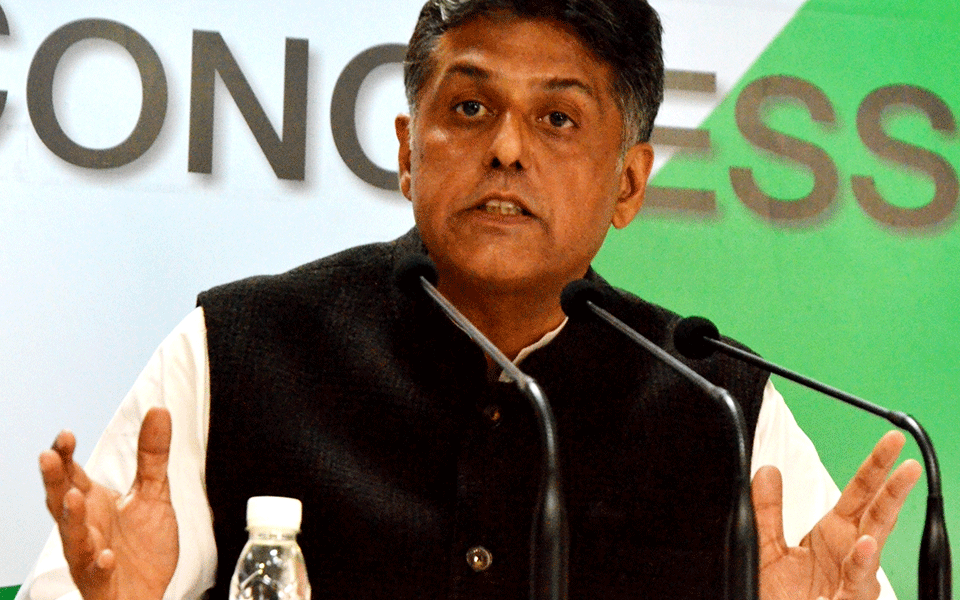
"Fascism was on full display when a young lady travelling from Chennai to Tuticorin hit a raw nerve when she allegedly shouted 'Down with fascist BJP government'," Congress leader Manish Tewari told the media here referring to Sofia's arrest.
Sofia, 25, shouted slogans against the Modi government on a Tuticorin-bound aircraft when she was seated behind Tamil Nadu BJP President Tamilisai Soundararajan.
She was arrested following a complaint from Soundararajan, who alleged that Sofia had uttered "unspeakable words" at the airport lounge.
Charged with "public nuisance" under the Indian Penal Code, she was remanded to 15 days judicial custody. However, a court in Tuticorin granted her bail on Tuesday .
Claiming that the police was pressurized to register a case, Tewari said: "If this is not undeclared Emergency, then what is?
"This (arrest) was not only an assault on the freedom of speech and expression, not only was an assault on our fundamental rights, it was an assault on the Constitution, it was an assault on democracy, it was an assault on the Idea of India and it was fascism playing itself out in its fullest glory," said Tewari.
Referring to the arrest of five rights activists last week, Tewari said: "This is a pattern which has been playing out repeatedly and systematically since 2014."
Listing the incidents of muzzling dissent, the Congress leader said the assault on the students of Film Institute of Pune, events that led to the suicide of Hyderabad University student Rohith Vemula, derecognition of Periyar study circle in IIT-Madras, stopping the screening of a Kashmiri film in IIT-Delhi and vilification campaign against the Jawaharlal Nehru University (JNU) were among many such instances.
He said that there was a narrative which the BJP and the RSS (Rashtriya Swayamsewak Sangh) were trying to peddle.
"If you question the BJP, you are anti-national. If you question the government, you are a traitor. If you question the establishment, you are downright seditious. Is this the country that millions of people sacrificed their lives to bring into existence? Is this the India that we want?
"It is becoming increasingly clear that the battle for 2019 is going to be between fascism represented by the BJP and democracy represented by the progressive and pluralistic forces of this country. This is going to be the battle for 2019.
"This is not merely the removal of a government and its replacement by another. 2019 is going to be a battle for the very soul of India," added Tewari.
Besides the Congress, the DMK too has come out in support of Sofia with party President M.K. Stalin urging the Tamil Nadu government to withdraw the case filed against her.
Welcoming the bail granted to Sofia, Stalin said the AIADMK government should not only withdraw the case filed against her but also take action against the BJP members who had threatened her family.
Let the Truth be known. If you read VB and like VB, please be a VB Supporter and Help us deliver the Truth to one and all.
18 injured in amusement ride mishap at Jatra Mahotsava in Gadag
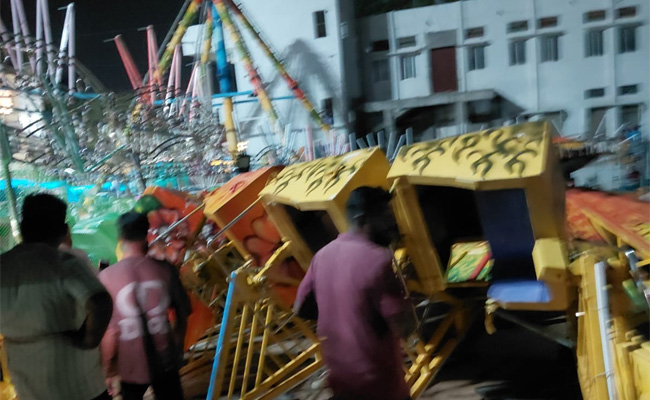
Gadag: At least 18 people were injured, four of them critically, after an amusement ride malfunctioned during the Jatra Mahotsava held at the premises of Tontadarya Mutt on Sunday night.
According to Deccan Herald, the incident occurred around 9 pm when the ‘Dancing Play’ ride (also known as Break Dance or Crazy Dance) reportedly developed a mechanical fault, causing three chairs to tilt dangerously while in motion.
The people inside these chairs were injured and rushed to Gadag Institute of Medical Sciences and Karnataka Medical College and Research Institute (KMC-RI) Hubballi.
Police said that among the injured, two are from Koppal district, one from Tumakuru, and the remaining are from Gadag district. The identities of some victims are yet to be confirmed.
The four victims, who are in critical condition, are severely injured in the head and have been shifted to KMC-RI, officials said.
Meanwhile, members of the Hindu Veerashaiva Lingayat Yuva Vedike staged a protest, demanding strict action against the contractor responsible for organizing the amusement rides, as well as the Jatra Mahotsava committee.