Some countries adopt terror as policy, some block actions against terrorists: PM Modi
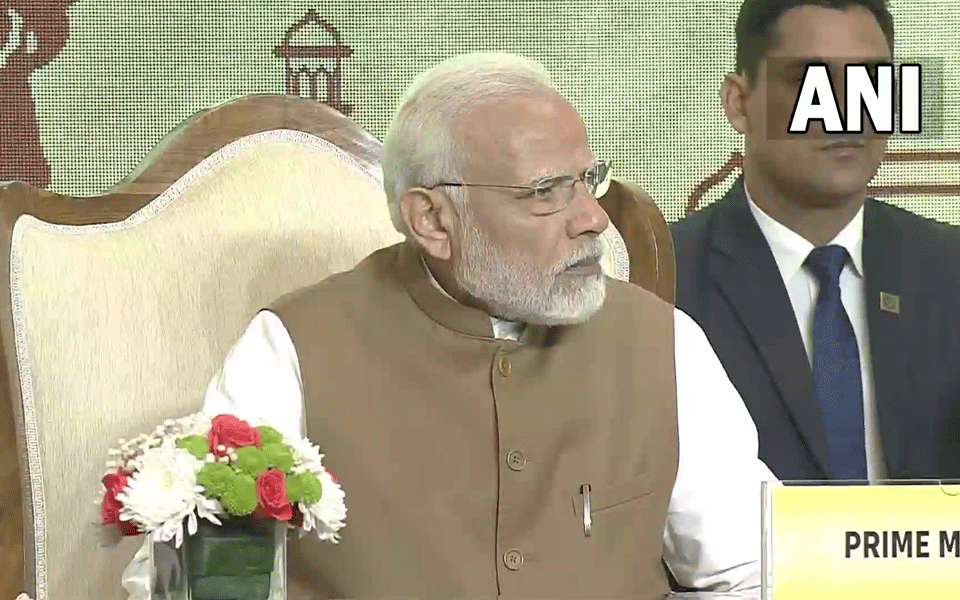
New Delhi (PTI): Certain countries support terrorism as part of their foreign policy while some others do so indirectly by blocking action against terrorists, Prime Minister Narendra Modi said Friday in an apparent reference to Pakistan and China.
He made the remarks before delegates from over 70 countries and international organisations at the third 'No Money for Terror Ministerial Conference on Counter-Terrorism Financing' hosted by the Ministry of Home Affairs here.
The prime minister said organisations and individuals that try to create sympathy for terrorists must also be isolated.
"International organisations must not think that absence of war means peace. Proxy wars are also dangerous and violent. There must be a cost imposed upon countries that support terrorism," he said.
Certain countries support terrorism as part of their foreign policy and they offer political, ideological and financial support, Modi said, adding, "There can be no ifs and buts entertained in such matters. The world needs to unite against all kinds of overt and covert backing of terror."
The prime minister said it is well known that terrorist organisations get money through several sources and one of them is state support.
New Delhi has for long been accusing Pakistan of providing all-round support to terrorist organisations in carrying out attacks in India, particularly in Jammu and Kashmir.
The prime minister said in present times, ideally there should be no need for anyone to remind the world of the dangers of terrorism. However, there are still certain mistaken notions about terrorism in some circles, he said.
Modi said the intensity of the reaction to different attacks cannot vary based on where it happens and all terrorist attacks deserve equal outrage and action.
"Further, sometimes, there are indirect arguments made in support of terrorism to block actions against terrorists," the prime minister said.
China has on several occasions foiled international efforts to take action by the United Nations against terrorists, mostly against those who were responsible for terror attacks in India.
Modi said there is no place for an ambiguous approach while dealing with a global threat. "It is an attack on humanity, freedom and civilisation. It knows no boundaries. Only a uniform, unified and zero-tolerance approach can defeat terrorism," he said.
It is significant that this conference is happening in India as the country faced the horrors of terror long before the world took serious note of it, the prime minister said. "Over the decades, terrorism in different names and forms tried to hurt India. We lost thousands of precious lives, but we have fought terrorism bravely."
Modi said the delegates have a chance to interact with a country and people who have been firm in tackling terror. "We consider that even a single attack is one too many. Even a single life lost is one too many. So, we will not rest till terrorism is uprooted," he said.
There is no place for an ambiguous approach while dealing with a global threat. It is an attack on humanity, freedom and civilisation. It knows no boundaries. Only a uniform, unified and zero-tolerance approach can defeat terrorism, the prime minister said.
Modi said uprooting terrorism needs a larger proactive response and to make citizens safe no one can wait until terror comes to individual homes. "We must pursue terrorists, break their support networks and hit their finances."
The prime minister said organised crime should not be seen in isolation as it is one of the sources of terror funding. These gangs often have deep links with terrorist outfits and the money made in gun-running, drugs and smuggling is pumped into terrorism, he said.
"These groups help with logistics and communication too. Action against organised crime is extremely important in the fight against terror. At times, even activities like money laundering and financial crimes have been known to help terror funding. Fighting it needs global collaboration," Modi said.
In such a complex environment, the United Nations Security Council, Financial Action Task Force, Financial Intelligence Units, and the Egmont Group, are boosting cooperation in the prevention, detection and prosecution of illegal fund flows, he said. "This is helping the war against terror in many ways over the past two decades. This also helps in understanding terror funding risks."
At the conference, the prime minister also talked about terrorists using technology, the challenges of the dark net and private currencies.
"There is a need for a uniform understanding of new finance technologies. It is also important to involve the private sector in these efforts... But we must be careful about one thing. The answer is not to demonise technology. Instead, it is to use technology to track, trace and tackle terrorism," he said.
Modi said many different nations have their own legal principles, procedures and processes but everyone must also be careful not to allow extremists to misuse differences between systems. "This can be prevented through deeper coordination and understanding between governments. Joint operations, intelligence coordination and extradition help the fight against terror."
The two-day conference is being attended by about 450 delegates from across the world, including ministers, and heads of multilateral organisations. Officials said Pakistan and Afghanistan are not participating in the conference while China was invited but did not come.
Let the Truth be known. If you read VB and like VB, please be a VB Supporter and Help us deliver the Truth to one and all.
Vartha Bharati–Sankalp predictions align closely with Karnataka bypoll results
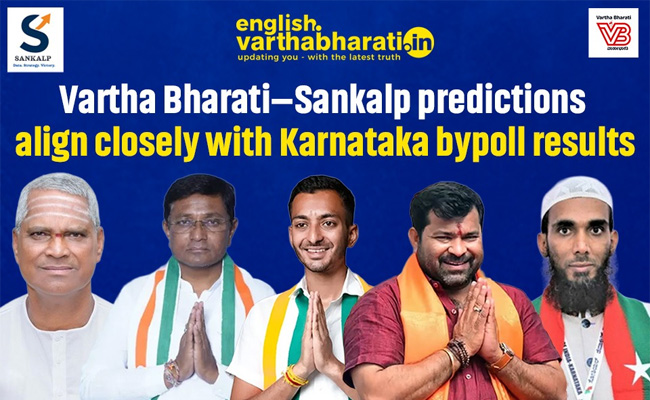
Bengaluru: The Vartha Bharati–Sankalp election analysis has shown a high level of accuracy in predicting the outcome of the recent Karnataka Assembly by-elections held in May 2026, correctly calling winners in both constituencies and closely estimating vote share trends.
The by-elections were held in Bagalkot and Davanagere South, drawing significant political attention as both seats were seen as key tests for the ruling Congress and opposition BJP.
According to the analysis, Vartha Bharati–Sankalp had made three major projections ahead of the results the winning party, vote share percentages, and margin of victory.
In both constituencies, the platform accurately predicted that the Congress would emerge victorious. The outcome matched the projections, with Congress candidates winning in Bagalkot and Davanagere South.
In terms of vote share, the predictions were largely in line with the final results. In Bagalkot, the BJP’s vote share was forecast in the range of 40 to 46 per cent, while the actual figure stood at 42.9 per cent. The Congress vote share, however, exceeded expectations, with the party securing 55.4 per cent against a projected range of 43 to 48 per cent.
The margin of victory in Bagalkot turned out to be significantly higher than anticipated. While the projection had placed the margin between 2,000 and 3,500 votes, the final margin was around 22,332 votes.
In Davanagere South, the predictions also remained largely accurate. The Congress vote share was projected between 43 and 51 per cent, and the final figure stood at 43.9 per cent. The BJP was expected to secure between 42 and 50 per cent but ended with 40.3 per cent.
The analysis had also identified the role of SDPI as a potential spoiler in the constituency. While its vote share was estimated around 6 per cent, the party eventually secured around 12 per cent of the vote.
The margin of victory in Davanagere South was predicted to be between 1,500 and 2,600 votes. The actual margin was higher at around 5,708 votes, though the contest remained relatively close as anticipated.
Overall, the performance of Vartha Bharati–Sankalp stood out for correctly identifying the winning parties in both seats and maintaining close accuracy in vote share estimates, with only limited deviations in specific cases.