'Sorry state of affairs' in law-making process: CJI Ramana; rues lack of debates in Parliament
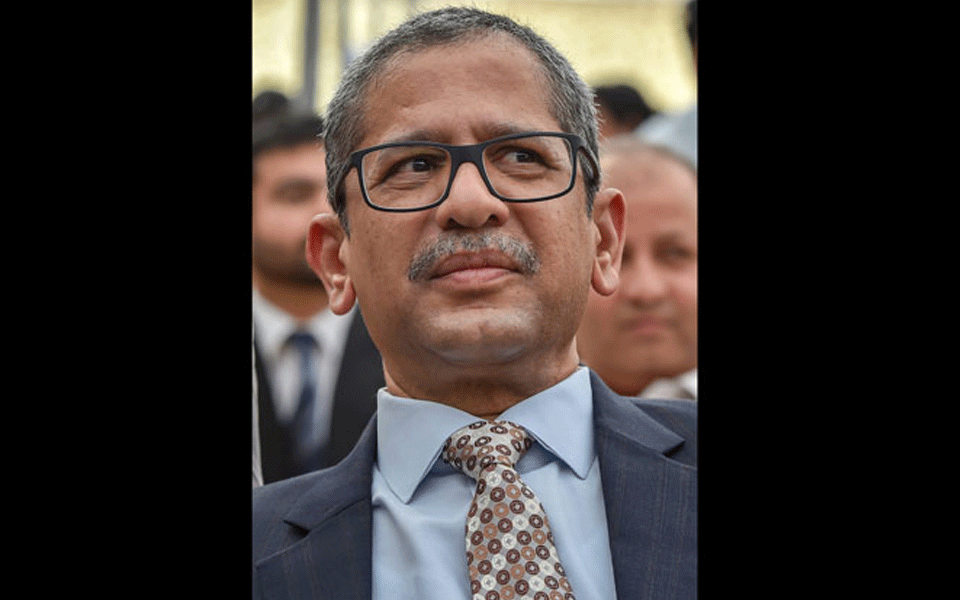
New Delhi: Observing that the law-making process in the country is in a "sorry state of affairs", Chief Justice of India N V Ramana on Sunday rued the lack of debates in Parliament, saying this led to absence of clarity and a "lot of gaps and ambiguity" in the legislations.
Doing some plain speaking at a public event, Justice Ramana said an elaborate discussion during the law-making process reduces litigation since when courts interpret legislations, "we all know the intent of the legislature". He was speaking at the 75th Independence Day function organised by the Supreme Court Bar Association(SCBA).
Justice Ramana's remarks come against the backdrop of the tumultuous Monsoon session of Parliament when several bills were passed without any debate during the pandemonium following relentless protests by the Opposition over the Pegasus snooping row, farm laws, price rise and other issues. Parliament was adjourned sine die on Wednesday two days of the scheduled date of August 13.
The crucial observations of the CJI also assume significance in connection with a case where though the apex court is seized of matters concerning appointment in tribunals, the Centre went ahead and secured the passage of the amendment bill relating to tribunals without any debate in Parliament. The bill restored the provisions struck down by the Supreme Court recently.
The CJI also exhorted the members of the legal fraternity to participate in public life and share their experience about laws.
He said the country's long freedom struggle was led by lawyers. "Whether it is Mahatma Gandhi or Babu Rajendra Prasad, they were legal luminaries, who sacrificed their property, family and life and led the movement."
"Most of the members of first Lok Sabha and Rajya Sabha were all lawyers and members from the legal fraternity. Unfortunately, we know what is happening now in the Parliament with respect to debates on laws."
He said there used to be debates in Parliament on various constitutional amendments and how they will affect the people.
"Long ago, I have seen a debate during the introduction of the Industrial Disputes Act and a member from Tamil Nadu used to discuss the law so elaborately as to how the law will affect the working class. It used to reduce the burden on the courts, as when the courts interpreted the law, we all knew the intent of the legislature," the Chief Justice said.
"Now, it is a sorry state of affairs. There are a lot of gaps and a lot of ambiguity in the law-making process due to lack of debates... There is no clarity regarding the laws. We don't know what the intent of the legislature is. We don't know for what purpose the laws are made. This causes great inconvenience to the people. This happens when members of the legal fraternity are not in the Parliament and state legislature," he added.
During the function, the CJI told the lawyers, "Don't confine yourself to your profession, earning money and living comfortably. Please think over it. We should actively participate in public life, do some good service and share the experience with the country. Hopefully, goodness will come out of it in the country."
He added that the Supreme Court has played an active role in the country and has given more than what the Constitution has thought of, but he expects the legal fraternity to contribute more.
"There are small issues but around 75 percent of the people in need of justice have got legal aid. You (lawyers) all should participate in the legal aid movement. On November 26 and 27, we may have two-day workshops on Constitution Day and legal aid," he said.
At the outset, the CJI said it is a historic day and an occasion for all to rethink and review the policies to understand "what we have achieved and what we have to achieve in the future".
"Seventy-five years is not a small period in the history of the country but we have to also consider the vast landscape and geographical condition of our country," the CJI said, while recalling his childhood days when they were given jaggery and and murmura (puffed rice) in school on the occasion of Independence Day.
"Since then, a lot of development has taken place. Small things given to us in school made us very happy but in today's time when we have so many facilities, we are not happy. I think this is due to our saturation level," he added.
Supreme Court Judges AM Khanwilkar and V Ramasubramanian were also present on the occasion along with several lawyers and members of the SCBA.
Solicitor General Tushar Mehta, who was also present on the occasion, said the Chief Justice of India is the karta' (guardian) of the Indian legal family and thus he does not wish to say anything more.
"India is a young democracy and when we look around the neighbouring countries and they call themselves democracy and we all know how they have failed. In contrast, we have been able to sustain it the way it was envisioned by the framers of our Constitution," Mehta said.
The CJI also unfurled the national flag after which the national anthem was played by a police band.
SCBA President and senior advocate Vikas Singh said it is a historic day as the country is celebrating its 75th Independence Day and thanked the Chief Justice and other judges for gracing the occasion.
Let the Truth be known. If you read VB and like VB, please be a VB Supporter and Help us deliver the Truth to one and all.
Two arrested for allegedly sexually assaulting woman at knifepoint in Kochi

Kochi (PTI): Two persons have been arrested after a three-member gang allegedly sexually assaulted a woman at knifepoint near Ernakulam Junction Railway station, officials said on Friday.
The arrested accused were identified as Danish (26), a native of Varkala in Thiruvananthapuram district, and Rahul (39), a native of Paravoor in Kollam district.
Police officials said they were searching for the prime accused, Sanjay, a native of Aroor in Alappuzha district.
According to police, the incident occurred on the night of May 5 when the victim was chatting with her friend near a closed hotel near Ernakulam Junction Railway station.
Officials said the accused approached them, attacked the victim’s friend and then allegedly threatened the woman with a knife before sexually assaulting her.
Police said the accused also allegedly disrobed the victim during the attack.
However, the woman managed to escape from the spot and approached a nearby shop for help.
Police were informed immediately and shifted the victim to the police station.
Officials said the accused were heavily drunk at the time of the incident and went into hiding soon after the attack.
Police registered a case on May 6 under charges including rape, disrobing a woman, criminal intimidation and robbery.
The two accused were later arrested in the city, while efforts are continuing to trace Sanjay, police said.
The accused were produced before a court and remanded to judicial custody.