Space race on with endeavour to return to Moon sustainably: Sunita Williams
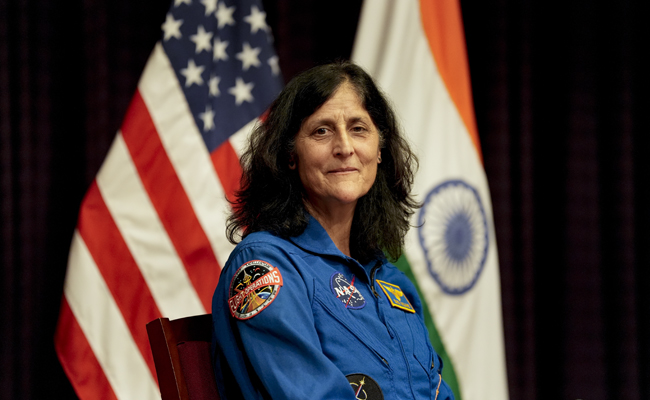
New Delhi (PTI): Astronaut Sunita Williams on Tuesday said there is a "space race" going on at present but the endeavour is to ensure humanity returns to the Moon sustainably and that it is done in a "productive and democratic way".
Before settling into a nearly hour-long interactive session held at the American Center here, Williams, in her brief opening remarks, also said that coming back to India felt akin to a homecoming, as it is the country where her father was born.
Wearing a trademark deep blue space overalls and sporting a pair of space-themed canvas shoes, Williams, 60, strode into an auditorium full of Indian youths to a loud cheer, and later actively engaged with the audience with an unassuming ease, punctuating the conversation with delectable humour.
A former US Navy captain, she was born to a Gujarati father, Deepak Pandya, hailing from Jhulasan in Mehsana district and a Slovenian mother, Ursuline Bonnie Pandya, on September 19, 1965, in Euclid, Ohio, in the US.
During the conversation, she also shared her experiences from the time when she had got stuck in space when an eight-day mission to the International Space Station had turned out to be a challenge of a lifetime as problems cropped up on their Boeing space flight that stretched her stay in orbit to over nine months.
A montage of visuals from that period was played on screen, and it showed the ISS's multi-cultural crew, celebrating Thanksgiving, Christmas and the birthday of a crew member.
"We are not the best singers, but we can make space cakes," Williams said, as the audience broke into laughter.
She further said, "You would see almost 12 people on the ISS at one point in time".
"The International Space Station with our Russian, Japanese, European, Canadian... and a lot of other great countries. (Group) Captain (Shubhanshu) Shukla came up a little bit after me. I'm really sad I missed him while I was up there; we could have shared some stories," she said.
During the interaction, she was asked a plethora of questions, ranging from ways to maintain mental health to managing space debris and from commercialisation of the space sector to collaboration of the public and private sectors in space missions.
Asked if the growing number of players in the private sector in space could actually trigger a space race, moving it beyond the realm of science fiction into reality, she said, "There is a space race going on."
"On the space race. I mean, I think there is a space race going on. I think people have talked about that. There is... you know, we want to get back to the Moon. We want to get back to the Moon sustainably.
"We want to get back to the Moon, to sort of start the conversation about rules of engagement, and how we actually work on the Moon, how we work together with other countries on the Moon," the noted astronaut said.
"So yes, there is a race to ensure that we do this in a productive, democratic way. Just like Antarctica. I mean, it's the same type of thing. We want to get back to the Moon so we can all be there at the same time and working together," she added.
American Neil Armstrong was the first person to walk on the Moon as part of the Apollo 11 mission in 1969. NASA's last crewed mission to the Moon was in 1972.
NASA, in coordination with the US Department of State and seven other initial signatory nations, established the Artemis Accords in 2020. With many countries and private companies conducting missions and operations around the Moon, the Artemis Accords provide a common set of principles to enhance the governance of the civil exploration and use of outer space.
India is a signatory to this Accord.
Also, India's long-term ambitions in space include setting up the Bharatiya Antariksha Station by 2035 and sending the first Indian to the Moon by 2040.
To another query on the private sector increasingly engaging in space exploration, Williams said, "Commercialisation of space is great. And, what it means in the United States, at least, is ... there are opportunities for people to work in so many different companies."
"So not only rockets, not only spacecraft, but parts of space experiments, satellites, new technologies, 3D printing of metals, wherever anybody wants to work... I think it's awesome. I think it is great. I think there's more opportunity in the future," she said.
She underlined that space travel is a "team sport" and countries need to work together as "this is our one planet, we are here together".
Asked if space travel has changed her perspective towards life in general, Williams said, "Yes, absolutely."
"It changes one's perception about people having any differences. It really makes you feel like we are just one, and we all should probably work a little bit closer and easier together. And it actually sort of made me feel like, why would anybody argue about anything. I know, I'm married. I have a husband. We argue. So I understand arguments, but like the reality of it is, like why? You know, it seems so silly when you look at Earth from that perspective," Williams said.
Let the Truth be known. If you read VB and like VB, please be a VB Supporter and Help us deliver the Truth to one and all.
Man arrested with Rs 2.54-crore heroin in Mumbai

Mumbai (PTI): Police have arrested a man and seized over 500 grams of heroin worth Rs 2.54 crore in the illicit market from him in Mumbai, officials said on Friday.
The police's Anti-Narcotics Cell (ANC) made the drug seizure in Santacruz in the western suburbs. The operation was conducted by the Kandivali unit of the ANC on Thursday as part of a special crackdown against drug trafficking in the area, they said.
Acting on specific inputs, an ANC team conducted a raid in Santacruz (East) and intercepted a man. During a search, the team recovered 508 grams of high-grade heroin from his possession, an official said.
The seized contraband, a highly addictive, opioid drug derived from morphine, is estimated to be worth Rs 2.54 crore in the international market, he informed.
Following the seizure, a case was registered against the man under relevant sections of the Narcotic Drugs and Psychotropic Substances (NDPS) Act, 1985, and he was formally placed under arrest in the early hours of Friday.
The police are currently investigating the source of the drug and trying to identify the intended recipients of the consignment, he said.